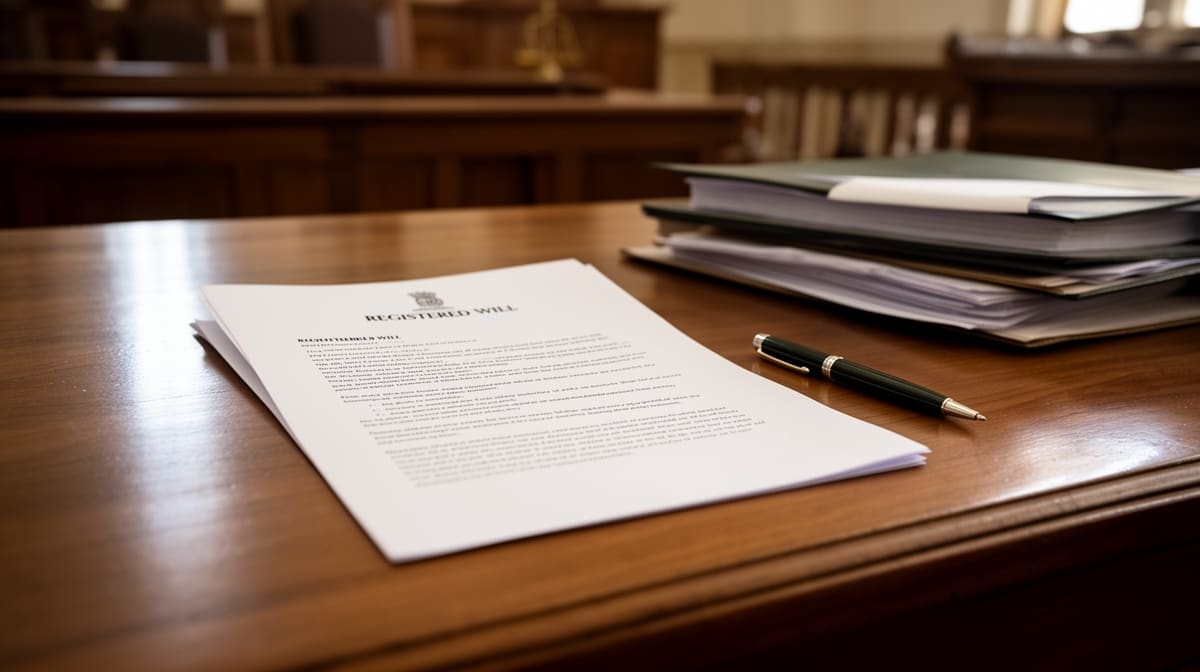
The Punjab and Haryana High Court has clarified that a court cannot implead a person as legal representative of a deceased party merely on the basis of an unverified Will, especially when its authenticity is contested. The judgment reinforces the mandatory procedural safeguard under Order 22 Rule 5 CPC, ensuring that disputes over succession or representation are resolved before a suit proceeds.
Background & Facts
The Dispute
The present revision petition challenges an order passed by the Civil Judge (Junior Division), Jalandhar, allowing the impleadment of Jaswinder Kaur as the legal representative of Swaran Kaur, the deceased plaintiff in a civil suit. Swaran Kaur had filed a suit seeking a declaration that she was the exclusive owner of properties in Village Bal, Jalandhar, based on a registered Will dated 28.04.2003 executed by her husband, Bhawikhan Singh. She also sought to declare that Narinder Pal Singh was not the lawful son of Bhawikhan Singh and that a prior judgment in favor of the defendant, Sarabjit Kaur, had been obtained by fraud.
Key Facts
- Swaran Kaur, the plaintiff, died on 16.09.2021 at Forest Lodge, Nottingham, UK.
- Jaswinder Kaur, who is not a blood relative of Swaran Kaur, filed an application under Order 22 Rule 4 CPC claiming to be the legal representative based on a Will dated 21.07.2005.
- The petitioner, Sarabjit Kaur (defendant in the suit), contested the application, alleging that the Will dated 21.07.2005 was forged and that Jaswinder Kaur had no legal right to represent the deceased.
- A prior suit titled "Sarabjit Kaur v. Swaran Kaur" had been decided in favor of the petitioner on 09.10.2012, with appeals dismissed on 12.08.2014 and 28.04.2015.
- The trial court allowed the impleadment without conducting any inquiry into the validity of the Will or the claim of representation.
Procedural History
- 28.04.2003: Bhawikhan Singh executed a registered Will in favor of Swaran Kaur.
- 21.07.2005: Jaswinder Kaur claims Swaran Kaur executed a Will in her favor.
- 09.10.2012: Judgment and decree passed in favor of Sarabjit Kaur in the earlier suit.
- 12.08.2014: First appeal dismissed by the High Court.
- 28.04.2015: Revisional petition dismissed.
- 2021: Swaran Kaur died on 16.09.2021.
- 15.11.2022: Trial Court allowed application under Order 22 Rule 4 CPC to implead Jaswinder Kaur as legal representative.
- 24.03.2026: Punjab and Haryana High Court heard the revision petition and set aside the impugned order.
The Parties' Positions
- Petitioner (Sarabjit Kaur): Argued that Jaswinder Kaur is a stranger with no legal claim to represent Swaran Kaur, and that the trial court erred by bypassing Order 22 Rule 5 CPC. The Will was alleged to be fabricated.
- Respondent (Jaswinder Kaur, through LR): Contended that the impleadment was merely procedural to continue the suit and that the validity of the Will could be decided later during trial.
Relief Sought
The petitioner sought quashing of the order dated 15.11.2022, setting aside the impleadment of Jaswinder Kaur, and directing the trial court to follow the procedure under Order 22 Rule 5 CPC before determining legal representation.
The Legal Issue
The central question was whether a court may implead a person as legal representative of a deceased plaintiff under Order 22 Rule 4 CPC when the validity of the Will relied upon to establish representation is disputed, without first conducting a formal inquiry under Order 22 Rule 5 CPC.
Arguments Presented
For the Petitioner
Learned counsel argued that Order 22 Rule 5 CPC mandates a judicial determination of legal representation whenever a dispute arises regarding who qualifies as the legal representative of a deceased party. The trial court’s reliance on a contested Will without evidence, cross-examination, or adjudication violated this mandatory procedure. Citing Smt. Sahab Kaur v. Avtar Singh, counsel emphasized that the purpose of Rule 5 is to prevent unauthorized persons from continuing litigation on behalf of the deceased. The trial court conflated procedural convenience with legal entitlement.
For the Respondent
Counsel for the respondent submitted that the impleadment was only for the purpose of enabling the continuation of the suit and that the authenticity of the Will could be tested during trial. He argued that Rule 5 CPC applies only when the question of representation is raised before an appellate court, and that the trial court had discretion to allow impleadment under Rule 4 CPC without a full-fledged inquiry.
The Court's Analysis
The Court examined the interplay between Order 22 Rule 4 and Rule 5 CPC, emphasizing that Rule 4 permits substitution of legal representatives only when their identity is undisputed. Where a dispute exists - as here, regarding the validity of a Will - the court is bound by Rule 5 to determine the question of representation.
"The words, 'such question shall be determined by the Court,' in Rule 5 Order 22 enjoin that for the purpose of determining as to who is the legal representative, the Court, wherever necessary, must hold an enquiry in which evidence may even be adduced."
The Court noted that the trial court had merely accepted the claim of representation based on an unverified Will, without requiring proof of execution, attestation, or testamentary capacity. It failed to consider whether Jaswinder Kaur was a person who "intermeddled with the estate" or whether she had any legal right under the Will. The Court held that such a determination cannot be deferred to trial, as it goes to the very foundation of the suit’s continuation.
The Court relied on Smt. Sahab Kaur v. Avtar Singh, where a coordinate Bench had held that failure to conduct a Rule 5 inquiry constitutes a jurisdictional error. The trial court’s observation that "the entitlement over the property shall depend upon the outcome of the evidence" was irrelevant at the stage of impleadment. The purpose of Rule 5 is not to decide succession rights, but to ensure that only a legally recognized representative may continue the suit.
The Court further clarified that the decision under Rule 5 is limited to procedural representation and does not determine inheritance rights. However, this limited determination cannot be avoided when the claim to representation is contested.
The Verdict
The revision petition was allowed. The order dated 15.11.2022 allowing the impleadment of Jaswinder Kaur as legal representative was set aside. The trial court was directed to conduct a formal inquiry under Order 22 Rule 5 CPC to determine whether Jaswinder Kaur is the legal representative of Swaran Kaur, including the opportunity to lead evidence on the validity of the Will dated 21.07.2005. No opinion was expressed on the merits of the underlying suit or the authenticity of the Will. All pending applications stood disposed of.
What This Means For Similar Cases
Impleadment Requires Judicial Scrutiny, Not Assumption
- Practitioners must now file a separate application under Order 22 Rule 5 CPC whenever the claim to legal representation is contested, even if the opposing party does not object.
- Courts cannot rely on affidavits or unverified documents to grant impleadment under Rule 4 CPC.
- A contested Will, regardless of its registration status, triggers the mandatory requirement of a Rule 5 inquiry.
Procedural Compliance Is Non-Negotiable
- The trial court’s error was not merely procedural - it was jurisdictional. Orders passed without Rule 5 compliance are voidable.
- Parties opposing impleadment must specifically raise the issue of disputed representation; silence does not waive the right to a Rule 5 determination.
- Evidence under Rule 5 may include testimony, handwriting experts, and proof of testamentary capacity, even if the suit itself is not yet on trial.
Distinction Between Representation and Succession
- A finding under Rule 5 does not confer ownership or inheritance rights - it only permits continuation of the suit.
- This prevents fraudulent or unauthorized persons from hijacking litigation by producing forged documents.
- Practitioners should treat Rule 5 as a gatekeeping mechanism, not a formality.