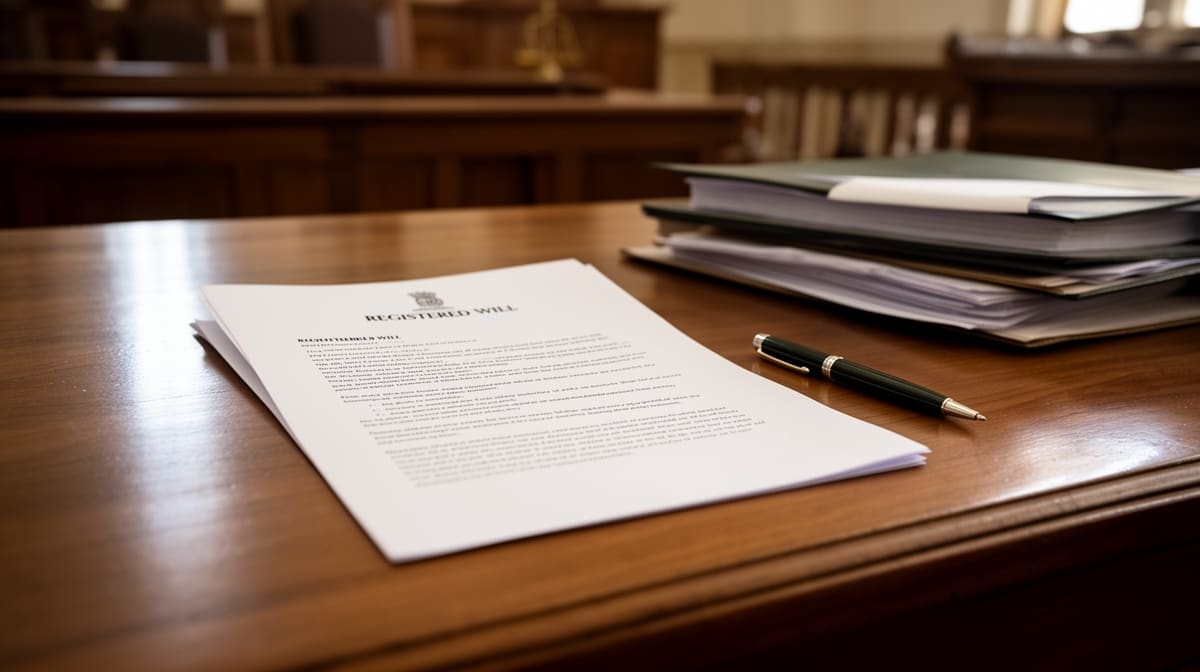
The Madhya Pradesh High Court has clarified that substitution of a deceased plaintiff under Order 22 Rule 3 of the Code of Civil Procedure is not contingent upon final adjudication of a Will’s validity. Where a registered Will transfers interest in the suit property, and the surviving plaintiff consents to substitution, the court must permit it to ensure procedural fairness and prevent prejudice to the propounder.
Background & Facts
The Dispute
The plaintiffs, Suresh Choubey and Prakash Choubey, filed a civil suit for declaration and permanent injunction against the defendants, claiming ownership of a property originally purchased by their grandfather through a registered sale deed dated 28.06.1944. The defendants contested the claim, asserting title based on a prior decree dated 24.04.2009 in Civil Suit No. 47-A of 2007. The rival claims were independent: the plaintiffs derived title from their grandfather, while the defendants relied on a separate adjudication.
Key Facts
- The suit property was claimed by plaintiffs as inherited from their grandfather, Balmukund Chingamal Brahmin, via registered sale deed dated 28.06.1944
- The defendants asserted title based on a decree dated 24.04.2009 in Civil Suit No. 47-A of 2007
- Plaintiff no.1, Prakash Choubey, died on 10.01.2016, unmarried and without Class-I heirs
- Applicant Alok Raghuvanshi produced a registered Will dated 24.12.2007, executed by Prakash Choubey, bequeathing his interest in the suit property to him
- Plaintiff no.2, Suresh Choubey, filed an affidavit supporting the substitution application
- The defendants disputed the authenticity of the Will, alleging forgery
- The trial court rejected substitution on grounds that the surviving plaintiff could continue the suit and the Will’s validity required separate adjudication
Procedural History
- 24.04.2009: Defendants obtained decree in Civil Suit No. 47-A of 2007
- 28.06.1944: Registered sale deed executed by grandfather in favor of plaintiffs’ ancestor
- 24.12.2007: Registered Will executed by Prakash Choubey in favor of Alok Raghuvanshi
- 10.01.2016: Death of plaintiff no.1, Prakash Choubey
- 01.02.2017: Trial Court rejected application under Order 22 Rule 3 CPC for substitution
- 2026: Misc. Petition No. 506 of 2026 filed before the High Court of Madhya Pradesh at Gwalior
- 18.03.2026: Case reserved
- 24.03.2026: Judgment pronounced
The Parties' Positions
- Applicant (Alok Raghuvanshi): Claimed to be the sole beneficiary under a registered Will; argued he is a necessary party whose interest will be directly affected if the suit is decided against the plaintiffs; substitution is mandatory under CPC to ensure procedural justice
- Defendants: Contended that the Will is forged; any substitution would necessitate a trial on the Will’s validity, which is beyond the scope of summary proceedings under Order 22 Rule 3; the surviving plaintiff can continue the suit
- Plaintiff no.2 (Suresh Choubey): Did not oppose substitution; filed affidavit in support of applicant’s claim
Relief Sought
The applicant sought substitution in place of the deceased plaintiff under Order 22 Rule 3 read with Section 151 CPC, to be recognized as legal representative and bound by the outcome of the suit.
The Legal Issue
Can a person claiming interest in the suit property through a registered Will be substituted as legal representative under Order 22 Rule 3 CPC, even if the validity of the Will is disputed by the opposing party, provided the surviving plaintiff consents and the rival claim of the defendants is independent?
Arguments Presented
For the Appellant/Petitioner
The applicant argued that he is a legal representative under Section 2(11) CPC, as he claims the estate of the deceased through a registered Will. He cited Than Singh v. Majboot Singh and Raghunathsingh v. Gangabai to establish that substitution under Order 22 Rule 3 is procedural, not substantive, and does not determine heirship. He emphasized that the defendants’ claim is independent of the plaintiffs’ title, and their objection to the Will is irrelevant to substitution. The surviving plaintiff’s consent further negates any prejudice. The applicant offered to be bound by the suit’s outcome, making his inclusion essential to prevent a decree being passed behind his back.
For the Respondent/State
The respondents contended that the validity of the Will must be adjudicated before substitution, as it is a contested document. They relied on the trial court’s view that allowing substitution would convert the suit into a tripartite dispute over succession, which is beyond the scope of summary proceedings under Order 22 Rule 5. They argued that since the surviving plaintiff can continue the suit, substitution is unnecessary and would delay adjudication.
The Court's Analysis
The Court examined the definition of "legal representative" under Section 2(11) of the CPC, which includes any person who represents the estate of a deceased, whether by inheritance, Will, or intermeddling. The Court emphasized that Order 22 Rule 3 is procedural and designed to ensure continuity of litigation, not to determine title or heirship.
"The legal representative brought on record is for the limited purpose of conducting the litigation. It is, therefore, left open to Raghunath Singh if he considers fit, to get the dispute between him and Bhuwansingh in regard to the succession to the estate of Gangabai, cleared in a separate litigation."
The Court relied on Than Singh v. Majboot Singh and Raghunathsingh v. Gangabai to affirm that substitution under Order 22 Rule 3 does not confer title or operate as res judicata. The enquiry under Rule 5 is summary and does not preclude future litigation on succession.
Crucially, the Court noted that the defendants’ claim is independent of the plaintiffs’ title. Their success in the suit would extinguish the applicant’s interest under the Will, yet he would remain a stranger to the proceedings. This would violate the principle of natural justice. The Court observed:
"If the defendants succeed in the suit, that would definitely adversely affect the applicant, inasmuch as he claims interest in the property on the basis of the registered Will. In such a case, the decree would be passed behind the back of a necessary party."
The consent of the surviving plaintiff further removed any legitimate concern about prejudice. The Court held that the trial court erred in requiring a full trial on the Will’s validity at the substitution stage.
The Verdict
The High Court set aside the order dated 01.02.2017 of the 4th Civil Judge, Gwalior. The application under Order 22 Rule 3 CPC was allowed. Alok Raghuvanshi is substituted as legal representative of the deceased plaintiff, Prakash Choubey. The substitution is strictly for the purpose of continuing the suit and does not constitute adjudication of the Will’s validity. The Court clarified that any challenge to the Will’s authenticity may be raised in a separate proceeding.
What This Means For Similar Cases
Substitution Is Mandatory When Interest Is Transferred by Will
- Practitioners must file substitution applications under Order 22 Rule 3 whenever a deceased party’s interest passes by registered Will, regardless of dispute
- Consent from co-plaintiffs strengthens the application but is not mandatory
- Courts must not require proof of Will’s validity at the substitution stage
Independent Claims Do Not Preclude Substitution
- If the opposing party’s claim is based on a separate title or decree, their objection to the Will is irrelevant to substitution
- The court’s role is to ensure the suit proceeds with all materially interested parties on record
- Failure to substitute may render a decree voidable against the unrepresented party
Procedural Fairness Trumps Theoretical Complexity
- The burden of proving forgery or invalidity lies in a separate suit, not in the summary substitution process
- Delay in substitution risks injustice to beneficiaries who have no other recourse
- Courts must prioritize continuity of litigation over speculative objections to documents