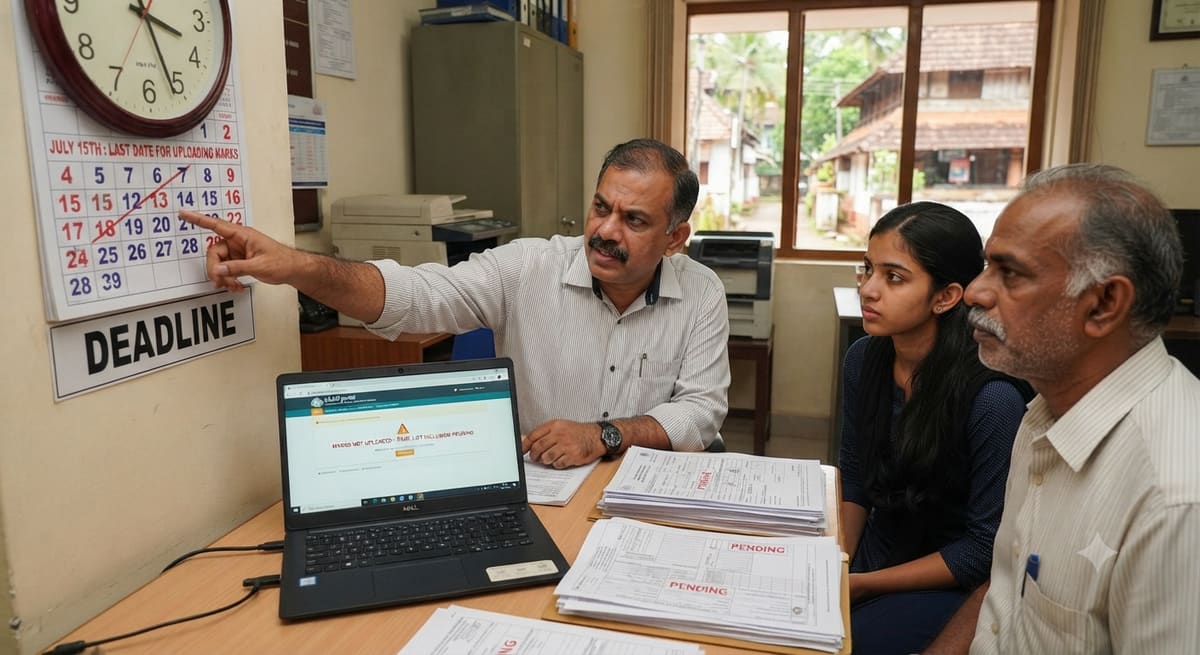
The Kerala High Court has upheld the state’s revised normalization formula for engineering admissions, rejecting petitions that the methodology unfairly disadvantaged students from CBSE and ICSE boards. The judgment affirms the state’s authority to design fair evaluation systems and reinforces judicial restraint in academic policy matters.
Background & Facts
The Dispute
The petitioners, all Class XII students from CBSE and other non-Kerala state boards, challenged Clause 1.4 and Clause 9.7.4(b) of the Prospectus for Admission to Professional Degree Courses 2026 issued by the Government of Kerala. The dispute centered on the methodology used to normalize marks obtained in the qualifying examination (Class XII) for admission to engineering courses. The petitioners alleged that the new normalization formula, introduced in 2026, was arbitrary, lacked expert consultation, and systematically disadvantaged students from boards with higher average performance, particularly CBSE.
Key Facts
- The Government of Kerala has conducted entrance examinations for professional courses since the early 1980s.
- In 2012, a standardization system was introduced to account for differences in evaluation standards across CBSE, ICSE, and Kerala Board of Public Examination.
- The 2012 system used a 50:50 weightage between entrance exam scores and normalized qualifying exam scores.
- In 2025, the Government revised the subject weightage for qualifying exam subjects (Mathematics, Physics, Chemistry) from equal weightage to a 5:3:2 ratio.
- The revised 2025 formula was challenged in court and stayed by the Kerala High Court on the ground that "rules of the game cannot be changed after the game starts."
- On 06.12.2025, the Government constituted an Internal Committee comprising the Commissioner for Entrance Examinations, Director of Technical Education, and Director of SCERT.
- The Internal Committee reviewed complaints that the 2012 standardization system caused downward revision of marks for students from high-performing boards.
- The Committee recommended adopting the normalization formula used in Tamil Nadu since 2007, which treats the highest score in each board as 100%.
- The Government approved the recommendation via G.O.(RT) No. 1615/2025/HEDN dated 26.12.2025.
- The new formula was incorporated into the Prospectus 2026, published on 01.01.2026, and applications were invited thereafter.
- The petitioners filed writ petitions on 26.05.2026, seeking quashing of the Prospectus 2026.
Procedural History
- 01.01.2026: Prospectus 2026 officially published by the Government.
- 12.11.2025: Petitioners submitted representations against the proposed formula.
- 13.12.2025: Internal Committee submitted its report recommending Tamil Nadu’s normalization method.
- 26.12.2025: Government issued G.O.(RT) No. 1615/2025/HEDN approving the new formula.
- 26.05.2026: Writ Petitions W.P.(C) No. 4399/2026 and W.P.(C) No. 1480/2026 filed before the Kerala High Court.
- 08.06.2026: Judgment delivered by Justice Bechu Kurian Thomas.
The Parties' Positions
Petitioners (CBSE/ICSE students):
- Argued that the new formula, though appearing neutral, resulted in no upward adjustment for high-performing boards, effectively freezing their scores.
- Claimed the Internal Committee lacked experts and acted without scientific study.
- Contended that the change was made after the 2025 exam and without public consultation.
- Cited comparative data (Exhibit P-10) showing disparity between old and new systems.
Respondents (State of Kerala & Commissioner for Entrance Examinations):
- Asserted that the 2012 standardization system caused systematic downward revision of marks for students from boards with higher averages.
- Stated the new normalization method was transparent, simple, and adopted from Tamil Nadu’s long-standing, judicially validated system.
- Emphasized that no student’s marks were reduced under the new formula.
- Argued that the Internal Committee members were education experts with institutional experience.
- Cited Minor S. Aswin Kumar v. State of Tamil Nadu (2007) and University of Mysore v. C.D. Govinda Rao (1965) to support policy autonomy.
Relief Sought
The petitioners sought:
- Quashing of Clause 1.4 and Clause 9.7.4(b) of Prospectus 2026.
- Restoration of the 2012 standardization formula.
- A direction to conduct admissions based on the previous system.
- Costs and any other relief deemed fit.
The Legal Issue
The central question was whether the Government of Kerala’s adoption of a normalization formula treating the highest score in each board as 100% constitutes an arbitrary, discriminatory, or unconstitutional departure from prior practice, and whether the Court may interfere with such an academic policy decision absent clear malafide or violation of statutory rights.
Arguments Presented
For the Petitioner
The petitioners contended that the new normalization formula, while appearing neutral, failed to account for the relative difficulty of boards. They argued that students from CBSE, who typically scored higher, received no upward adjustment, whereas students from lower-performing boards saw their marks scaled up. This, they claimed, violated the principle of equality under Article 14 of the Constitution. They relied on Maneka Gandhi v. Union of India to assert that any state action must be reasonable and non-arbitrary. They further argued that the Internal Committee lacked independent experts and that the decision was made without public consultation or empirical validation, rendering it procedurally flawed. The petitioners cited the earlier Review Committee’s caution against hasty changes (Ext.P4) as evidence of the Government’s deviation from expert advice.
For the Respondent
The respondents countered that the 2012 standardization system had been shown to disadvantage high-performing boards by artificially lowering their scores. The new normalization method, they argued, was designed to eliminate this bias by ensuring no student’s score was reduced. They emphasized that the formula was identical to the one upheld by the Madras High Court in Minor S. Aswin Kumar and had been in use in Tamil Nadu for nearly two decades without complaint. The respondents asserted that the Internal Committee members were senior education administrators with direct experience in entrance examinations and were therefore qualified to review the system. They maintained that the Government had the constitutional authority under Article 21A and Entry 25 of List III to frame admission policies, and that judicial intervention was impermissible absent arbitrariness or constitutional violation.
The Court's Analysis
The Court undertook a comprehensive review of the policy rationale, procedural history, and comparative legal framework. It noted that the petitioners conceded that under the new formula, no student’s marks were subject to downward revision - a critical factual concession undermining their core grievance.
"The system does not reveal any reduction in marks for any student from any Board."
The Court observed that the normalization formula adopted - treating the highest score in each board as 100% - was not novel but had been judicially validated in Tamil Nadu since 2007. The Madras High Court in Minor S. Aswin Kumar v. State of Tamil Nadu had held that such a system satisfies the requirements of fairness, transparency, and non-exploitativeness, and does not violate Article 14.
The Court further emphasized that the Internal Committee, though termed "internal," comprised the Commissioner for Entrance Examinations, Director of Technical Education, and Director of SCERT - all senior officials with direct responsibility for the admission process. The Court rejected the argument that these officials were "non-experts," noting their institutional expertise rendered them competent to evaluate the system.
The Court also addressed the petitioners’ claim that the change was made without adequate study. It held that while the earlier Review Committee (Ext.P4) had recommended further study, the Government was not bound to follow that advice. The Court stated:
"The wisdom of the Government in identifying and evolving methodologies for examination... are ordinarily not amenable to judicial review."
Citing University of Mysore v. C.D. Govinda Rao and University Grants Commission v. Neha Anil Bobde, the Court reaffirmed the principle of judicial restraint in academic matters. It held that courts lack the technical expertise to substitute their judgment for that of academic authorities, unless there is ex facie arbitrariness, malafide, or constitutional violation.
The Court also relied on Maharashtra S.B.O.S. and H.S. Education v. Paritosh, which held that courts cannot strike down a policy merely because it is perceived as unwise or inefficient. The Court concluded that the new formula was rational, transparent, and aimed at eliminating a documented bias in the prior system.
The Verdict
The writ petitions were dismissed. The Court upheld the normalization formula in Prospectus 2026, finding no arbitrariness, discrimination, or constitutional violation. The Government’s policy decision to adopt the Tamil Nadu model - which ensures no downward revision of marks and treats the highest score in each board as 100% - was deemed lawful, reasonable, and within its statutory authority. No relief was granted to the petitioners.
What This Means For Similar Cases
Academic Policy Is Presumed Valid Unless Arbitrarily Applied
- Practitioners must now demonstrate clear arbitrariness or malafide to challenge state admission policies - mere disagreement with methodology is insufficient.
- Courts will not substitute their judgment for that of education authorities absent constitutional breach.
- The burden of proving systemic disadvantage shifts to petitioners; absence of downward revision is a strong defense.
Normalization Based on Board-Specific Maxima Is Legally Sustainable
- The Kerala HC’s endorsement of the "highest score = 100%" model provides a precedent for other states adopting similar systems.
- This formula is now validated as fair under Article 14, provided it is uniformly applied and does not penalize any board.
- CBSE and ICSE students can no longer claim systemic disadvantage merely because their scores are not scaled up - the formula protects them from being scaled down.
Internal Committees with Administrative Experts Are Legally Sufficient
- Committees composed of senior education administrators (e.g., Directors of Technical Education, SCERT) are deemed competent to review admission methodologies.
- The requirement for "external experts" is not mandatory unless statutorily prescribed.
- Petitioners cannot invalidate policy decisions on the basis of committee composition alone.