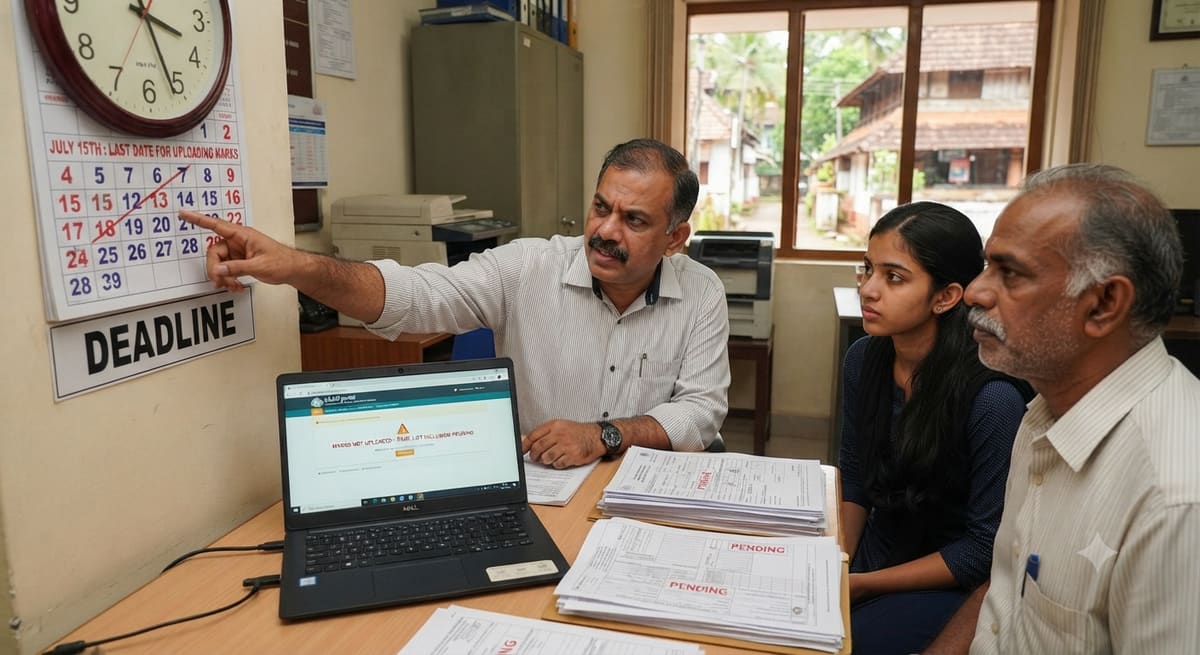
The Kerala High Court recently dismissed a writ petition seeking inclusion in the Kerala Engineering, Architecture, Medicine (KEAM) 2026 rank list, reinforcing the mandatory nature of uploading qualifying examination marks within the prescribed timeline. The judgment underscores that procedural compliance in admission processes is non-negotiable, even in the absence of prejudice, and that courts cannot intervene to relax statutory timelines under Article 226 of the Constitution unless there is a default attributable to the authorities.
Background & Facts
The Dispute
The petitioner, Mekhana Siby, an 18-year-old Higher Secondary School graduate, applied for KEAM 2026 conducted by the Commissioner for Entrance Examinations, Kerala. She scored 37.5255 out of 300 in the entrance examination, which was above the minimum cutoff. However, her name was excluded from the rank list as she failed to upload her qualifying examination marks (12th standard) within the stipulated timeline prescribed in the Prospectus for Professional Degree Courses 2026.
Key Facts
The petitioner passed her 12th standard examination on 26.05.2026, as per the results published by the Board of Higher Secondary Education
She applied for KEAM 2026 and claimed to have uploaded all necessary documents, including her mark list, through the online portal
The Prospectus required candidates to upload their qualifying examination marks within a specified timeline to be included in the rank list
The petitioner’s name was not included in the rank list published by the respondents
The petitioner alleged that she was never intimated of any defect in her application and presumed her upload was successful
Procedural History
23.01.2026: Petitioner received acknowledgment for her KEAM 2026 application
26.05.2026: Results of the 12th standard examination published
27.06.2026: Petitioner attempted to log in to the KEAM portal (Ext.P8)
03.06.2026 to 02.07.2026: Petitioner received text messages (Ext.P8) from the respondents, though their exact content is unclear
08.07.2026: Writ petition filed before the Kerala High Court
13.07.2026: Writ petition dismissed by the High Court
The Parties' Positions
Petitioner’s Contentions
The petitioner claimed she had uploaded her qualifying marks and received no notification of any defect
She argued that a sympathetic consideration should be adopted, as no prejudice would be caused by permitting her to upload the marks at a later stage
Alternatively, she contended that even if her qualifying marks were treated as ‘0’, she should be included in the rank list under clause 1.5 of the Prospectus
Respondents’ Contentions
The respondents stated that the petitioner failed to upload her qualifying marks within the prescribed timeline
No Mark Submission Confirmation Report was generated in her portal, indicating non-compliance
The marks received from the Board are in a protected mode and cannot be accessed until the candidate uploads them
Permitting late uploads would open the floodgates for similar requests, disrupting the admission process
The respondents emphasized that the Prospectus clauses are peremptory and cannot be diluted by judicial intervention
Relief Sought
The petitioner sought:
A direction to include her in the KEAM 2026 rank list by either permitting her to upload her qualifying marks or accepting the marks already available with the respondents
Reliance on clause 1.5 and 9.7.5 of the Prospectus to argue that she could be included even without her qualifying marks
The Legal Issue
The central question was whether the failure to upload qualifying examination marks within the stipulated timeline could be condoned by the court, particularly when:
The petitioner claimed no defect memo was issued
The Prospectus clauses appeared to permit inclusion in the rank list even without qualifying marks
The respondents argued that the upload requirement was mandatory and non-compliance could not be rectified post facto
Arguments Presented
For the Petitioner
The petitioner’s counsel argued that the absence of a defect memo implied her application was complete
It was contended that the petitioner’s entrance examination score (37.5255) was above the cutoff, and no prejudice would be caused by permitting late upload
Reliance was placed on clause 1.5 and 9.7.5 of the Prospectus, which seemingly allowed inclusion in the rank list irrespective of academic eligibility
It was submitted that even if her qualifying marks were treated as ‘0’, she could still be included in the rank list
For the Respondents
The learned Government Pleader submitted that defect memos are issued only at the initial application stage, not when marks are to be uploaded later
The marks received from the Board are in a protected mode and cannot be accessed until the candidate uploads them
Permitting late uploads would disrupt the admission process and encourage similar requests from other candidates
The Prospectus clauses are mandatory and cannot be relaxed by judicial intervention under Article 226 of the Constitution
The respondents relied on the decision in Dr. Arun Thomas and Others v. State of Kerala and Others (2016 SCC OnLine Ker 3777) to argue that stipulations in the Prospectus have the force of law
The Court's Analysis
The Court conducted a detailed examination of the Prospectus clauses to determine the legal validity of the petitioner’s contentions. The key observations were:
Scheme of KEAM 2026: The rank list is prepared by giving equal weightage (50:50) to the normalized scores of the entrance examination and the qualifying Board examination. Both components are mandatory for inclusion in the rank list.
"The admission to the Engineering degree course is governed by the Prospectus for admission to Professional Degree Courses 2026. The said Prospectus requires the marks of the qualifying Board examination to be uploaded within a timeline."
Mandatory Nature of Upload Requirement: The Court held that clause 6.2.6(ii) and clause 7.7(v) of the Prospectus are peremptory. Clause 6.2.6(ii) mandates that candidates qualified in the Engineering Entrance Examination must submit their qualifying examination marks online within the stipulated time. Clause 7.7(v) explicitly states that candidates who fail to upload their marks will not be included in the rank list.
"Clause 7.7(v) provides that those candidates appearing for Engineering Entrance Examination who do not submit the marks/upload the mark list of the final year of the qualifying examination through the official website of the Commissioner for Entrance Examinations... on or before the date specified will not be included in the Engineering Rank List."
No Evidence of Technical Error: The petitioner’s contention that a technical error prevented her from uploading the marks was rejected due to the absence of any material (e.g., email complaints, documentary evidence) to substantiate this claim. The Court noted that if such an error existed, other candidates would have raised similar complaints.
"If at all the petitioner was unable to upload the mark list, there would have been some material, at least in the form of an email communication or other documents, indicating a complaint raised by the petitioner immediately. In the absence of any such detail, this Court cannot accept the contention of a system error."
Interpretation of Clause 1.5: The petitioner relied on clause 1.5, which states that the rank list shall include all candidates qualified in the entrance examination irrespective of their academic eligibility. The Court clarified that this clause does not mean absence of qualifying marks but rather irrespective of the marks scored in the qualifying examination. The purpose of this clause is to include candidates who may have scored below the minimum academic eligibility (e.g., 45% or 40%) required by Central Councils like AICTE or CoA.
"The term 'irrespective of their academic eligibility' does not mean absence of marks of the qualifying Board examination, but irrespective of the marks scored in the Board examination."
Judicial Restraint: The Court emphasized that stipulations in the Prospectus have the force of law and cannot be relaxed by judicial intervention under Article 226 unless there is a default attributable to the respondents. The decision in Dr. Arun Thomas and Others v. State of Kerala and Others was cited to reinforce this principle.
"Stipulations prescribed in a Prospectus have the force of law and it is not proper for this Court to make any variation to the stipulations in the prospectus invoking the power under Article 226 of the Constitution of India."
Prejudice to Other Candidates: The Court noted that permitting late uploads would cause prejudice to other candidates who complied with the timeline and could disrupt the entire admission process.
The Verdict
The writ petition was dismissed. The Court held that:
The petitioner’s failure to upload her qualifying marks within the stipulated timeline was fatal to her inclusion in the rank list
The Prospectus clauses are mandatory and cannot be relaxed by judicial intervention
There was no material to indicate any default on the part of the respondents that would justify condoning the delay
Sympathetic considerations cannot override procedural compliance in admission processes
What This Means For Similar Cases
Procedural Compliance Is Non-Negotiable
This judgment reinforces that admission processes governed by statutory prospectuses are bound by strict timelines. Practitioners and candidates must note:
Upload requirements are mandatory: Failure to comply with timelines for uploading documents (e.g., mark lists, certificates) will result in automatic exclusion from rank lists, regardless of the candidate’s performance in the entrance examination
No presumption of compliance: Mere submission of an application or absence of a defect memo does not imply compliance. Candidates must actively verify the generation of confirmation reports (e.g., Mark Submission Confirmation Report) in their portals
Burden of proof lies on the candidate: In case of alleged technical errors, candidates must immediately raise complaints with documentary evidence (e.g., emails, screenshots). The absence of such evidence will be fatal to their claims
Judicial Intervention Is Limited
Courts will exercise restraint in interfering with admission processes under Article 226 unless:
There is a clear default attributable to the authorities (e.g., failure to issue defect memos, technical errors on the portal)
The Prospectus clauses are ambiguous or arbitrary
The prejudice caused is minimal and does not disrupt the process for other candidates
Practitioners should advise clients that:
Sympathetic considerations (e.g., unintentional omission, high entrance scores) will not suffice to condone non-compliance
Prospectus clauses are binding and have the force of law. Courts will not rewrite them to accommodate individual cases
Alternative remedies (e.g., representations to authorities, review petitions) should be exhausted before approaching courts
Clarifying Misinterpretations of Prospectus Clauses
This judgment clarifies a common misinterpretation of clauses like 1.5 of the KEAM Prospectus. Candidates and practitioners must note:
‘Irrespective of academic eligibility’ ≠ absence of qualifying marks: This phrase means that candidates will be included in the rank list even if their qualifying marks are below the minimum eligibility (e.g., 45% or 40%) required by Central Councils. It does not mean that qualifying marks are unnecessary
Rank list preparation requires both components: The entrance examination score and the qualifying examination marks are equally weighted (50:50). Omission of either component will result in exclusion
Normalization process is mandatory: The marks of both the entrance examination and the qualifying examination are subjected to normalization before rank calculation. This process cannot be bypassed