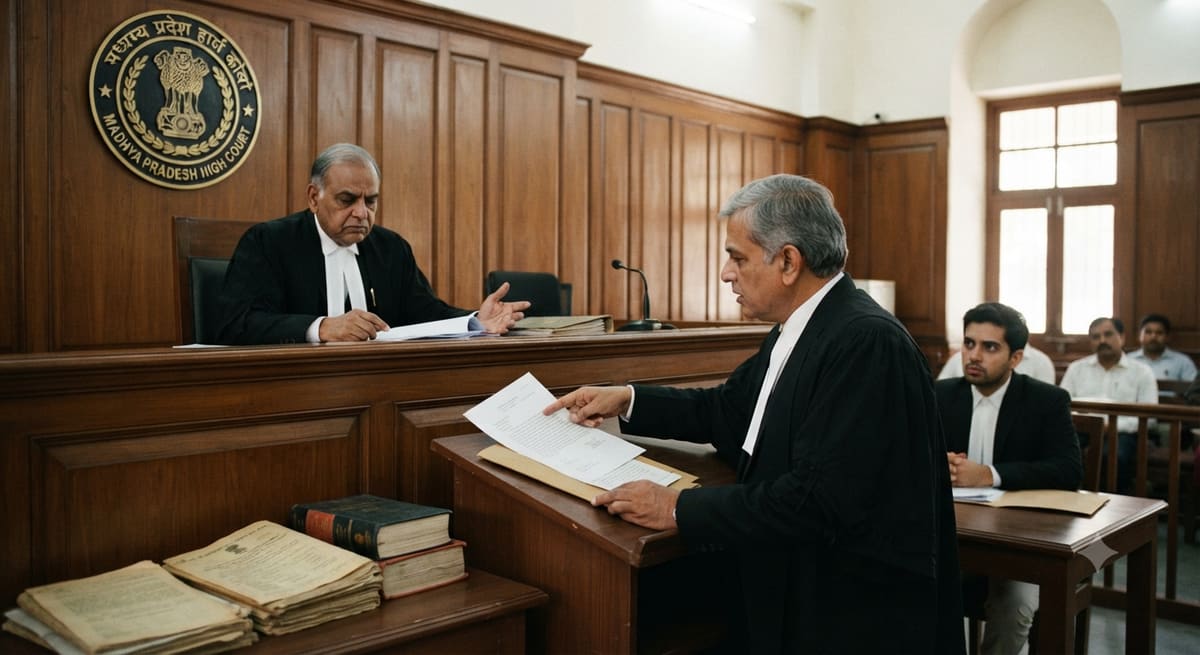
The Madhya Pradesh High Court has delivered a decisive affirmation of procedural fairness in public service administration, holding that the issuance of a No Dues Certificate after formal handover of government assets conclusively closes the matter of asset accountability. This judgment reinforces that financial penalties against public servants cannot be imposed retroactively without adherence to statutory procedure and the foundational principles of natural justice.
Background & Facts
The Dispute
The petitioner, Anil Mathur, served as a Class-I Gazetted Officer and Librarian at Government B.K.S.N. Post Graduate College, Shajapur, from 1995 until his transfer in 2015. Upon assuming charge in 2000, he received 15,373 books. Despite repeated attempts between 2015 and 2019 to hand over the library’s inventory, the respondents failed to accept the charge. He finally handed over 42,747 books on 18.07.2020, receiving a formal No Dues Certificate.
Procedural History
- 2000: Petitioner assumed charge of 15,373 books
- 2015: Transferred; attempted multiple handovers (14 documented visits between 2015 - 2019)
- 2020: Final handover of 42,747 books; No Dues Certificate issued
- 2021: Respondents issued orders directing recovery of Rs. 3,86,337 for alleged loss of 3,064 books
Relief Sought
The petitioner sought quashing of the recovery orders dated 10.08.2021 and 23.09.2021, arguing lack of jurisdiction, violation of natural justice, and finality of the No Dues Certificate.
The Legal Issue
The central question was whether a No Dues Certificate issued after formal handover of government assets can be disregarded to impose retrospective financial liability, and whether administrative authorities without statutory power may impose minor penalties under the M.P. Civil Services Rules.
Arguments Presented
For the Petitioner
The petitioner’s counsel relied on State of U.P. v. Mohd. Noor and K. Sankaran v. State of Tamil Nadu to argue that the issuance of a No Dues Certificate constitutes conclusive acceptance of asset accountability. He further contended that recovery of pecuniary loss is a minor penalty under Rule 10(iii) of the M.P. Civil Services (Classification, Control and Appeal) Rules, 1966, which requires compliance with Rule 16 - including show-cause notice, opportunity of hearing, and inquiry. As Respondents 2 and 3 were not the appointing authority, they lacked jurisdiction.
For the Respondent
The State contended that the petitioner, as Librarian, remained accountable for the library’s assets throughout his tenure. The deficit was calculated from a revised total of 44,855 books, and recovery at 1.5 times cost was standard practice. The respondents asserted that the In-charge Principal had implied authority to impose recovery, citing administrative necessity.
The Court's Analysis
The Court conducted a rigorous analysis of statutory framework, procedural compliance, and the doctrine of finality in administrative actions. It emphasized that the No Dues Certificate was not a mere formality but a legally significant act of acknowledgment by the competent authority.
"Once the competent authorities have verified the inventory, accepted the handover of the charge, and issued a 'No Dues Certificate', the matter attains finality with respect to the physical custody of the assets."
The Court rejected the State’s argument that the deficit was discovered later, noting that such a claim could not override the conclusive nature of the certificate. It further held that the recovery amount, calculated unilaterally at 1.5 times book cost, lacked any rational basis or statutory sanction.
On jurisdiction, the Court examined the petitioner’s service records and confirmed his status as a Class-I Gazetted Officer. Under Rule 16, only the Appointing Authority or a duly delegated Disciplinary Authority may impose minor penalties. Respondents 2 and 3, holding posts of Professor and Associate Professor, were merely officiating as In-charge Principals and lacked delegated authority. The Court declared the orders coram non judice.
The Court also invoked the audi alteram partem principle, noting the complete absence of a show-cause notice, hearing, or inquiry. This violation, coupled with jurisdictional infirmity, rendered the orders void ab initio.
The Verdict
The petitioner won. The Court quashed both impugned recovery orders, holding that a No Dues Certificate issued after formal handover conclusively extinguishes liability for asset loss, and that minor penalties under the M.P. Civil Services Rules require strict procedural compliance and can only be imposed by the Appointing Authority. The State was directed to refund any recovered amount within 60 days and update the petitioner’s service record.
What This Means For Similar Cases
No Dues Certificate Is Conclusive
- Practitioners must treat a No Dues Certificate as a binding administrative conclusion on asset accountability
- Any attempt to reopen asset liability after issuance invites judicial intervention on grounds of arbitrariness and finality
- Employers must conduct thorough inventory verification before issuing such certificates
Penalty Authority Must Be Statutorily Delegated
- Only the Appointing Authority or a formally delegated Disciplinary Authority may impose minor penalties under Rule 10(iii)
- Officers acting in an officiating capacity cannot assume disciplinary powers absent explicit delegation
- Service departments must maintain clear records of delegation of authority under Rule 16
Natural Justice Is Non-Negotiable in Financial Penalties
- No show-cause notice or hearing = automatic invalidity of penalty order
- Even if liability is suspected, procedural compliance cannot be bypassed for administrative convenience
- Courts will not uphold financial penalties imposed without affording the employee a meaningful opportunity to defend