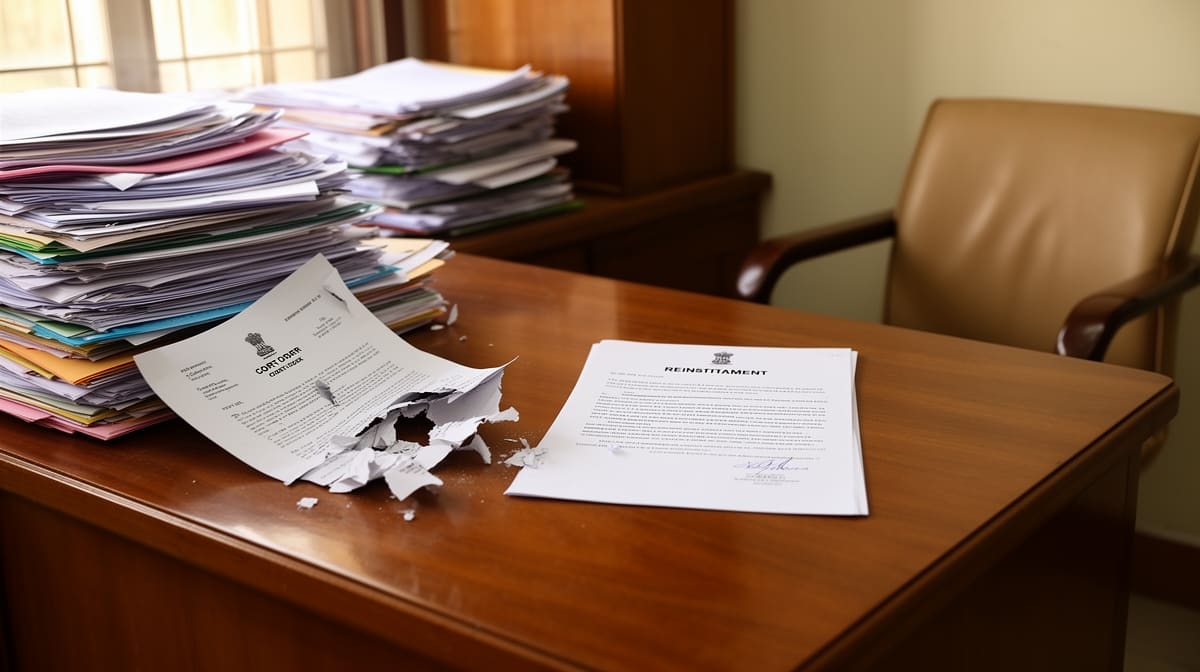
The Madhya Pradesh High Court has reaffirmed that administrative authorities cannot impose penalties on government employees without recording reasoned orders, even in minor penalty cases. The judgment underscores that the absence of reasons renders disciplinary action arbitrary and violative of fundamental principles of natural justice, setting a clear precedent for procedural compliance in service matters.
Background & Facts
The Dispute
The petitioner, Kunwar Singh, was serving as a Junior Engineer at the Distribution Centre, Rajmilan under the Executive Engineer (O&M), Waidhan, District Singrauli. On 09.07.2007, an electrocution accident occurred in Village Karsua Raja, resulting in the death of a seven-year-old girl, Ku. Divya. The legal heirs of the deceased filed a civil suit, which was decided on 18.09.2013, awarding compensation of Rs. 1,79,500 to the family. The respondent company, responsible for the electrical infrastructure, paid the full compensation.
Key Facts
- The accident occurred on 09.07.2007 at a location under the petitioner’s maintenance responsibility
- The civil suit was filed and adjudicated, with award dated 18.09.2013
- The company recovered Rs. 87,413/- from each of two Junior Engineers, including the petitioner and Pankaj Yadav (petitioner in connected petition), as their share of the compensation
- A show-cause notice was issued to the petitioner on an unspecified date prior to 21.02.2014, the date on which he submitted his detailed written reply (Annexure P/3)
- The disciplinary authority passed an order on 29.10.2015 (Annexure P/2) directing recovery of Rs. 87,413/- from the petitioner’s salary in ten instalments and imposing the penalty of censure
- The petitioner filed a departmental appeal, which was dismissed by the appellate authority on 09.02.2016 by a non-speaking order
- No departmental enquiry was conducted; no findings of misconduct were recorded
- The recovery and penalty were based solely on the civil court’s compensation award, not on any independent determination of negligence or breach of duty
Procedural History
- 09.07.2007: Electrocution accident resulting in death of child
- 18.09.2013: Civil Tribunal awards compensation of Rs. 1,79,500 to legal heirs
- 21.02.2014: Petitioner submits detailed reply to show-cause notice
- 29.10.2015: Disciplinary authority issues impugned order directing recovery and censure
- 09.02.2016: Appellate authority dismisses appeal without assigning any reasons
- 2016: Writ Petition No. 4672 of 2016 filed before the High Court of Madhya Pradesh at Jabalpur
- 14.07.2016: Connected petition (WP No. 14274 of 2016) filed by Pankaj Yadav on identical facts
- 01.07.2026: Judgment delivered by Justice Deepak Khot
The Parties' Positions
The petitioner contends that the disciplinary authority acted arbitrarily by:
- Failing to conduct a departmental enquiry
- Not considering his reply to the show-cause notice
- Not assigning any reasons for rejecting his defence
- Imposing financial recovery based solely on a civil court award, without establishing culpability
The State contends that:
- The show-cause notice was issued under Rule 16 of the M.P. Civil Services (Classification, Control and Appeal) Rules, 1966
- The petitioner’s reply was duly considered
- The negligence of the petitioner in maintaining electrical lines led to the accident
- Recovery of compensation is a legitimate administrative action under the Rules
Relief Sought
The petitioner seeks:
- Quashing of the impugned order dated 29.10.2015
- Quashing of the appellate order dated 09.02.2016
- Cancellation of the recovery of Rs. 87,413/- from salary
- Cancellation of the penalty of censure
- Direction to the authority to reconsider the case after affording a fair opportunity and recording reasons
The Legal Issue
The central question was whether an administrative authority can impose a minor penalty, including financial recovery, under the M.P. Civil Services Rules, 1966, without considering the delinquent employee’s reply or assigning any reasons in support of its decision, and whether such an order violates the principles of natural justice.
Arguments Presented
For the Petitioner
The petitioner’s counsel relied on Rule 16(1) of the M.P. Civil Services (Classification, Control and Appeal) Rules, 1966, which mandates that the disciplinary authority must consider the representation or reply submitted by the delinquent employee before imposing any penalty. It was argued that the failure to consider the reply and the absence of reasons in both the original and appellate orders rendered the proceedings violative of natural justice. The counsel cited Kranti Associates Private Limited v. Masood Ahmed Khan (2010 9 SCC 496), where the Supreme Court held that recording reasons is not a mere formality but an essential component of fair decision-making. The counsel also relied on a coordinate Bench judgment in Manbahor Patel v. Managing Director (WP No. 1121/2017, decided on 16.09.2021), which had quashed a similar non-speaking order.
For the Respondent
The State’s counsel argued that the show-cause notice was issued under Rule 16 and that the petitioner’s reply was duly considered. It was contended that the petitioner did not deny his responsibility for maintaining the electrical lines and that the recovery was merely a mechanism to recoup compensation paid by the employer due to the employee’s negligence. The counsel submitted that the order was not arbitrary and that the principles of natural justice were not violated, as the employee had been given an opportunity to explain.
The Court's Analysis
The Court examined the impugned orders dated 29.10.2015 and 09.02.2016 and found them to be entirely silent on the petitioner’s defence. The disciplinary authority did not address any of the points raised in the reply dated 21.02.2014, nor did it explain why the explanation was rejected. The appellate authority merely affirmed the order without any reasoning whatsoever.
The Court emphasized that Rule 16(1) of the M.P. Civil Services Rules, 1966, imposes a statutory obligation to consider the employee’s representation. More importantly, the Court held that the requirement to record reasons is not merely procedural but substantive, flowing from the doctrine of natural justice and the constitutional guarantee under Article 14 and Article 21.
"Recording of reasons shows that the authority has applied its mind to the facts and the submissions of the parties."
The Court extensively relied on the Supreme Court’s judgment in Kranti Associates, which held that:
"Reasons have virtually become as indispensable a component of a decision-making process as observing principles of natural justice by judicial, quasi-judicial and even by administrative bodies."
The Court noted that the appellate authority’s order was a classic example of a non-speaking order, amounting to a rubber-stamp affirmation without independent application of mind. The Court observed that such orders undermine transparency, accountability, and the litigant’s faith in the administrative system.
The Court distinguished the present case from situations where recovery is made under statutory provisions after a proper enquiry. Here, no enquiry was held, no misconduct was established, and the penalty was derived entirely from a civil award - a practice the Court found legally unsustainable.
The Verdict
The petition succeeded. The High Court quashed the impugned order dated 29.10.2015 and the appellate order dated 09.02.2016. The recovery of Rs. 87,413/- from the petitioner’s salary and the penalty of censure were set aside. The matter was remitted to the disciplinary authority to reconsider the case afresh from the stage of the petitioner’s reply, after affording a proper opportunity of hearing and recording a reasoned, speaking order. The authority was directed to complete the exercise within three months from the date of receipt of the certified copy of this order.
What This Means For Similar Cases
Reasoned Orders Are Non-Negotiable
- Practitioners must challenge any departmental order that fails to address the employee’s reply or provides no reasoning, regardless of whether the penalty is minor or major
- Non-speaking orders are void ab initio under Kranti Associates and cannot be cured by subsequent justification in litigation
- The burden shifts to the authority to prove that reasons were recorded and considered - not to the employee to prove they were not
Civil Compensation Cannot Substitute Departmental Findings
- Recovery of compensation awarded in a civil suit cannot be the sole basis for imposing a penalty in departmental proceedings
- Negligence must be independently established through a fair enquiry; a civil court’s finding of liability does not equate to a finding of misconduct under service rules
- Employers cannot use civil liability as a proxy for administrative discipline
Procedural Compliance Is Mandatory Under Rule 16
-
Rule 16(1) of the M.P. Civil Services Rules, 1966, is mandatory - not directory
-
Failure to consider a reply renders the penalty illegal, even if the outcome might have been the same
-
Appellate authorities must independently apply their minds; mere affirmation of a non-speaking order is impermissible
-
Always demand a copy of the reasoned order before filing an appeal
-
In writ petitions, cite Kranti Associates and Manbahor Patel as binding precedents
-
Where no reasons are given, pray for quashing and remand - not modification