The Andhra Pradesh High Court has delivered a significant ruling on compensation for vehicle damage in motor accidents, holding that claimants are entitled to the full cost of repairs without depreciation deductions when new spare parts are used. The Court also recognized incidental income loss during the repair period, enhancing the compensation awarded by the Motor Accidents Claims Tribunal (MACT). This judgment clarifies the legal principles governing compensation calculations under the Motor Vehicles Act, 1988 and sets a precedent for future claims.
Background & Facts
The Dispute
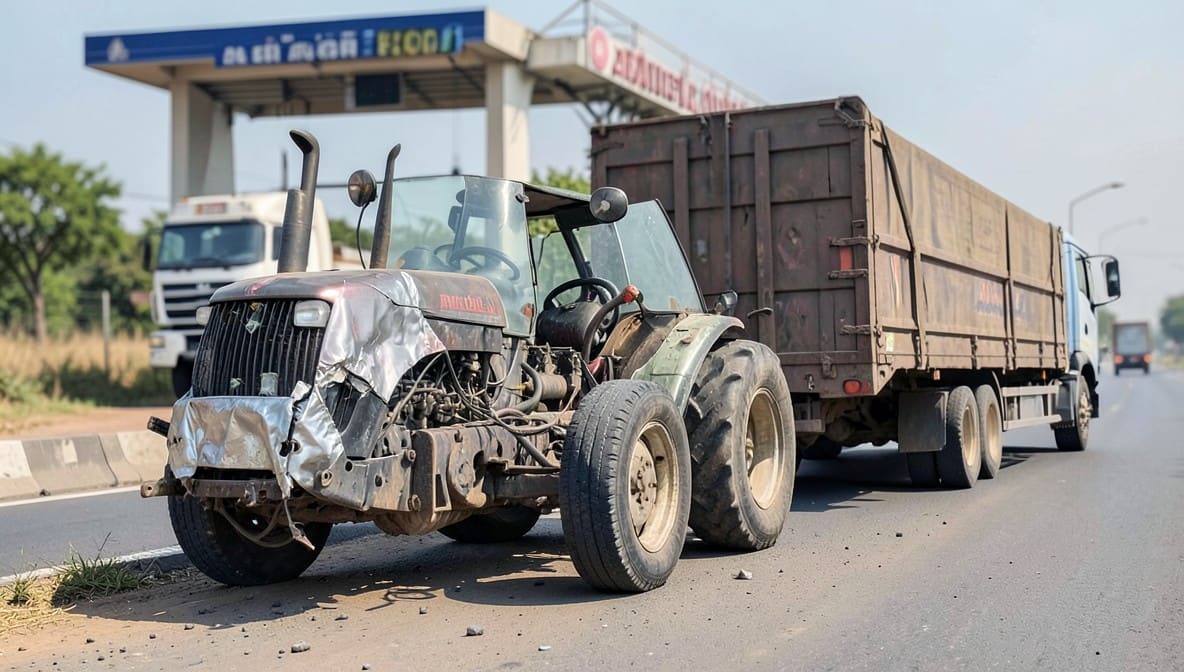
The appellant, G. Jayarami Reddy, owner of a tractor and trailer (Registration Nos. AP 21K 4127 and AP 21K 4128), filed a claim for compensation after his vehicles were damaged in an accident on 19.04.2008. The accident occurred due to the rash and negligent driving of a lorry (Registration No. AP 21 W 4758), owned by respondent No. 1 (A.V.N. Muralimohan) and insured by respondent No. 2 (Oriental Insurance Company Limited). The appellant claimed compensation of Rs. 1,50,000, but the MACT awarded only Rs. 41,400, deducting depreciation. Aggrieved by the inadequacy of the award, the appellant filed the present appeal.
Key Facts
- 19.04.2008: Accident occurred near Silpa Weigh Bridge on National Highway-18, Nandyal. The offending lorry dashed into the appellant’s stationary tractor and trailer.
- Crime No. 78/2008: Registered against the lorry driver for offences under Sections 337 and 338 IPC.
- Expenditure Incurred: The appellant spent Rs. 70,566 on tractor repairs (Ex.A4) and Rs. 35,700 on trailer repairs (Ex.A5), totaling Rs. 1,06,266.
- Insurance Policy: The offending vehicle was insured, and the policy was in force on the date of the accident.
- Surveyor’s Report (Ex.A2): Assessed the repair cost at Rs. 1,07,000 but deducted depreciation, reducing the amount to Rs. 41,400.
Procedural History
- MVOP No. 36/2010: Filed before the Chairman, MACT cum V Additional District Judge (FTC), Kurnool at Nandyal.
- 16.12.2011: MACT awarded Rs. 41,400 as compensation, deducting depreciation and denying incidental income loss.
- M.A.C.M.A. No. 833/2012: Appeal filed before the High Court challenging the MACT’s award.
- IA No. 1/2012: Petition to condone a 15-day delay in filing the appeal.
Relief Sought
The appellant sought:
- Enhancement of compensation to Rs. 1,06,266 (actual repair costs) without depreciation deduction.
- Compensation for incidental income loss at Rs. 1,000 per day for the repair period.
- Interest on the awarded amount.
The Legal Issue
The central questions before the Court were:
- Whether depreciation should be deducted from the compensation awarded for vehicle repairs when new spare parts are used.
- Whether the claimant is entitled to compensation for incidental income loss during the repair period.
Arguments Presented
For the Appellant
- The MACT erred in deducting depreciation when new spare parts were used for repairs. Depreciation is irrelevant in such cases as the vehicle is restored to its pre-accident condition.
- The appellant is entitled to compensation for incidental income loss during the repair period, as the vehicle was non-operational.
- The surveyor’s report (Ex.A2) itself acknowledged that no depreciation should be deducted when new parts are used.
For the Respondent (Insurance Company)
- The deduction of depreciation is rational and justified, as the vehicle’s value diminishes over time.
- The compensation awarded by the MACT is just and reasonable.
- The evidence of the surveyor (P.W.5) was properly appreciated by the MACT.
The Court's Analysis
The Court undertook a detailed examination of the evidence and legal principles governing compensation for vehicle damage in motor accidents.
Depreciation Deduction
The Court relied on the Full Bench decision of the Kerala High Court in M.M. Joseph vs. Venkata Rao (2016 SCC OnLine Ker 4646), which held that depreciation should not be deducted when new spare parts are used to restore a vehicle to roadworthy condition. The Court observed:
"When a vehicle is repaired, the owner will get a better utility for the vehicle as if it is a new vehicle and therefore depreciation is justified to arrive at the actual damage. But what is to be considered is whether these spare parts are required for making the vehicle roadworthy. One cannot expect a person to repair his vehicle with old spare parts. Therefore, necessarily, new spare parts will have to be purchased for making the vehicle roadworthy. Even assuming for the sake of argument that the utility of the vehicle might be increased on account of new spare parts being fitted into the vehicle, it is by way of restitution, to enable the claimant to use the vehicle as he was using it before the accident. In other words, without effecting such repairs, it may not be possible for the claimant to put the vehicle on road. Therefore, making a further reduction to the actual value of spares will in effect amount to reduction from the actual loss suffered by him."
The Court held that the MACT’s deduction of depreciation was unjustified and contrary to legal precedent. The appellant was entitled to the full cost of repairs (Rs. 1,06,266) as evidenced by Exs.A4 and A5.
Incidental Income Loss
The Court also addressed the appellant’s claim for incidental income loss during the repair period. Relying on the Division Bench decision of the Andhra Pradesh High Court in G.Md. Masoom vs. S.K. Khader Vali (2003 SCC OnLine AP 1197), the Court held that a claimant is entitled to compensation for loss of income due to the non-availability of the vehicle during repairs. The Court observed:
"The incidental loss of income due to non-availability of the vehicle, which is under repairs is covered. That has to be taken into consideration while awarding compensation. The incidental loss of income differs from business loss. The business loss has to be arrived at after taking into consideration of non-availability of the vehicle on the particular period and its availability after repairs. We are of considered view that just compensation has to be arrived at by calculating the compensation towards damages including the incidental loss occasioned during the period of non-availability of the vehicle."
The Court awarded Rs. 15,000 (Rs. 500 per day for one month) as compensation for incidental income loss, in addition to the repair costs.
Interest
The Court awarded interest at the rate of 6% per annum from the date of the petition till realization, considering the facts and circumstances of the case.
The Verdict
The appeal was allowed in part, and the Court enhanced the compensation as follows:
- Total Compensation Awarded: Rs. 1,21,266 (Rs. 1,06,266 for repairs + Rs. 15,000 for incidental income loss).
- Interest: 6% per annum from the date of the petition till realization.
- Liability: Respondent Nos. 1 and 2 (owner and insurer of the offending vehicle) are jointly and severally liable, with the insurer bearing primary liability under the insurance policy.
- Payment Timeline: The insurer must deposit the enhanced amount within one month of the judgment. If the appellant furnishes his bank account details within 15 days, the amount shall be directly deposited; otherwise, it shall be deposited before the MACT for withdrawal by the appellant.
- Costs: No order as to costs in the appeal.
What This Means For Similar Cases
No Depreciation for New Spare Parts
- Legal Principle: When new spare parts are used to repair a damaged vehicle, depreciation should not be deducted from the compensation awarded. The claimant is entitled to the actual cost of repairs as restitution for the loss suffered.
- Practical Implication: Insurance companies and tribunals must refrain from deducting depreciation in such cases. Claimants should rely on bills and surveyor reports to prove the actual cost of repairs.
Incidental Income Loss Recognized
- Legal Principle: Claimants are entitled to compensation for incidental income loss during the repair period, as the non-availability of the vehicle directly impacts their livelihood.
- Practical Implication: Tribunals should calculate incidental income loss based on the daily income the vehicle would have generated and the duration of repairs. Evidence such as income records or industry standards can be used to substantiate such claims.
Interest on Compensation
- Legal Principle: Courts may award interest on compensation from the date of the claim petition till realization, to compensate for the delay in payment.
- Practical Implication: Claimants should explicitly pray for interest in their petitions, and tribunals should consider awarding interest as a matter of just compensation.
Joint and Several Liability of Insurer
- Legal Principle: The insurer is primarily liable for compensation under the insurance policy, even though the owner of the offending vehicle is also jointly and severally liable.
- Practical Implication: Claimants should implead the insurer as a respondent in motor accident claims to ensure recovery of compensation. Insurers cannot evade liability merely on technical grounds.