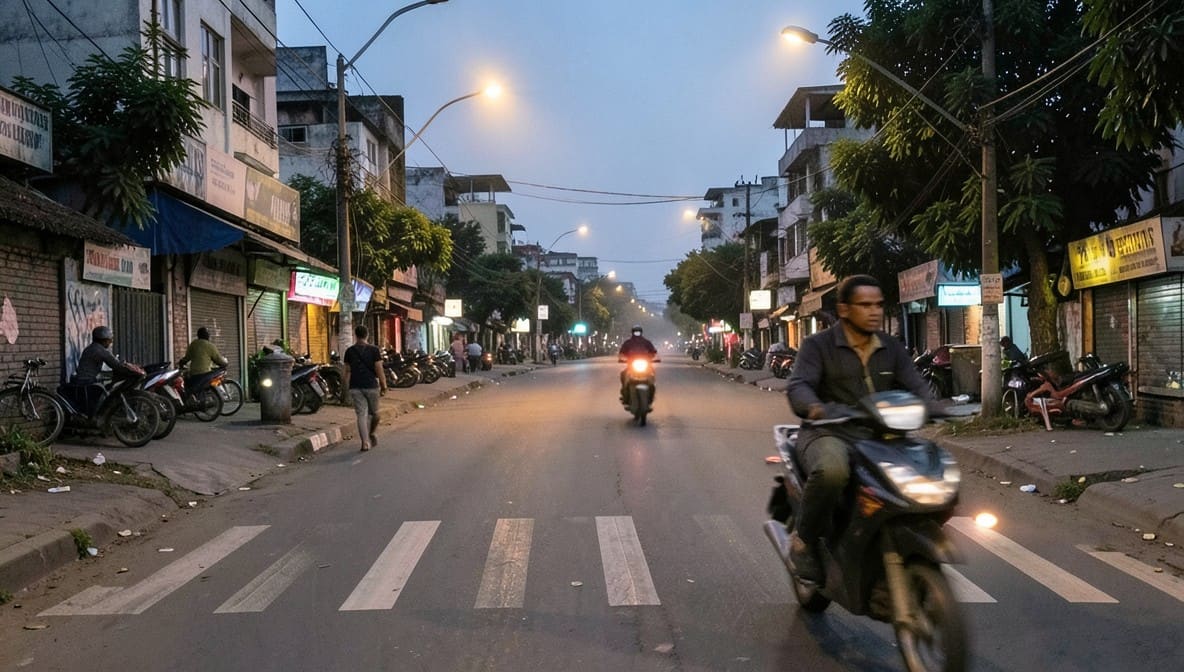
The Karnataka High Court has clarified that where a pedestrian is standing near a road divider and is struck by a speeding motorcycle driven by an unlicensed rider, attributing 25% contributory negligence to the victim is legally unsustainable. The judgment also reinforces mandatory entitlements to future prospects and spousal consortium in wrongful death claims under the Motor Vehicles Act.
Background & Facts
The Dispute
The appellant, Smt. Jayanthi, filed a claim petition under Section 166 of the Motor Vehicles Act, 1988, seeking compensation for the death of her husband, Shiva, who was killed in a road accident on 29.11.2022. The deceased, aged 55, was a daily wage coolie. He was standing on the road divider at Puttur, NH-66, after crossing the western lane, when a motorcycle bearing registration KA-21-V-2895, driven by respondent No.1, Akash Nithyananda Kaitkar, collided with him at high speed. He sustained severe head injuries and succumbed on 01.12.2022.
Key Facts
- The accident occurred at approximately 11:20 a.m. on 29.11.2022 at a point 2 feet from the road divider on a 24-foot-wide road.
- The deceased was not crossing the road at the time of impact but was standing near the divider.
- The motorcycle rider, respondent No.1, was not in possession of a valid driving license at the time of the accident.
- A charge sheet was filed against the rider under Section 304A IPC and Section 185 of the Motor Vehicles Act.
- The claimant examined herself as P.W.1 and one witness as P.W.2. Documentary evidence included Ex.P.1 to Ex.P.12, including the spot mahazar (Ex.P.3) and sketch (Ex.P.4).
- Respondent No.2, the owner of the motorcycle, and respondent No.1, the rider, remained absent and unrepresented before the Tribunal.
- Respondent No.3, Future General India Insurance Co. Ltd., denied negligence and raised the defense that the rider lacked a license.
Procedural History
- 29.11.2022: Date of accident.
- 01.12.2022: Death of the deceased.
- 2023: Claim petition (MVC No.364/2023) filed before the Additional MACT and Principal Senior Civil Judge, Udupi.
- 09.12.2024: Tribunal delivered judgment and award.
- 09.06.2026: Karnataka High Court delivered judgment on MFA No.1449/2025.
The Parties' Positions
For the Claimant (Appellant)
- Argued that the deceased was not negligent as he was standing near the divider, not crossing the road.
- Contended that the rider’s failure to apply brakes and his unlicensed status made him solely responsible.
- Challenged the Tribunal’s use of Rs.15,000 as notional income, citing the Karnataka State Legal Services Authority’s 2022 chart fixing it at Rs.15,500.
- Sought inclusion of 10% future prospects and spousal consortium.
For the Respondent (Insurer)
- Supported the Tribunal’s finding of 25% contributory negligence, arguing the deceased was on a busy road without a zebra crossing.
- Accepted the Tribunal’s compensation quantum as fair.
- Did not contest the liability of the insurer but emphasized recovery rights against the owner.
Relief Sought
The appellant sought:
- Setting aside of the 25% deduction for contributory negligence.
- Enhancement of notional income to Rs.15,500 per month.
- Addition of 10% future prospects to loss of dependency.
- Award of spousal consortium.
- Enhanced total compensation with interest.
The Legal Issue
The central questions were: (1) Whether the Tribunal was justified in attributing 25% contributory negligence to a pedestrian standing near a road divider? (2) Whether the notional income of Rs.15,000 was legally sustainable? (3) Whether future prospects and spousal consortium were mandatory under the precedent in National Insurance Co. v. Pranay Sethi?
Arguments Presented
For the Appellant
The appellant’s counsel relied on the physical evidence - the spot sketch (Ex.P.4) and mahazar (Ex.P.3) - to show the deceased was stationary near the divider, not crossing. He cited National Insurance Co. v. Pranay Sethi (AIR 2017 SC 5157) to argue that 10% future prospects must be added for a deceased aged 55 - 60. He further contended that spousal consortium is a recognized head of compensation under Section 166, and the Tribunal’s award of Rs.1,00,000 for "love and affection" was redundant once consortium was granted.
For the Respondent
The insurer’s counsel conceded the rider’s unlicensed status but defended the 25% deduction on the ground that pedestrians must exercise caution even near dividers. He argued that the Tribunal’s notional income figure was within reasonable bounds and that consortium was not a separate head under the Act. He did not dispute the insurer’s liability but emphasized the right of recovery from the owner.
The Court's Analysis
The Court conducted a meticulous review of the evidence, particularly the spot sketch and mahazar, which showed no brake marks and placed the deceased 2 feet from the divider on a 24-foot-wide road. The Court observed:
"If the rider of the motorcycle was driving his motorcycle in slow and cautious manner he could have avoided the accident. Evidence of P.W.2 also indicate that the accident has taken place due to entire negligence on the part of the rider of the motorcycle."
The Court held that standing near a divider does not constitute contributory negligence, especially when the road is not a high-speed corridor and the victim is not attempting to cross. The absence of brake marks confirmed reckless driving.
On notional income, the Court held that the Tribunal erred in ignoring the official chart issued by the Karnataka State Legal Services Authority, which fixed the monthly income for coolies in 2022 at Rs.15,500. The Court emphasized that such official benchmarks must be followed unless exceptional circumstances exist.
Regarding future prospects, the Court applied National Insurance Co. v. Pranay Sethi and held that for a deceased aged 56, a 10% enhancement on loss of dependency is mandatory. The Court clarified that this is not discretionary but a settled principle.
On consortium, the Court held that the Tribunal’s award of Rs.1,00,000 under "love and affection" was legally incorrect. Spousal consortium is a distinct head of compensation, and the appropriate quantum for a wife is Rs.40,000, enhanced by 10% to Rs.44,000. The Court directed that the Rs.1,00,000 be set aside and replaced with the consortium amount.
The Court also corrected the medical expenses, noting the Tribunal had erroneously recorded Rs.28,764 instead of Rs.78,254 as per Ex.P.12, and upheld the correct figure.
The Verdict
The appellant succeeded in part. The Court set aside the 25% deduction for contributory negligence, enhanced the notional income to Rs.15,500 per month, added 10% future prospects, and awarded Rs.44,000 as spousal consortium. The total compensation was recalculated at Rs.13,30,400. The appellant is entitled to an enhanced amount of Rs.3,58,827 over the Tribunal’s award, with interest at 6% per annum from the date of the petition until realization. Respondent No.3, the insurer, shall pay this amount within six weeks and may recover the same from respondent No.2, the owner of the motorcycle.
What This Means For Similar Cases
Contributory Negligence Cannot Be Presumed Against Pedestrians Near Dividers
- Practitioners must argue that mere presence near a divider, without attempting to cross, does not constitute negligence.
- Absence of brake marks and unlicensed riders shift full liability to the motorist.
- Tribunals must rely on physical evidence (sketches, mahazars) and not speculative assumptions about pedestrian conduct.
Future Prospects and Consortium Are Mandatory, Not Discretionary
- For deceased aged 55 - 60, 10% future prospects must be added to loss of dependency - no exceptions.
- Spousal consortium is a separate head of compensation; awards under "love and affection" are legally invalid and must be replaced.
- Consortium quantum: Rs.40,000 - 50,000 for spouses, adjusted for inflation (10% escalation).
Official Income Charts Must Be Followed
- State Legal Services Authority’s notional income charts are binding on Tribunals unless contradicted by credible evidence.
- Arbitrary figures like Rs.15,000 for coolies are unsustainable when official benchmarks exist.
- Practitioners must always produce and rely on these charts in claims involving daily wage earners.