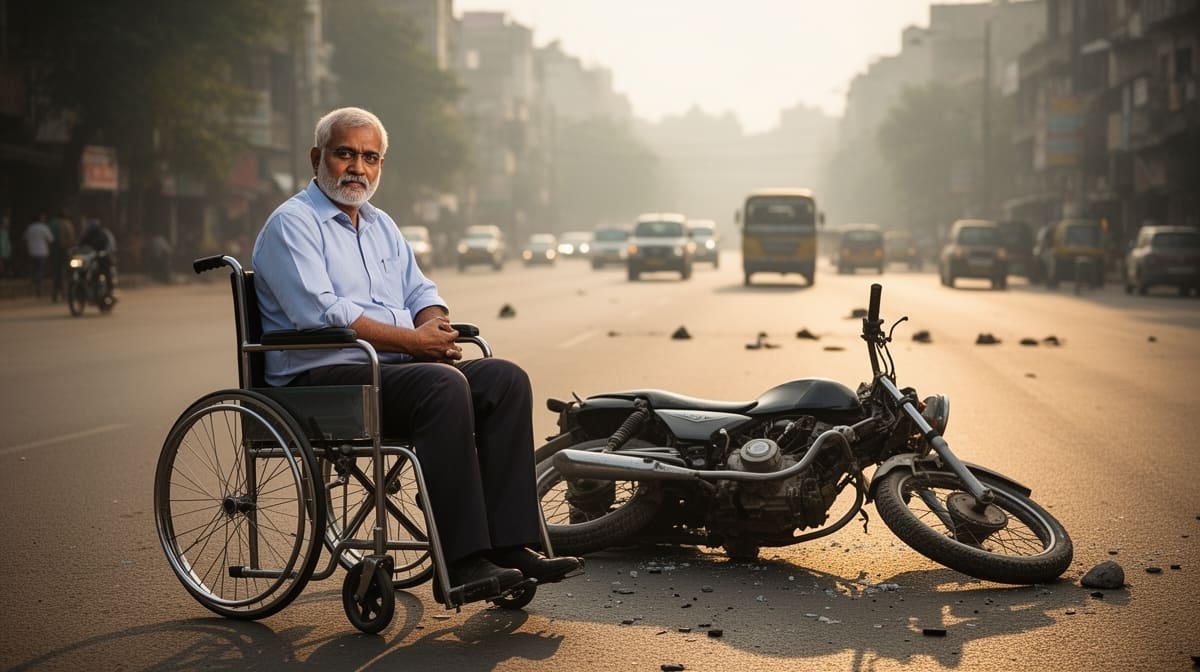
The Madhya Pradesh High Court has significantly enhanced compensation in a motor accident claim involving a student, clarifying that contributory negligence cannot be presumed without cogent evidence and affirming that future earning capacity must be assessed realistically for young claimants with promising careers. This judgment reinforces the principle that compensation under the Motor Vehicles Act must reflect actual loss, not arbitrary assumptions.
Background & Facts
The Dispute
The appellant, Deepak Singh, was involved in a head-on motor accident on 15.04.2010 while traveling as a passenger on a two-wheeler. The accident resulted in severe and permanent injuries, rendering him partially disabled. The respondent, Sajid Khan, was the driver of the offending vehicle. The insurance company, respondent No.2, was the insurer of the offending vehicle. The claim petition was filed before the II Additional Motor Accident Claims Tribunal, Morena, under Claim Case No.34/2010.
Key Facts
- The appellant was a student of BBA First Year at Pioneer Institute of Professional Studies, Indore, at the time of the accident on 15.04.2010
- He was 20 years old and had no formal employment but was pursuing a professional degree with clear career prospects
- The police registered an FIR against the driver of the offending vehicle and filed a charge-sheet
- No eyewitnesses were examined by the insurance company to rebut the claimant’s version of events
- The Claims Tribunal relied solely on a spot map, which was not formally proved by any witness, to infer 25% contributory negligence
- The appellant’s income was assessed at Rs. 18,000 per annum, despite his status as a student with no current earnings but significant future earning potential
- The Tribunal awarded Rs. 7,41,000/- as total compensation, comprising:
- Rs. 5,00,000/- for medical expenses
- Rs. 1,50,000/- for future medical expenses
- Rs. 50,000/- for pain, suffering, and attendant charges
- Rs. 41,000/- for loss of income (based on Rs. 18,000 p.a.)
Procedural History
- 15.04.2010: Motor accident occurred
- 10.06.2010: Claim petition filed before II Additional Motor Accident Claims Tribunal, Morena (Claim Case No.34/2010)
- 31.10.2011: Claims Tribunal awarded compensation of Rs. 7,41,000/- with interest from date of filing
- 20.04.2012: Miscellaneous Appeal No.277/2012 filed before the High Court of Madhya Pradesh, Gwalior, challenging inadequacy of compensation
- 04.05.2026: Judgment delivered by the High Court
Relief Sought
The appellant sought enhancement of compensation on the following grounds:
- Income assessment at Rs. 18,000 per annum was manifestly inadequate; should be Rs. 7,000 per month
- 25% contributory negligence was wrongly inferred without evidence
- Future prospects were not properly considered
- Amounts under pain and suffering, attendant charges, and future medical expenses were unreasonably low
- Total compensation should reflect actual loss of earning capacity and future needs
The Legal Issue
The central questions were: (1) Whether contributory negligence can be inferred against a claimant solely on the basis of a spot map and the nature of a head-on collision, in the absence of any eyewitness or corroborative evidence; and (2) Whether the income of a student pursuing higher education, with no current earnings but clear future prospects, can be assessed at a nominal rate under the Motor Vehicles Act.
Arguments Presented
For the Appellant
Learned counsel for the appellant argued that the Claims Tribunal erred in attributing 25% contributory negligence without any evidence. No eyewitness was examined by the insurance company, and the driver of the offending vehicle did not testify. The spot map was not formally proved under Section 65B of the Evidence Act. Reliance was placed on Meera Devi & Anr. v. Himachal Road Transport Corporation (2014 ACJ 1012), which held that contributory negligence cannot be presumed under common law without specific evidence. The counsel further contended that the appellant’s income should be assessed at Rs. 7,000 per month, citing ICICI Lombard v. Prabhudayal Dubey (2026 MPHC-GWL), where a B.Sc. student was awarded Rs. 7,000 per month. The appellant was entitled to 40% future prospects under National Insurance Co. v. Pranay Sethi (2017 ACJ 2700) and a multiplier of 18 under Sarla Verma v. Delhi Transport Corporation (2009) 6 SCC 121.
For the Respondent
Learned counsel for the Insurance Company supported the Tribunal’s award, arguing that the assessment of income and contributory negligence was based on the evidence on record. The spot map, though not formally proved, was a legitimate tool for inferring fault. The Tribunal’s award was within reasonable bounds and should not be disturbed.
The Court's Analysis
The Court undertook a rigorous review of the factual and legal basis for the Tribunal’s findings. It emphasized that contributory negligence is not a presumption but a fact that must be established by cogent evidence. The Court observed:
"Merely because an accident involves a head-on collision, contributory negligence cannot be presumed unless supported by cogent and reliable evidence. In the present case, the Insurance Company has not examined any eye-witness. Furthermore, the driver of the offending vehicle did not step into the witness box to rebut the evidence led by the claimant."
The Court distinguished the Tribunal’s reliance on the spot map, noting that such documents are not self-authenticating and require corroboration through testimony. The absence of any rebuttal evidence from the respondents rendered the claimant’s oral testimony credible. The Court held that the finding of 25% contributory negligence was speculative and legally unsustainable.
Regarding income assessment, the Court rejected the nominal figure of Rs. 18,000 per annum as wholly inadequate. It recognized that the appellant, though a student, was at the threshold of a professional career. The Court adopted a realistic approach, assessing income at Rs. 5,000 per month (Rs. 60,000 per annum), which was deemed just and reasonable given the appellant’s educational trajectory and the prevailing market for BBA graduates. The Court applied the 40% future prospects multiplier as mandated by Pranay Sethi, and the multiplier of 18 under Sarla Verma, given the appellant’s age of 20 at the time of accident.
The Court further held that the Tribunal’s award of Rs. 50,000 for pain, suffering, and attendant charges was inadequate. Considering the nature of permanent disability, the need for special diet, ongoing medical care, and psychological trauma, the amount was enhanced to Rs. 2,00,000. The future medical expenses of Rs. 1,50,000 were also increased to Rs. 3,00,000 to account for long-term rehabilitation needs.
The Verdict
The appellant succeeded in part. The High Court set aside the Tribunal’s award of Rs. 7,41,000 and enhanced the total compensation to Rs. 25,12,000, an increase of Rs. 17,71,000. The enhanced amount shall carry interest at the same rate as awarded by the Tribunal from the date of deposit of court fee and shall be paid within three months from the date of receipt of a certified copy of this order. The appellant shall deposit any differential court fee within one month of the order. All other conditions imposed by the Tribunal remain intact.
What This Means For Similar Cases
Contributory Negligence Cannot Be Presumed
- Practitioners must now insist on concrete evidence - eyewitness testimony, forensic reports, or certified accident reconstruction - to establish contributory negligence
- Spot maps, without witness authentication, are insufficient to shift burden of proof
- In cases involving head-on collisions, the burden remains on the insurer to prove claimant’s fault
Future Prospects Must Reflect Educational Trajectory
- Students pursuing professional degrees (BBA, B.Tech, MBBS, etc.) are entitled to income assessment based on realistic earning potential, not minimum wage
- A multiplier of 40% for future prospects applies even if the claimant has no current income
- Courts must consider the claimant’s educational institution, course, and industry norms when assessing future earnings
Compensation Heads Must Be Realistically Quantified
- Pain and suffering, attendant charges, and future medical expenses must be assessed based on medical reports, expert opinions, and actual treatment needs
- Awards under these heads should not be mechanical or tokenistic
- Enhancement of Rs. 2,00,000 for non-economic heads sets a new benchmark for serious injuries