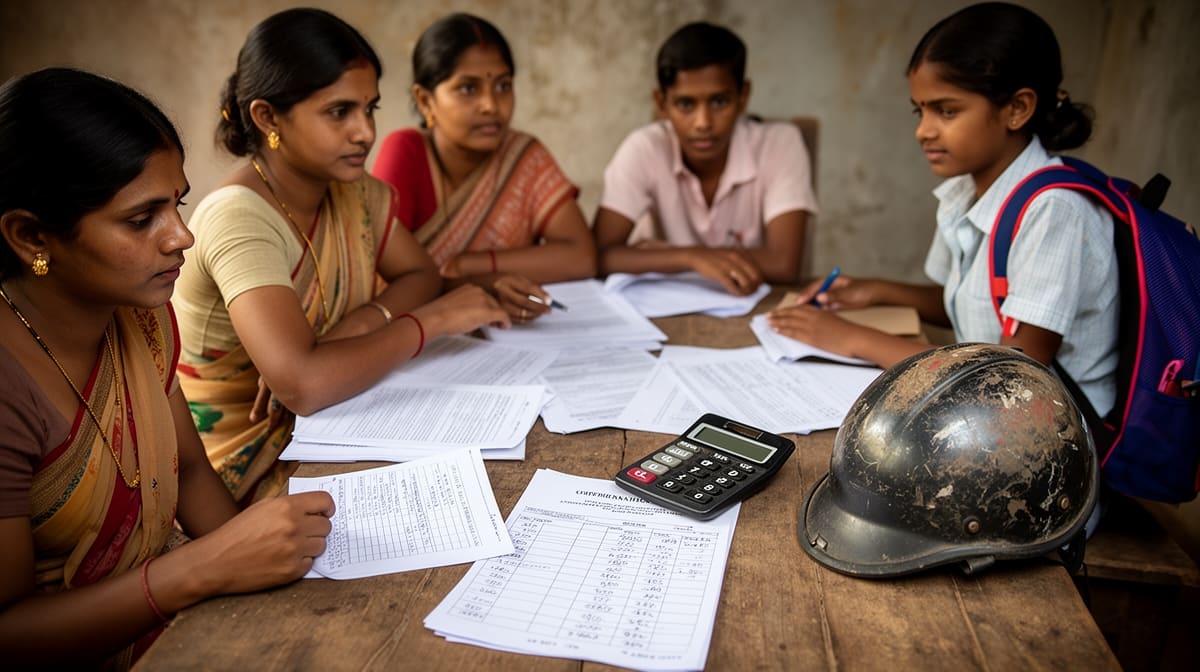
The Andhra Pradesh High Court significantly enhanced compensation awarded in a fatal motor accident claim, setting aside the finding of contributory negligence and applying correct multiplier and future prospects principles.
Background & Facts
The Genesis of the Claim
The claimants, comprising the wife and two daughters of the deceased, filed M.V.O.P.No. 376 of 2003 before the Motor Accidents Claims Tribunal-cum-IV Additional District Judge (Fast Track Court), Ongole, seeking compensation for the death of their husband and father in a road traffic accident on 24.02.2003.
Key Facts
- The deceased, K. Venkata Narayana Rao, was a businessman running a wine shop and was also a director of Khajana Chit Funds and a partner in Vijaya Parvathi Constructions.
- He was aged 38 years at the time of death and was earning between Rs.10,000 to Rs.12,000 per month.
- The second petitioner was studying in Vikas Mahila Residential College, Guntur, and the third petitioner was studying in Vikas Public School, Guntur.
- The accident occurred near Palmolin Oil Garden within Addanki Police Station limits.
- The offending vehicle was a jeep bearing No. AP 27 U 1889 owned by respondent No.1.
Procedural History
- 24.02.2003: Date of accident and death of the deceased.
- M.V.O.P.No. 376 of 2003: Original claim petition filed before the Motor Accidents Claims Tribunal, Ongole.
- 02.09.2006: The learned MACT awarded compensation of Rs.1,39,750 with 7.5% interest per annum.
- 12.06.2012: Present appeal filed before the High Court of Andhra Pradesh.
- IA NO: 1 OF 2007(MACMAMP 5680 OF 2007): Application filed under Section 151 CPC for condonation of delay of 227 days in filing the appeal.
- IA NO: 1 OF 2012(MACMAMP 2700 OF 2012): Application filed under Section 151 CPC to declare the appellants 2 and 3 as majors.
- 21.07.2026: Judgment pronounced enhancing compensation to Rs.8,50,005 with 6% interest per annum.
The Parties' Positions
- Claimants' Case: The accident occurred due to rash and negligent driving of the offending jeep. The deceased was proceeding on his motorcycle when the jeep hit him. The claimants sought enhanced compensation.
- Respondent No.1's Case: The deceased was driving at high speed and hit the jeep while trying to avoid buffaloes crossing the road. The driver of the jeep did not act negligently.
- Respondent No.2 (Insurance Company)'s Case: The claimants failed to prove negligence, valid driving licence, age, occupation, and income of the deceased. The vehicle was allegedly planted and the motorcycle owner and insurer were necessary parties.
Relief Sought
The appellants sought enhancement of compensation from Rs.1,39,750 to a just and reasonable amount, setting aside the finding of contributory negligence and the low income estimation by the learned MACT.
The Legal Issue
The central question was whether the Motor Accidents Claims Tribunal erred in:
- Holding contributory negligence on the part of the deceased despite finding the driver of the offending vehicle negligent.
- Notodally accepting the income of the deceased at Rs.2,000 per month instead of the claimed Rs.10,000 to Rs.12,000 per month.
- Awarding compensation of Rs.1,39,750 which was inadequate and unjust.
Arguments Presented
For the Appellant
- The learned MACT erred in observing contributory negligence while quantifying compensation despite holding the driver of the offending vehicle negligent.
- The income of the deceased was not correctly assessed. The evidence on record, including partnership deeds, firm registration, and school fee receipts, supported a higher income.
- The learned MACT failed to apply the correct multiplier and future prospects as per Supreme Court guidelines.
- The compensation awarded was grossly inadequate and did not reflect the actual loss suffered by the claimants.
For the Respondent
- The appeal lacked sufficient grounds for interference.
- The learned MACT's findings were based on the evidence on record and did not warrant enhancement.
- The Insurance Company contended that the claimants failed to prove the pleaded accident, negligence, and income of the deceased.
The Court's Analysis
The Court examined the evidence and legal principles in detail.
"In a situation of this nature, the Tribunal has rightly taken a holistic view of the matter. It was necessary to be borne in mind that strict proof of an accident caused by a particular bus in a particular manner may not be possible to be done by the claimants. The claimants were merely to establish their case on the touchstone of preponderance of probability. The standard of proof beyond reasonable doubt could not have been applied."
The Court held that the claimants had established the accident and negligence on the part of the driver of the offending vehicle through the evidence of P.Ws.2 and 3, the eye witnesses, and the FIR, charge sheet, and post-mortem certificate. There was no evidence from the respondents' side to rebut the claimants' case.
Regarding income, the Court noted the evidence of P.Ws.4 and 5, the partners of the deceased, and the firm registration certificate and partnership deed, which indicated the deceased's involvement in business. The school fee receipts (Ex.A9 to Ex.A16) also reflected the financial capacity of the deceased. The Court held that the income of the deceased could be accepted at least at Rs.50,000 per annum, not Rs.2,000 per month as assessed by the learned MACT.
The Court applied the multiplier method as per Sarla Verma (Smt.) and Ors. v. Delhi Transport Corporation and Anr. and National Insurance Company Ltd. v. Pranay Sethi and Others. For the age group of 36-40 years, the multiplier applicable was 15. The Court also applied 40% addition towards future prospects, as the deceased was below 40 years.
The Court rejected the finding of contributory negligence, holding that there was no convincing evidence to show such negligence on the part of the deceased.
The Court also relied on Rajesh and others vs. Rajbir Singh and others to hold that there is no bar for awarding more compensation than what is claimed, as the function of the Tribunal is to award just compensation.
The Verdict
The appeal was allowed in part. The Court set aside the order dated 02.09.2006 and enhanced the compensation from Rs.1,39,750 to Rs.8,50,005. The Court awarded:
- Rs.7,00,005 towards loss of dependency.
- Rs.15,000 towards loss of estate.
- Rs.1,20,000 towards loss of consortium (Rs.40,000 each to the wife and two daughters).
- Rs.15,000 towards funeral expenses.
The Court awarded interest at 6% per annum from the date of petition till the date of realization. The apportionment was as follows:
- Claimant No.1 (wife): Rs.4,50,005 with proportionate interest.
- Claimant Nos.2 and 3 (daughters): Rs.2,00,000 each with proportionate interest.
The respondents were held jointly and severally liable to pay the compensation, with respondent No.2 (Insurance Company) liable in view of the insurance policy. The balance amount was to be deposited within two months, with specific directions for direct deposit into the claimants' bank account or deposit before the learned MACT.
What This Means For Similar Cases
Contributory Negligence Must Be Proven
- The Court emphasized that contributory negligence cannot be presumed or inferred without convincing evidence.
- Practitioners must ensure that evidence of negligence on the part of the deceased is clearly established before such a finding is made.
- The burden of proof lies on the respondents to rebut the claimants' case.
Income Must Be Realistically Assessed
- The Court rejected the notional income of Rs.2,000 per month, holding that the evidence on record supported a higher income.
- Practitioners should gather and present documentary evidence such as partnership deeds, firm registration, income tax returns, and school fee receipts to support the income claimed.
- The Court applied 40% addition towards future prospects for the deceased below 40 years, reflecting the need to account for career growth and inflation.
Compensation Can Exceed Claimed Amount
- The Court reiterated that the Tribunal is empowered to award compensation exceeding the claimed amount if justified by evidence.
- This principle is particularly relevant where claimants are minors or where the evidence shows a higher loss than claimed.
- Practitioners should ensure that the claim petition reflects the true extent of loss, but should not hesitate to seek enhancement if the evidence supports it.
Strict Adherence to Multiplier Method and Guidelines
- The Court applied the multiplier method as per Sarla Verma and Pranay Sethi, ensuring consistency and uniformity in compensation awards.
- Practitioners should familiarize themselves with these guidelines and ensure that the Tribunal applies the correct multiplier based on the age of the deceased.
- The Court also awarded compensation under conventional heads such as loss of consortium, funeral expenses, and loss of estate, as per Supreme Court guidelines.
Timely Compliance and Directions
- The Court directed the respondents to deposit the balance amount within two months, with specific directions for direct deposit or deposit before the learned MACT.
- Practitioners should ensure that compliance with such directions is strictly followed to avoid further litigation.
No Order as to Costs
- The Court held that there would be no order as to costs in the appeal.
- This underscores the Court's focus on ensuring just compensation rather than punitive costs.