The Himachal Pradesh High Court recently granted bail to an accused found in possession of 254 grams of charas under Section 20 of the Narcotic Drugs and Psychotropic Substances Act, 1985 (NDPS Act), emphasizing that continued detention post-charge sheet filing is unwarranted without concrete risks of witness tampering or flight. The judgment reinforces the principle that bail cannot be denied merely on apprehensions, especially when the investigation is complete and the accused has roots in society.
Background & Facts
The Dispute
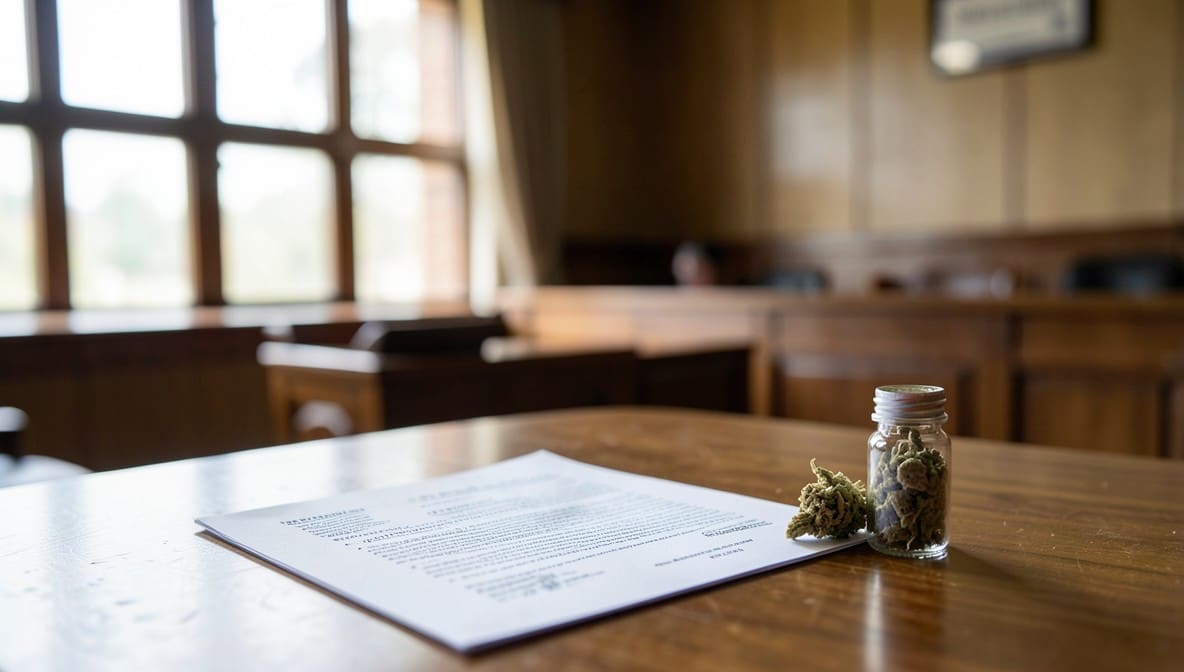
The petitioner, Komal Chand, was arrested on 23.04.2026 following the recovery of 254 grams of charas from a backpack he was carrying while travelling as a passenger in a Haryana Roadways bus (Registration No. HR-55GV-6329). The police intercepted the bus at a nakka set up on 23.04.2026 near Sundernagar, District Mandi, Himachal Pradesh. Upon noticing the police, the petitioner allegedly attempted to conceal the backpack, leading to its seizure and subsequent arrest. The charas was later confirmed as cannabis extract by the State Forensic Science Laboratory (SFSL), Junga.
Key Facts
- FIR No. 49 of 2026 was registered on 24.04.2026 at Police Station BSL Colony, Sundernagar, under Section 20 of the NDPS Act.
- The petitioner was arrested on 23.04.2026 and has been in custody since.
- The recovered quantity (254 grams) exceeds the small quantity threshold (100 grams for charas) but falls short of the commercial quantity (1 kg for charas), thereby excluding the rigours of Section 37 of the NDPS Act.
- The police completed the investigation and filed a charge sheet before the Trial Court.
- The petitioner denied any connection to the contraband, claiming he was merely a passenger.
Procedural History
- 23.04.2026: Petitioner arrested and remanded to custody.
- 24.04.2026: FIR registered under Section 20 NDPS Act.
- Post-23.04.2026: Investigation completed; charge sheet filed.
- 24.06.2026: Present bail petition (Cr. MP(M) No. 843 of 2026) argued before the High Court.
- 25.06.2026: Bail granted subject to conditions.
The Parties' Positions
For the Petitioner
- The petitioner is innocent and has been falsely implicated.
- He is a first-time offender with no criminal antecedents.
- The police have completed the investigation and filed the charge sheet; his continued custody serves no purpose.
- He is willing to abide by any conditions imposed by the Court.
- He has roots in society (resident of District Mandi) and is unlikely to abscond.
For the Respondent/State
- The petitioner was found in possession of 254 grams of charas, a huge quantity not meant for personal consumption.
- The offence is heinous and adversely affects society.
- There is a risk of witness intimidation and repeat offences if the petitioner is released on bail.
Relief Sought
The petitioner sought regular bail under Section 439 of the Code of Criminal Procedure, 1973 (CrPC), arguing that his continued detention was unjustified post-investigation.
The Legal Issue
The central question was whether bail could be denied under Section 20 of the NDPS Act when:
- The investigation was complete and the charge sheet filed,
- The recovered quantity was intermediate (neither small nor commercial), and
- The apprehensions of witness tampering or flight were generalized rather than specific.
Arguments Presented
For the Petitioner
- Cited Pinki v. State of U.P. ((2025) 7 SCC 314) to argue that bail cannot be denied merely on apprehensions.
- Emphasized that the petitioner has no criminal antecedents and is a first-time offender.
- Highlighted that the police do not require his custody for further investigation.
- Contended that continued detention would hinder reformation and expose him to hardened criminals.
For the Respondent/State
- Relied on the gravity of the offence, arguing that 254 grams of charas is a significant quantity.
- Asserted that the petitioner could intimidate witnesses or commit similar offences if released.
- Submitted that the societal impact of narcotics justifies denial of bail.
The Court's Analysis
The Court meticulously applied the bail jurisprudence laid down by the Supreme Court in Pinki v. State of U.P. ((2025) 7 SCC 314), which synthesized principles from landmark judgments such as Gudikanti Narasimhulu v. High Court of A.P. ((1978) 1 SCC 240), Prahlad Singh Bhati v. State (NCT of Delhi) ((2001) 4 SCC 280), Ram Govind Upadhyay v. Sudarshan Singh ((2002) 3 SCC 598), and Brijmani Devi v. Pappu Kumar ((2022) 4 SCC 497). The Court observed:
"The legal principles and practice validate the Court considering the likelihood of the applicant interfering with witnesses for the prosecution or otherwise polluting the process of justice. It is not only traditional but rational, in this context, to enquire into the antecedents of a man who is applying for bail to find whether he has a bad record, particularly a record which suggests that he is likely to commit serious offences while on bail."
The Court further noted:
"While granting the bail, the court has to keep in mind the nature of accusations, the nature of evidence in support thereof, the severity of the punishment which conviction will entail, the character, behaviour, means, position and standing of the accused, circumstances which are peculiar to the accused, reasonable possibility of securing the presence of the accused at the trial, reasonable apprehension of the witnesses being tampered with, the larger interests of the public or State and similar other considerations."
Applying these principles to the present case, the Court held:
- Investigation Complete: The police had completed the investigation and filed the charge sheet, rendering the petitioner’s continued custody unnecessary.
- Quantity Not Commercial: The recovered quantity (254 grams) was not commercial, thus Section 37 of the NDPS Act (which imposes stricter conditions for bail) was not attracted.
- No Criminal Antecedents: The status report did not disclose any criminal antecedents, weakening the State’s apprehensions.
- Roots in Society: The petitioner is a resident of District Mandi, reducing the risk of absconding.
- Apprehensions Not Specific: The State’s fears of witness tampering or repeat offences were generalized and not substantiated by specific evidence.
- Trial Delay: Given the pendency of cases in Himachal Pradesh courts, the trial would take time, and the petitioner cannot be detained indefinitely.
The Court concluded that bail could not be denied based on mere apprehensions, especially when conditions could be imposed to mitigate risks.
The Verdict
The Court allowed the bail petition and directed the petitioner’s release on furnishing bail bonds of ₹1,00,000 with one surety in the like amount, subject to the following conditions:
- The petitioner shall not intimidate witnesses or influence evidence.
- He shall attend trial on every hearing and not seek unnecessary adjournments.
- He shall not leave his present address for more than seven continuous days without informing the SHO, Police Station, and Trial Court.
- He shall surrender his passport, if any, to the Court.
- He shall furnish his mobile number and social media contacts to the Police and Court and update any changes within five days.
The Court expressly clarified that violation of any condition would entitle the prosecution to seek cancellation of bail.
What This Means For Similar Cases
Bail Cannot Be Denied on Apprehensions Alone
- Courts must distinguish between generalized fears and specific risks when considering bail.
- Mere allegations of witness tampering or repeat offences without evidence are insufficient to deny bail.
- Conditions can be imposed to address apprehensions, making denial of bail unnecessary.
Intermediate Quantity Cases Under NDPS Act
- Section 37 of the NDPS Act (stricter bail conditions) does not apply to intermediate quantities (between small and commercial).
- Bail is more readily granted in such cases, provided the investigation is complete and the accused has roots in society.
Reformation and Detention
- Continued detention of first-time offenders without criminal antecedents may hinder reformation and expose them to hardened criminals.
- Courts must balance societal interests with the right to liberty, especially when trial delays are likely.
Practical Takeaways for Practitioners
- Argue for bail post-charge sheet by emphasizing completed investigation and lack of specific risks.
- Highlight roots in society (e.g., local residence) to counter flight risks.
- Propose conditions to address State’s apprehensions (e.g., surrendering passport, regular reporting).
- Distinguish Section 37 NDPS Act in cases involving intermediate quantities.
- Cite Pinki v. State of U.P. to reinforce that apprehensions alone cannot deny bail.