The National Company Law Appellate Tribunal has clarified that e-filing of appeals under the Insolvency and Bankruptcy Code, even after regular court hours, constitutes timely filing if done within the statutory limitation period. The judgment affirms that a 'day' for limitation purposes ends at midnight, not at the close of court working hours, reinforcing the primacy of statutory timelines over procedural restrictions.
Background & Facts
The Dispute
The appellants, Acrow Realcon Pvt. Ltd. and others, were aggrieved by an order dated 13.02.2026 passed by the National Company Law Tribunal (Adjudicating Authority), Ahmedabad Bench, in an insolvency proceeding under the Insolvency and Bankruptcy Code, 2016. The order pertained to the admission and rejection of claims, interpretation of 'related party' under Section 5(24) of the IBC, and reconstitution of the Committee of Creditors. The appellants sought to file an appeal before the NCLAT within the statutory 30-day period, with a 15-day condonable extension.
Key Facts
- Impugned order dated: 13.02.2026
- Last day of statutory limitation (30 days): 14.03.2026
- Last day of condonable extension (45 days): 30.03.2026
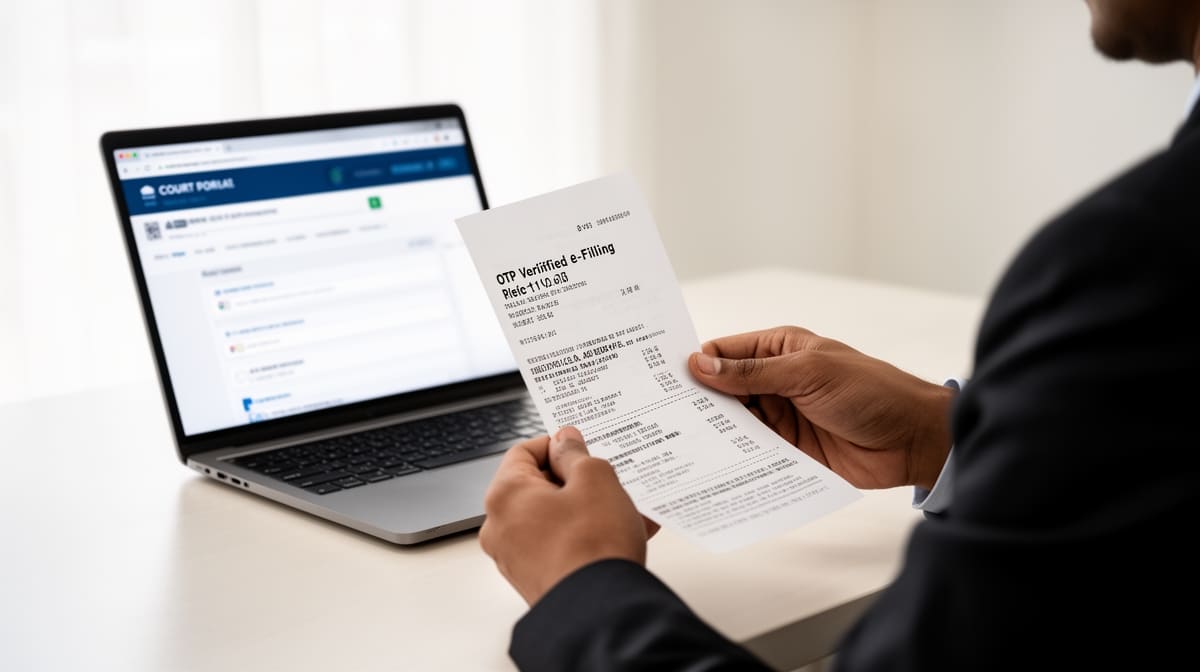
- Appeal e-filed on: 30.03.2026 at 9:00 PM
- Physical copies of appeal not yet filed at time of e-filing
- Respondent Union Bank of India objected to e-filing time, arguing it was after working hours
- Appellants submitted detailed explanation for delay in filing, citing complexity of order, stakeholder coordination, board approvals, and document collation
Procedural History
- 13.02.2026: Adjudicating Authority passes impugned order
- 14.03.2026: End of 30-day statutory limitation period under Section 61(2) IBC
- 30.03.2026 at 9:00 PM: Appeals e-filed electronically
- 31.03.2026: Respondent files reply opposing condonation, arguing e-filing after 1600 hrs should be deemed filed on next day
- 29.05.2026: NCLAT hears applications for condonation of delay (I.A. Nos. 2936-2939 of 2026)
Relief Sought
The appellants sought condonation of 15 days' delay in filing the appeals, arguing that e-filing on 30.03.2026 at 9:00 PM was within the permissible 45-day window under Section 61(2) IBC. They requested that the appeals be admitted for hearing.
The Legal Issue
The central question was whether an appeal e-filed at 9:00 PM on the 45th day of limitation under Section 61(2) of the Insolvency and Bankruptcy Code should be deemed filed on that day, or whether it must be treated as filed on the next working day due to being submitted after the NCLAT’s official working hours.
Arguments Presented
For the Appellant
The appellants relied on the Supreme Court’s judgment in Raj Kumar Yadav v. Samir Kumar Mahaseth, which held that the word 'day' in statutory limitation periods means a full 24-hour period beginning at midnight. They argued that the NCLAT’s own order dated 24.12.2022 explicitly provided that limitation shall be computed from the date of e-filing, not physical filing. They further contended that the Delhi High Court’s e-filing rules, which restrict e-filing after 1600 hrs, are inapplicable to NCLAT as they were never notified to govern NCLAT proceedings. The appellants submitted a detailed affidavit explaining the complexity of the impugned order, the need for board approvals across multiple entities, and the time required to collate voluminous CIRP records.
For the Respondent
The respondents relied on Rule 14.2 of the Delhi High Court E-Filing Rules, 2021, which provides that e-filing after 1600 hrs is deemed filed on the next working day. They argued that since NCLAT functions under the supervision of the Delhi High Court, these rules should apply by implication. They further cited Ambrosia Corner House Private Limited v. Hangro S Foods to support the proposition that e-filing after hours should be treated as filing on the next day. They contended that allowing e-filing at 9 PM would undermine procedural discipline and create arbitrariness.
The Court's Analysis
The NCLAT undertook a rigorous analysis of statutory interpretation, procedural rules, and binding precedents. It first examined the language of Section 61(2) of the IBC, which prescribes a 30-day limitation period with a 15-day condonable extension. The Court noted that the statute does not define 'day', and therefore, the ordinary legal meaning must apply.
"The word 'day' as per English calendar begins at midnight and covers a period of 24 hours thereafter, in the absence of there being anything to the contrary in the context."
The Court then turned to Raj Kumar Yadav v. Samir Kumar Mahaseth, where the Supreme Court unequivocally held that statutory limitation periods cannot be curtailed by procedural rules of High Courts. The Court emphasized that the Patna High Court’s rule limiting filing to court working hours could not override the substantive right conferred by the Representation of the People Act.
The NCLAT further examined its own Rule 104, which empowers the Chairperson to issue directions to remove difficulties. It noted that the order dated 24.12.2022, issued under Rule 104, explicitly stated: "Limitation shall be computed from the date of e-filing." This order was cited and approved by the Supreme Court in Sanket Kumar Agarwal v. APG Logistics Pvt. Ltd. (2024), lending it authoritative weight.
The Court rejected the respondents’ reliance on the Delhi High Court’s e-filing rules, noting that Rule 1 of those rules explicitly states they apply only to courts and tribunals notified by the High Court - and no such notification exists for NCLAT. The Court held that NCLAT, being a statutory tribunal under the Companies Act, 2013, operates under its own rules and is not subject to the procedural norms of the Delhi High Court unless expressly incorporated.
The Court also dismissed the argument that e-filing at 9 PM was improper, stating that the availability of electronic filing systems inherently allows for access beyond physical court hours. The Court observed that the appellants had provided a credible, detailed explanation for the delay, satisfying the requirement of 'sufficient cause' under the proviso to Section 61(2).
The Verdict
The appellants succeeded. The NCLAT allowed I.A. Nos. 2936-2939 of 2026 and condoned the 15-day delay in filing the appeals. The Court held that e-filing on 30.03.2026 at 9:00 PM constituted timely filing within the 45-day window under Section 61(2) of the IBC. The appeals were admitted for hearing, and the matter was listed for final disposal on 10.07.2026.
What This Means For Similar Cases
E-Filing at Any Time Within 24 Hours Is Valid
- Practitioners may e-file appeals under IBC, Companies Act, or NCLAT Rules at any time on the last day of limitation, including after midnight or during non-working hours
- The 24-hour definition of 'day' under Raj Kumar Yadav applies uniformly to all statutory limitation periods unless expressly overridden
- Physical filing deadlines (e.g., 7-day window under NCLAT Rule 104) remain separate and do not affect the computation of limitation
NCLAT’s E-Filing Rules Override High Court Norms
- Delhi High Court’s e-filing rules do not apply to NCLAT unless specifically notified
- Tribunals operating under their own statutory rules (e.g., NCLAT, NCLT, CESTAT) are not bound by High Court procedural guidelines
- Practitioners must verify whether any High Court rules have been formally extended to the tribunal in question
Burden of Explanation for Delay Is Manageable
- A detailed, factual affidavit explaining complexity, stakeholder coordination, and document preparation suffices to establish 'sufficient cause'
- Courts will not impose arbitrary time cutoffs for e-filing if the statutory period has not expired
- The judgment reinforces that procedural technicalities must not defeat substantive rights under insolvency law