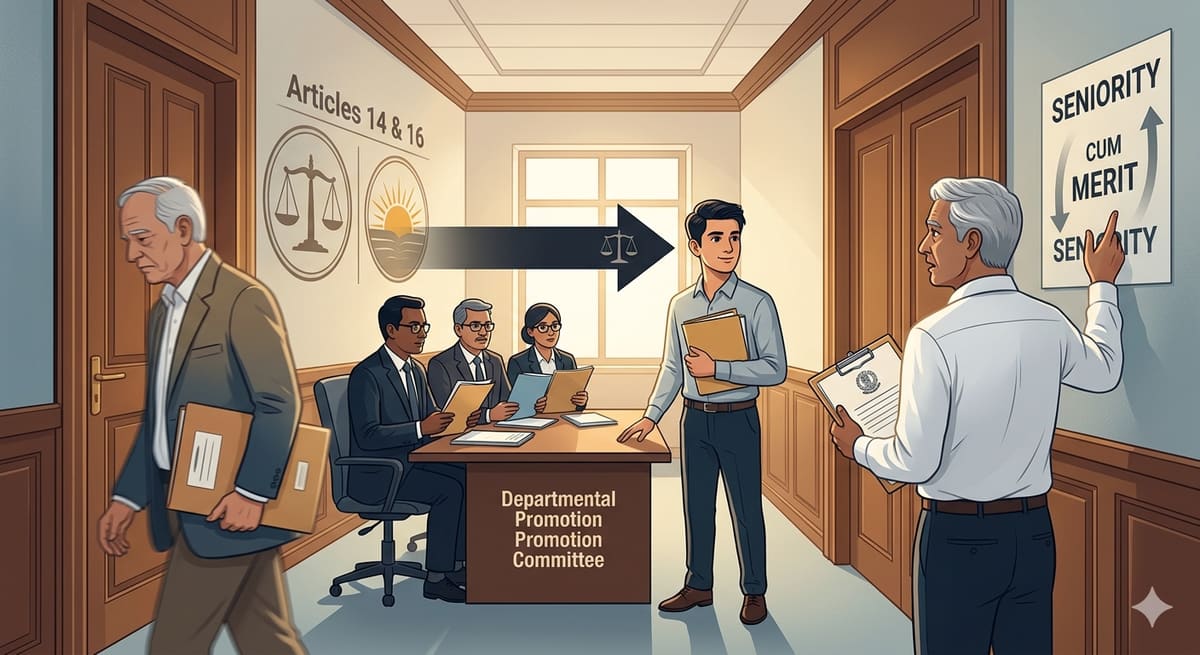
In a significant ruling on service law, the Allahabad High Court has underscored that once a Tribunal order favours an employee, promotion benefits must be extended uniformly without arbitrary discrimination. The Court directed the State to grant the petitioner promotion from the same date as his junior, reinforcing the principle that seniority must be respected in administrative decisions.
Background & Facts
The Dispute
The petitioner, Anupam Shukla, a government employee, challenged the non-grant of promotion despite a favourable order dated 26.09.2018 passed by the Public Services Tribunal. The Tribunal had quashed disciplinary proceedings against him and directed that all benefits, including promotions, should flow in his favour. However, while his junior, Sri Shiv Kumar Singh, was promoted to Deputy Municipal Commissioner w.e.f. 07.09.2015, the petitioner was granted only notional promotion w.e.f. 01.07.2018, leading to allegations of discrimination.
Key Facts
- The petitioner was subjected to disciplinary proceedings, which were quashed by the Public Services Tribunal on 26.09.2018
- A subsequent order dated 07.02.2019 directed that all benefits be accorded to the petitioner
- Despite the Tribunal’s order, the petitioner was granted notional promotion to Deputy Municipal Commissioner w.e.f. 01.07.2018, while his junior, Sri Shiv Kumar Singh, was promoted to the same post w.e.f. 07.09.2015
- The State justified the disparity by claiming Sri Shiv Kumar Singh was granted relaxation in service, including services rendered in local bodies, which was not extended to the petitioner
- The petitioner argued that this amounted to arbitrary discrimination, as he was entitled to the same benefits as his junior
Procedural History
- 26.09.2018: Public Services Tribunal quashed disciplinary proceedings against the petitioner and directed grant of all benefits
- 07.02.2019: Order passed directing compliance with the Tribunal’s decision
- 01.07.2018: Petitioner granted notional promotion to Deputy Municipal Commissioner
- 07.09.2015: Sri Shiv Kumar Singh (junior to the petitioner) promoted to Deputy Municipal Commissioner
- 15.01.2018: Sri Shiv Kumar Singh promoted to Joint Municipal Commissioner
- 22.08.2019: Sri Shiv Kumar Singh promoted to Additional Municipal Commissioner
- 2026: Present writ petition (WP-A No. 4056 of 2026) filed before the Allahabad High Court, Lucknow Bench
Relief Sought
The petitioner sought:
- Promotion to Deputy Municipal Commissioner w.e.f. 07.09.2015, the date on which his junior was promoted
- Promotion to Joint Municipal Commissioner w.e.f. 15.01.2018
- Promotion to Additional Municipal Commissioner w.e.f. 22.08.2019
- Placement higher in seniority than Sri Shiv Kumar Singh
- All consequential benefits, including arrears, to be granted within two months of the order
The Legal Issue
The central question was whether the State could arbitrarily deny promotion benefits to a senior employee, despite a Tribunal order directing their grant, while extending the same benefits to a junior employee on grounds of relaxation in service. Specifically, the Court had to determine if the State’s justification for the disparity was legally tenable or amounted to discrimination under service law principles.
Arguments Presented
For the Petitioner
- The petitioner contended that the Tribunal’s order dated 26.09.2018 was final and binding, and the State was obligated to comply with it without discrimination
- He argued that the denial of promotion from 07.09.2015, while granting it to his junior, violated the principle of seniority and amounted to arbitrary action
- The petitioner relied on the doctrine of equality in service law, emphasizing that once a Tribunal order favours an employee, the State cannot create artificial distinctions to deny benefits
For the Respondent
- The State admitted the Tribunal’s order but justified the disparity on the ground that Sri Shiv Kumar Singh was granted relaxation in service, including services rendered in local bodies, which was not applicable to the petitioner
- It contended that the petitioner’s promotion on the same terms as his junior was not possible due to the absence of such relaxation
- The State argued that the discretion to grant promotions lay with the authorities, and the petitioner could not claim parity as a matter of right
The Court's Analysis
The Court rejected the State’s justification as arbitrary and untenable. It held that once the Tribunal’s order had attained finality, the petitioner was entitled to all benefits that flowed to employees junior to him. The Court observed:
"The stand of the respondents is clearly arbitrary inasmuch as once, the petitioner's claim had been allowed by the Tribunal in its judgment dated 26.09.2018 and the consequent decision was also taken in favour of the petitioner, the petitioner was entitled to all the benefits, which were available to the persons, who were junior to the petitioner."
The Court emphasized that seniority is a fundamental principle in service law, and any deviation must be justified by objective criteria. The State’s reliance on relaxation in service for the junior employee was deemed insufficient to deny the petitioner his rightful promotion. The Court noted:
"Admittedly, Sri Shiv Kumar Singh was placed lower in rank of seniority, below the petitioner, and had been extended the benefits as admitted by the State in the counter affidavit, the reasoning for non-granting the similar benefits to the petitioner are apparently missing."
The Court further held that the State’s action amounted to discrimination, as it failed to provide any valid justification for treating the petitioner differently from his junior. The principle of equality in service mandates that once a Tribunal order favours an employee, the State must implement it uniformly without creating artificial distinctions.
The Verdict
The Allahabad High Court allowed the writ petition and directed the State to:
- Grant the petitioner promotion to Deputy Municipal Commissioner w.e.f. 07.09.2015
- Grant promotion to Joint Municipal Commissioner w.e.f. 15.01.2018
- Grant promotion to Additional Municipal Commissioner w.e.f. 22.08.2019
- Place the petitioner higher in seniority than Sri Shiv Kumar Singh
- Ensure all consequential benefits, including arrears, are granted within two months of submitting a certified copy of the order
What This Means For Similar Cases
Tribunal Orders Must Be Implemented Uniformly
- Practitioners should emphasize that Tribunal orders are binding and must be implemented without discrimination
- Any deviation from the Tribunal’s directions must be justified by objective criteria, failing which it may be struck down as arbitrary
- The judgment reinforces that seniority is a non-negotiable principle in service law, and juniors cannot be granted benefits while denying the same to seniors without valid grounds
Arbitrary Action by the State Is Unacceptable
- The State cannot create artificial distinctions to deny benefits to employees, especially when a Tribunal order is in force
- Relaxation in service or other discretionary grounds must be applied uniformly or justified with clear, objective reasoning
- Employees aggrieved by non-implementation of Tribunal orders can seek writ remedies under Article 226 of the Constitution, as demonstrated in this case
Compliance Timelines Are Mandatory
- Courts may impose strict timelines for compliance with orders, as seen in this judgment (two months for granting benefits)
- Failure to comply within the stipulated period may lead to contempt proceedings or further judicial intervention
- Practitioners should ensure that certified copies of orders are submitted promptly to trigger the compliance timeline