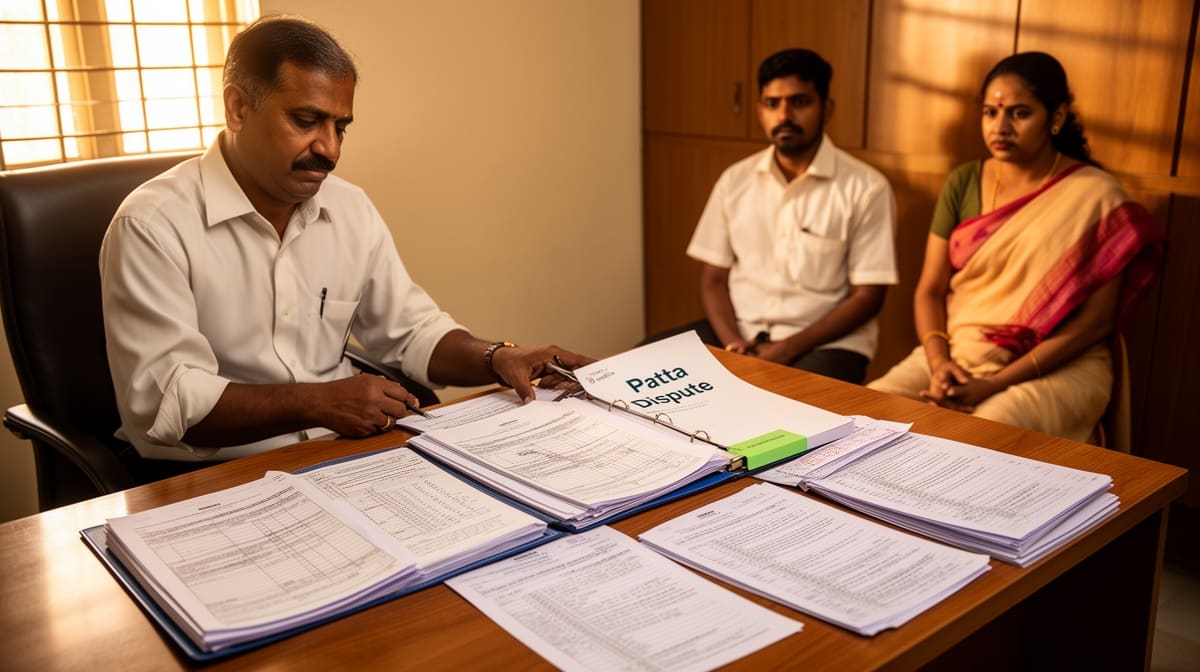
The Madras High Court has underscored the primacy of natural justice in land revenue disputes, directing the Tahsildar to consider a patta application on merits despite a 13-year delay in filing the representation. The judgment balances procedural timelines with substantive justice, setting a precedent for similar cases involving delayed administrative claims.
Background & Facts
The Dispute
The petitioner, Shenna Tabitha, discovered in 2012 that her property - Survey No. 251/12 (251/5), Zamin Pallavaram village, measuring 2178 sq.ft - had been allegedly encroached upon by a developer named Gemini Homes. Despite this knowledge, she filed a representation for issuance of patta in her name only on 17.11.2025, which remained unaddressed by the third respondent, the Tahsildar, Pallavaram Taluk.
Key Facts
- The petitioner became aware of the encroachment in 2012 but took no legal action until 2025.
- She submitted a representation for patta issuance on 17.11.2025.
- The property in question is Survey No. 251/12 (251/5), Zamin Pallavaram village, measuring 2178 sq.ft.
- The respondents include:
- The District Collector, Chengalpattu
- The Revenue Divisional Officer, Tambaram
- The Tahsildar, Pallavaram Taluk (third respondent).
Procedural History
- 17.11.2025: Petitioner submits representation for patta issuance to the third respondent.
- No action taken: The representation remains unconsidered.
- WP No. 10500 of 2026: Writ petition filed before the Madras High Court seeking direction to the third respondent to consider the representation.
Relief Sought
The petitioner sought a direction to the third respondent to:
- Consider her representation dated 17.11.2025.
- Issue patta passbook for the property in question.
- Fix a time frame for compliance.
The Legal Issue
The central question was whether the delay of 13 years in filing a representation for patta issuance could bar the petitioner from seeking administrative redressal on merits, or whether the principles of natural justice mandate consideration of the representation regardless of delay.
Arguments Presented
For the Petitioner
The petitioner’s counsel argued that:
- The delay in filing the representation should not preclude consideration of the merits of the claim.
- The encroachment by the developer (Gemini Homes) necessitated urgent administrative intervention.
- The failure of the third respondent to act on the representation violated the petitioner’s right to natural justice.
For the Respondent
The learned Special Government Pleader (Mr. D. Ravichander) contended that:
- The petitioner’s knowledge of the encroachment since 2012 rendered her representation time-barred.
- The delay of 13 years disentitled the petitioner from seeking relief at this stage.
The Court's Analysis
The Court refrained from expressing any opinion on the merits of the encroachment claim or the validity of the petitioner’s title. Instead, it focused on the administrative duty of the third respondent to consider representations on merits and in accordance with law, irrespective of delay.
The Court emphasized that natural justice requires authorities to:
- Hear all necessary parties, including the alleged encroacher (Gemini Homes).
- Examine supporting documents submitted by the petitioner.
- Pass reasoned orders after due consideration.
"No prejudice would be caused to the third respondent if the petitioner’s representation seeking for grant of patta, is considered, on merits and in accordance with law, after hearing all the necessary parties, which include the developer, i.e. Gemini Homes, which according to the petitioner has encroached upon the petitioner's property."
The Court further observed that delay alone cannot defeat a claim where substantive justice is at stake, particularly in matters involving land rights and administrative redressal.
The Verdict
The writ petition was disposed of with the following directions:
- The third respondent (Tahsildar, Pallavaram Taluk) must pass final orders on the petitioner’s representation dated 17.11.2025 within 12 weeks from the date of receipt of a copy of this order.
- The consideration must be on merits and in accordance with law, after:
- Examining the supporting documents produced by the petitioner.
- Hearing the objections of all necessary parties, including Gemini Homes.
- No costs were awarded.
What This Means For Similar Cases
Delay Does Not Defeat Substantive Justice
- Administrative authorities cannot reject representations solely on grounds of delay, especially in matters involving land disputes or property rights.
- Natural justice mandates that representations be considered on merits, provided no irreparable prejudice is caused to the respondents.
- Practitioners should argue that delay is not fatal where the underlying claim involves fundamental rights (e.g., property rights).
Duty to Hear All Necessary Parties
- The Court’s direction to hear the alleged encroacher (Gemini Homes) underscores the obligation of authorities to ensure fairness and transparency in administrative proceedings.
- Land revenue disputes must involve all stakeholders to avoid ex parte decisions that could later be challenged.
Time-Bound Compliance for Administrative Orders
- The Court’s 12-week deadline for compliance sets a benchmark for administrative efficiency.
- Practitioners can cite this judgment to seek time-bound directions in cases involving delayed administrative action.
- Authorities must adhere to timelines to avoid contempt proceedings or further judicial intervention.