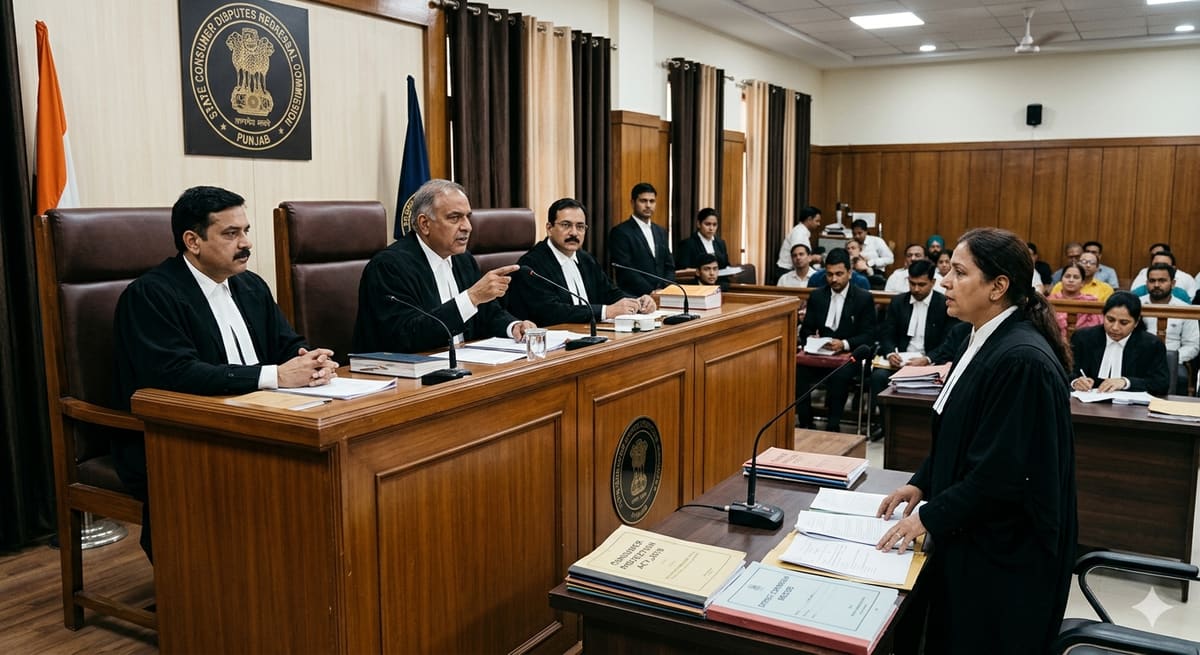
The Punjab and Haryana High Court has disposed of a writ petition challenging the rejection of a medical negligence complaint, directing that the matter be referred to a statutorily constituted District Medical Negligence Board. This outcome underscores the procedural necessity of institutional review over hasty administrative dismissals in healthcare disputes.
Background & Facts
The Dispute
The petitioner, Narendra Singh, filed a complaint alleging medical negligence by Dr. Tanveer Ahmed Bhatt, a surgeon at RMC Hospital, Tohana, Haryana. The complaint arose after the petitioner’s mother underwent knee replacement surgery on 09.07.2023, during which a Zimmer implant was used. Post-surgery, the patient experienced severe and persistent pain, prompting the petitioner to seek treatment at multiple private hospitals including Arora Hospital, Aadhar Hospital, Jindal Hospital, Sarvesh Hospital, and Healing Hospital, Chandigarh. The petitioner contended that RMC Hospital failed to provide adequate post-operative care, including physiotherapy, and that the surgeon did not respond to complaints.
Key Facts
- The petitioner’s mother underwent knee surgery on 09.07.2023 at RMC Hospital, Tohana
- The implant used was manufactured by Zimmer, as confirmed by the bill provided by Dr. Tanveer Ahmed Bhatt
- The petitioner filed a formal complaint alleging negligence on 15.08.2025 (inferred from inquiry date)
- An inquiry was conducted by hospital authorities, resulting in a report dated 08.10.2025
- The inquiry report concluded there was no negligence, citing:
- Absence of any hospital record indicating surgical error
- Delay in filing complaint (over two years post-surgery)
- Petitioner’s decision to consult private hospitals instead of raising concerns with the surgeon
- The petitioner was denied access to summon Dr. Tanveer Ahmed as a witness
- The petitioner’s complaint was filed under the Haryana Government’s reimbursement scheme for medical expenses
Procedural History
- 09.07.2023: Knee replacement surgery performed at RMC Hospital, Tohana
- Late 2023 - Early 2024: Petitioner sought treatment at multiple private hospitals due to post-operative complications
- 15.08.2025: Formal complaint of negligence filed with RMC Hospital administration
- 08.10.2025: Inquiry report issued rejecting complaint on grounds of no negligence, delay, and failure to consult surgeon
- 23.03.2026: Writ petition filed under Articles 226 and 227 of the Constitution before the Punjab and Haryana High Court
The Parties' Positions
Petitioner’s Position: The inquiry was procedurally flawed - no opportunity was given to examine the surgeon, no cross-examination of documents was permitted, and the report relied on unverified assertions. The petitioner argued that the refusal to summon the treating doctor violated principles of natural justice.
Respondent’s Position: The State contended that the inquiry was conducted in good faith and that the petitioner’s complaint was time-barred. The State further argued that no medical evidence supported the allegation of negligence.
Relief Sought
The petitioner sought quashing of the inquiry report dated 08.10.2025 and direction to the State to constitute a proper medical board to re-investigate the complaint with full procedural safeguards, including summoning the surgeon and permitting cross-examination.
The Legal Issue
The central question was whether an administrative inquiry into alleged medical negligence can be deemed valid when the treating surgeon is not summoned or examined, and when the complainant’s documentary evidence is ignored without reasoned analysis.
Arguments Presented
For the Petitioner
The petitioner’s counsel argued that the inquiry report was a non-speaking order, violating the principles of natural justice under Article 14 of the Constitution. Reliance was placed on State of Haryana v. Bhajan Lal to assert that administrative decisions affecting rights must be reasoned and fair. The petitioner emphasized that the surgeon’s testimony was critical to determine whether the post-operative pain resulted from surgical error or normal recovery, and that the refusal to examine him rendered the inquiry arbitrary.
For the Respondent
The State, through the Additional Advocate General, conceded that while the inquiry report was procedurally deficient, the matter was now under the purview of a newly constituted District Medical Negligence Board under the Haryana Medical Negligence Act, 2023. The State submitted that the Board, being a specialized statutory body, would conduct a fair, expert-led inquiry with full opportunity to both parties.
The Court's Analysis
The Court acknowledged the petitioner’s legitimate grievance regarding the flawed inquiry process. The report dated 08.10.2025 was found to be conclusory, lacking any analysis of the medical records, failure to record reasons for rejecting the petitioner’s documents, and absence of any opportunity for the surgeon to be heard. The Court noted that while delay in filing a complaint may be a relevant factor, it cannot override the right to a fair hearing.
"The denial of an opportunity to examine the treating surgeon, particularly in a case involving complex medical judgment, renders the inquiry procedurally defective and violative of the principles of audi alteram partem."
The Court further observed that the State had already constituted a District Medical Negligence Board under statutory authority, which was specifically designed to handle such complaints with medical expertise and procedural fairness. The Court expressed confidence that the Board would conduct a thorough, impartial, and time-bound inquiry.
The Verdict
The petition was disposed of with the direction that the District Medical Negligence Board shall re-investigate the complaint within 60 days from the date of this order. The Board shall summon Dr. Tanveer Ahmed Bhatt as a witness, permit the petitioner to present all documents, and provide a reasoned report. The petitioner’s complaint shall be treated as pending from the date of its original filing on 15.08.2025. No costs are awarded.
What This Means For Similar Cases
Procedural Fairness Is Non-Negotiable in Medical Negligence Inquiries
- Practitioners must insist on the right to examine treating doctors in all administrative medical negligence inquiries
- Reports that rely solely on hospital records without cross-verification or expert input are vulnerable to judicial review
- Delay alone cannot justify dismissal without examining the merits of the complaint
Statutory Boards Override Hasty Administrative Decisions
- Where a specialized statutory body exists (e.g., Medical Negligence Board), courts will prefer referral over direct intervention
- Petitioners should first exhaust statutory remedies before approaching High Courts under Article 226
- The existence of a statutory board does not validate prior procedural violations - it mandates a fresh, fair inquiry
Documentary Evidence Must Be Actively Considered
- Merely rejecting documents without analysis or explanation constitutes arbitrariness
- Petitioners should preserve all medical records, bills, and correspondence as evidence
- Courts will not uphold findings that ignore submitted documents without specific reasoning