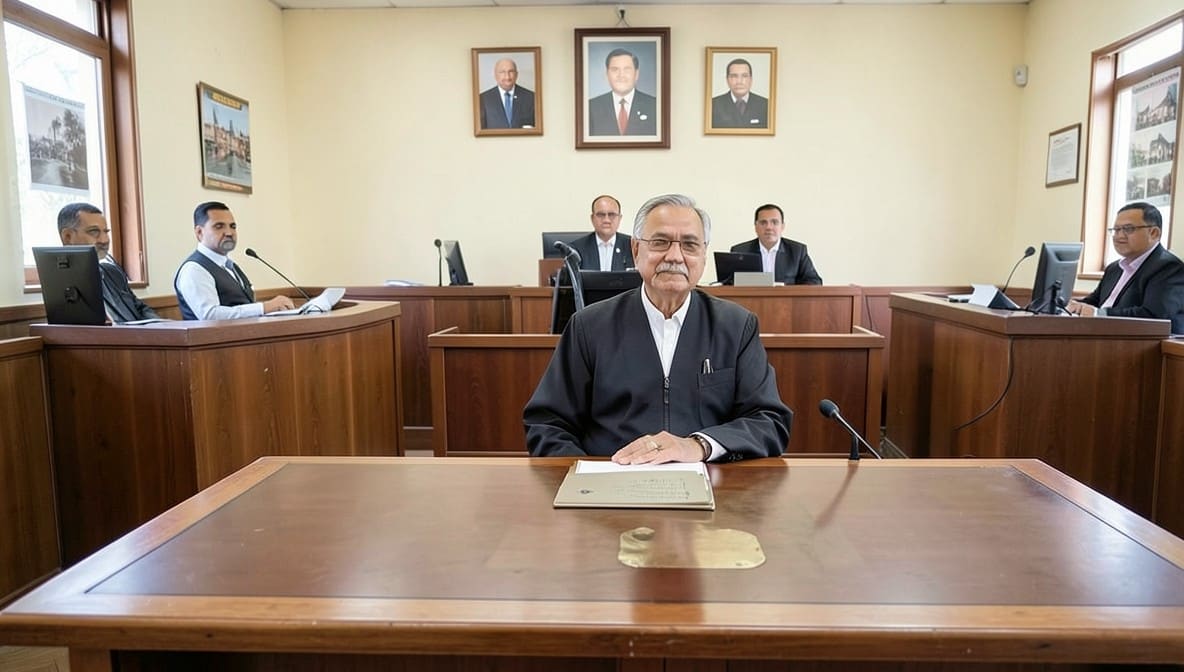
The Himachal Pradesh High Court recently underscored the fundamental principle of natural justice by quashing an ex parte interim order that restrained a society member from participating in managing committee meetings without prior notice. The judgment reaffirms that procedural fairness is non-negotiable, even in interim proceedings, and sets a clear precedent against arbitrary administrative actions.
Background & Facts
The Dispute
The petitioner, Pushpa Devi, was a committee member of the Mining Areas Land Looser and Affected Transport Co-operative Society, Giana, located in Sub-Tehsil Darlaghat, Tehsil Arki, District Solan. The dispute arose when respondent No.4, an unspecified authority, passed an interim order restraining the petitioner from attending meetings or participating in decisions of the society’s managing committee until the final resolution of an underlying dispute.
Key Facts
- The petitioner was elected as a committee member of the society
- Proceedings were initiated before respondent No.4, with the petitioner served notice on 30.08.2025 for a hearing scheduled on 09.09.2025
- On 09.09.2025, the matter was neither taken up nor was the petitioner informed of its listing for the next day
- On 10.09.2025, the matter was heard ex parte, and the petitioner was restrained from participating in managing committee meetings via order Annexure P-3
- The impugned order also directed respondent No.2, the Assistant Registrar, Cooperative Societies, Solan, to make alternative arrangements for managing the society’s day-to-day business if the quorum was incomplete
Procedural History
- 30.08.2025: Petitioner served notice for hearing on 09.09.2025
- 09.09.2025: Matter not taken up; petitioner not informed of rescheduling
- 10.09.2025: Ex parte interim order passed restraining petitioner
- Post-10.09.2025: Respondents failed to file replies despite repeated opportunities
- 20.03.2026: Present writ petition (CWP No.15590 of 2025) decided by the High Court
Relief Sought
The petitioner sought quashing of the interim order dated 10.09.2025 (Annexure P-3), arguing that it was passed in violation of the principles of natural justice due to lack of notice and opportunity to be heard.
The Legal Issue
The central question was whether an interim order passed ex parte, without affording the affected party an opportunity to be heard, violates the principles of natural justice and is liable to be quashed.
Arguments Presented
For the Petitioner
The petitioner contended that the impugned order was passed in her absence without any prior intimation, thereby depriving her of a fair hearing. She relied on established precedents, including Maneka Gandhi v. Union of India, to argue that natural justice is a constitutional mandate and cannot be bypassed even in interim proceedings.
For the Respondents
Despite repeated opportunities, the respondents failed to file any reply or counter-affidavit, leaving their arguments unrepresented in the proceedings.
The Court's Analysis
The Court observed that the respondents had been granted multiple opportunities to file replies but had failed to do so. In the absence of any rebuttal, the petitioner’s assertions had to be accepted as true. The Court emphasized that natural justice is not a mere procedural formality but a fundamental right enshrined in the Constitution.
"The principles of natural justice are not the creation of any statute or rule. They are embedded in the constitutional fabric and form the bedrock of fair administrative action. An order passed ex parte, without affording the affected party an opportunity to be heard, is inherently flawed and cannot sustain judicial scrutiny."
The Court further noted that the impugned order did not merely impose a temporary restraint but effectively disqualified the petitioner from participating in the society’s decision-making, a consequence that could not be justified without adherence to procedural fairness.
The Verdict
The Court quashed and set aside the impugned order dated 10.09.2025 (Annexure P-3) passed by respondent No.4. The judgment directed that all consequences of the order shall stand nullified, and the respondents were at liberty to proceed further in the matter in accordance with law. The writ petition was disposed of in these terms, along with any pending miscellaneous applications.
What This Means For Similar Cases
Ex Parte Orders Must Comply With Natural Justice
- Courts and administrative authorities must ensure that even interim orders are passed after affording the affected party a fair hearing
- Failure to provide notice or an opportunity to be heard renders the order legally unsustainable, regardless of the merits of the underlying dispute
- Practitioners should challenge ex parte orders on the ground of procedural impropriety, especially where the order has significant consequences for the affected party
Default by Respondents Can Strengthen Petitioner’s Case
- Where respondents fail to file replies despite repeated opportunities, courts may accept the petitioner’s assertions as true and decide the matter on merits
- This underscores the importance of timely compliance with procedural requirements, as non-participation can lead to adverse inferences
- Petitioners should highlight the absence of rebuttal as a factor weighing in their favor, particularly in cases involving natural justice violations
Liberty to Proceed Further: A Double-Edged Sword
- While the Court quashed the impugned order, it granted the respondents liberty to proceed further in accordance with law
- This means the underlying dispute remains open for adjudication, and the respondents may reinitiate proceedings with proper notice
- Practitioners should advise clients that quashing of an interim order does not preclude future action and that compliance with procedural fairness is essential in any subsequent proceedings