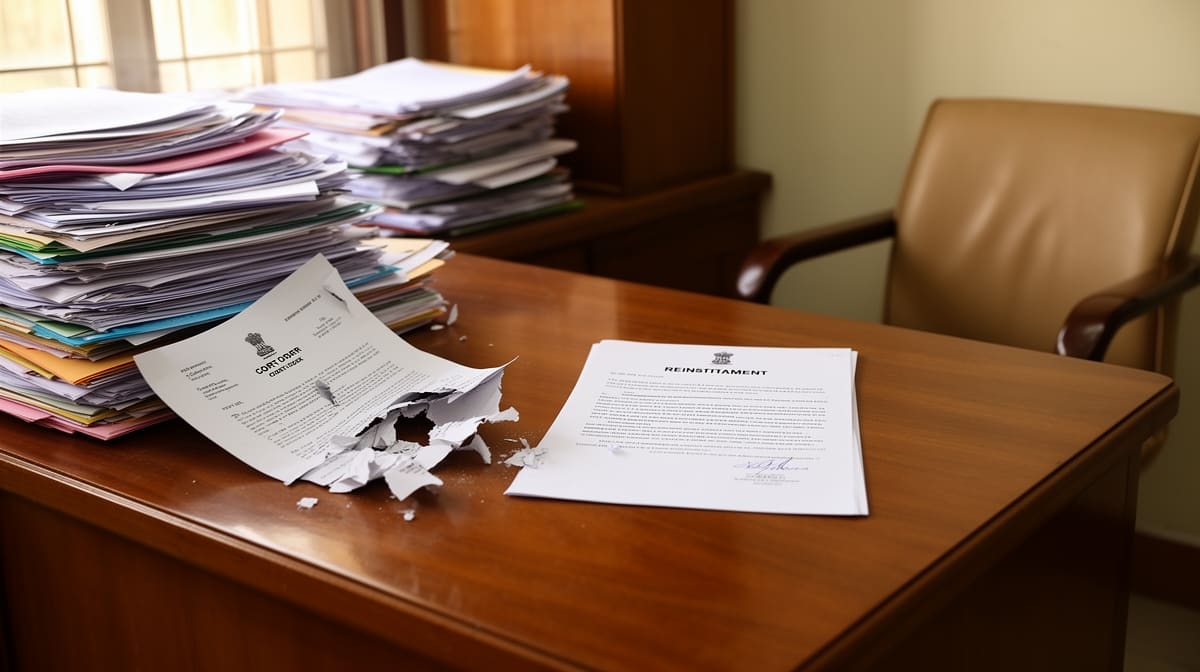
The Allahabad High Court has set aside the removal order of an employee of the Uttar Pradesh Metro Rail Corporation Limited (UPMRCL) after finding that the disciplinary authority failed to appreciate evidence and denied the employee an opportunity to cross-examine witnesses. The Court emphasized that departmental inquiries must adhere to principles of natural justice and that findings must be supported by evidence.
Background & Facts
The Genesis
The petitioner, Samaksh Agarwal, was appointed as Assistant Manager (Civil) in the Uttar Pradesh Metro Rail Corporation Limited (UPMRCL) for the Agra Metro Project. While discharging his duties, he raised concerns regarding irregularities in his Annual Performance Appraisal Report (APAR) for the financial year 2022-23 through multiple representations and grievances filed on the Centralized Public Grievance Redressal and Monitoring System (CPGRAMS).
Key Facts
- The petitioner was issued a show-cause notice under the UPMRC Conduct, Discipline and Appeal Rules, 2017 on 08.01.2024, to which he responded.
- Despite his representations, the petitioner’s grievances remained unresolved, leading to further appeals and grievances.
- On 11.03.2024, the petitioner’s duties were reassigned, and he was placed under suspension on 22.07.2024.
- His salary and statutory contributions (NPS and EPF) for July and August 2024 were withheld.
- A departmental inquiry was initiated against the petitioner, culminating in an inquiry report dated 19.10.2024.
- The petitioner was not afforded an opportunity to cross-examine witnesses during the inquiry.
- The Disciplinary Authority imposed a major penalty of removal from service on 06.01.2025, which was upheld by the Appellate Authority on 07.05.2025.
Procedural History
- 23.07.2024: Petitioner’s suspension order passed.
- 10.10.2024: Departmental inquiry concluded; petitioner submitted his defence brief.
- 11.11.2024: Inquiry report signed by the Inquiry Authority.
- 06.12.2024: Petitioner directed to submit objections to the inquiry report.
- 05.12.2024: Petitioner submitted objections.
- 06.01.2025: Disciplinary Authority passed removal order.
- 08.01.2025: Petitioner filed appeal before the Appellate Authority.
- 01.05.2025: Writ Petition (Writ A No. 4779 of 2025) disposed of with directions to decide the appeal within one week.
- 07.05.2025: Appellate Authority dismissed the appeal.
- 22.07.2026: Present writ petition decided by the High Court.
The Parties' Positions
The petitioner contended that the impugned orders were arbitrary and illegal as they did not disclose any specific charges or evidence against him. He relied on State of U.P. v. Saroj Kumar Sinha and Suraj Chandra Chakravarty v. State of West Bengal to argue that departmental authorities must prove charges with evidence and afford an opportunity to cross-examine witnesses.
The respondents argued that the inquiry was duly conducted, witnesses were examined, and the petitioner never sought permission to cross-examine them. They contended that the petitioner’s misbehavior with drivers and colleagues was established based on the statement of Raju Singh, the owner of the travel agency.
Relief Sought
The petitioner sought:
- Quashing of the impugned orders dated 07.05.2025, 06.01.2025, the inquiry report dated 19.10.2024, and the memorandum of charges dated 11.03.2024.
- Reinstatement in service with full back wages, continuity of service, and all consequential benefits.
- Expedited disposal of his representations dated 17.05.2024 and 18.05.2024.
- Direction to the respondents not to act upon adverse entries in his APAR for 2023-24 to his prejudice.
The Legal Issue
The central question was whether the disciplinary authority’s removal order and the appellate authority’s affirming order were legally sustainable in the absence of evidence appreciation and denial of the petitioner’s right to cross-examine witnesses.
Arguments Presented
For the Petitioner
The petitioner argued that the impugned orders were arbitrary and illegal as they did not disclose any specific charges or evidence against him. He relied on State of U.P. v. Saroj Kumar Sinha and Suraj Chandra Chakravarty v. State of West Bengal to contend that departmental inquiries must adhere to principles of natural justice, including the right to cross-examine witnesses and that findings must be supported by evidence.
For the Respondent
The respondents contended that the inquiry was duly conducted, witnesses were examined, and the petitioner never sought permission to cross-examine them. They argued that the petitioner’s misbehavior with drivers and colleagues was established based on the statement of Raju Singh, the owner of the travel agency. However, they did not dispute that none of the drivers who allegedly reported the petitioner’s misbehavior were examined during the inquiry.
The Court's Analysis
The Court examined the impugned orders and the inquiry proceedings in detail. It noted that the removal order dated 06.01.2025 and the appellate order dated 07.05.2025 did not contain any discussion or appreciation of the evidence on record. The Court observed:
"The impugned order merely records that the petitioner, while functioning as Assistant Manager, committed a serious breach of discipline while availing the transport facility and had, on several occasions, misbehaved with the drivers. However, the entire record reveals that none of the drivers with whom the petitioner allegedly misbehaved was examined during the departmental inquiry."
The Court held that the inquiry conducted by the Inquiry Officer was a stereotyped inquiry and that the disciplinary authority passed the punishment order without proper appreciation of the evidence. Similarly, the appellate authority dismissed the appeal without independently examining the material available on record. The Court emphasized that departmental inquiries must adhere to principles of natural justice, including the right to cross-examine witnesses and that findings must be supported by evidence.
The Verdict
The writ petition was allowed. The impugned orders dated 06.01.2025 and 07.05.2025 were set aside. The competent authority was directed to reinstate the petitioner in service with all service benefits without any service break except the salary from 06.01.2025 till the date of reinstatement on the principle of no work no pay.
What This Means For Similar Cases
Departmental Inquiries Must Adhere to Natural Justice
- Departmental authorities must ensure that inquiries are not stereotyped and that findings are supported by evidence.
- The right to cross-examine witnesses is a fundamental aspect of natural justice and must be afforded to the delinquent employee.
Findings Must Be Supported by Evidence
- Removal orders must disclose the evidentiary material on the basis of which findings have been recorded.
- Appellate authorities must independently examine the material available on record and cannot merely affirm orders without application of mind.
Procedural Compliance Is Non-Negotiable
- Departments must comply with procedural safeguards, including affording opportunities to cross-examine witnesses and providing reasoned orders.
- Failure to adhere to these safeguards renders disciplinary actions vulnerable to judicial review.