The Karnataka High Court has reaffirmed that administrative blacklisting of contractors without affording a meaningful opportunity of hearing is a fundamental violation of natural justice. This judgment sets a clear precedent that procedural fairness cannot be sacrificed even in public procurement matters, regardless of alleged misconduct.
Background & Facts
The Dispute
The dispute arose from the blacklisting of Sri. Ramesh Pawar, a Class-I contractor, by a departmental committee constituted under the Department of Minor Irrigation and Ground Water Development. The blacklisting was imposed for a period of two years, barring him from participating in any tenders floated by the respondent department. The petitioner had successfully completed a contract worth Rs. 82,59,453/- for improvement works near Wadagera village, Yadgir District, following a transparent e-procurement process.
Key Facts
- Tender notification was issued by Respondent No. 5 on 01.10.2024 via official e-procurement portal.
- Petitioner was declared successful bidder and received Letter of Acceptance on 17.08.2024.
- Agreement was executed between petitioner and Respondent No. 5.
- Completion of work was approved by the Deputy Commissioner after third-party inspection.
- Petitioner filed a complaint against an official of the department before the Karnataka Lokayukta, alleging irregularities.
- In response, Respondent No. 7 (Department Committee) initiated proceedings against the petitioner.
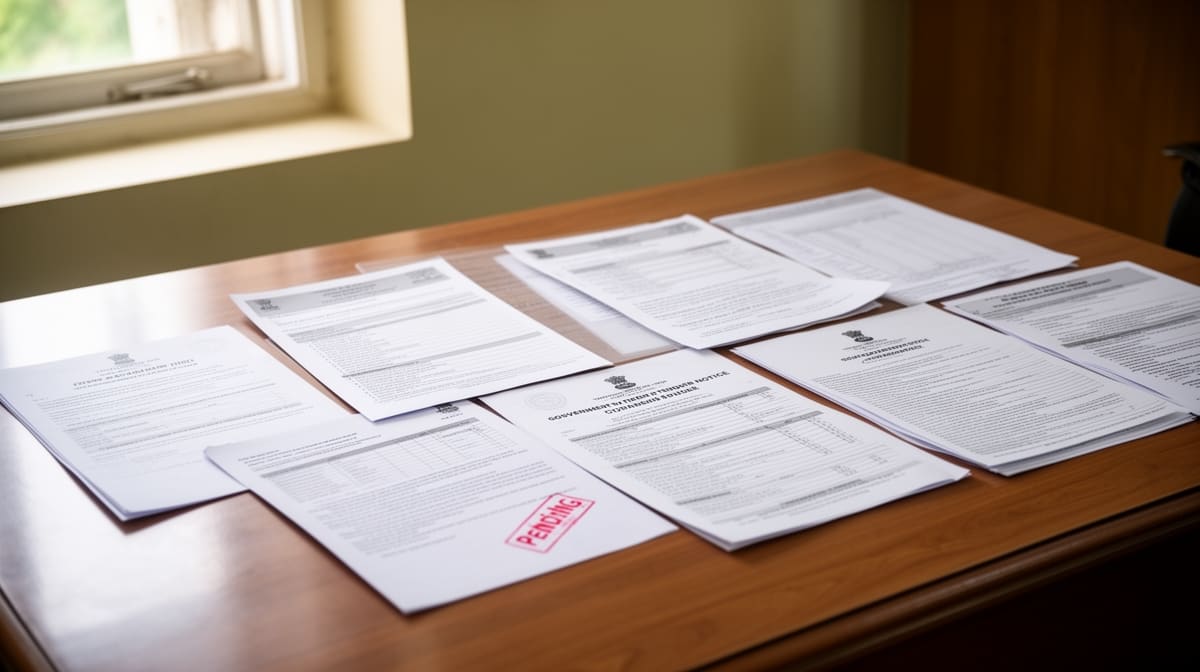
- Three notices were issued: dated 07.02.2026, 21.02.2026, and 23.03.2026 (Annexure-L).
- The final notice dated 23.03.2026 called upon the petitioner to appear before the Committee on 02.04.2026 and submit a written explanation.
Procedural History
- 01.10.2024: Tender floated by Respondent No. 5 via e-procurement.
- 17.08.2024: Letter of Acceptance issued to petitioner.
- Contract executed: Agreement signed between petitioner and Respondent No. 5.
- Completion approved: By Deputy Commissioner post-third-party inspection.
- Late 2025/early 2026: Petitioner lodged complaint with Karnataka Lokayukta against departmental official.
- 07.02.2026: First notice issued by Respondent No. 7.
- 21.02.2026: Second notice issued.
- 23.03.2026: Final notice (Annexure-L) issued, calling for appearance on 02.04.2026.
- 02.04.2026: Petitioner appeared through counsel; requested time to file written objections.
- 02.04.2026: Impugned order (Annexure-O) passed by Respondent No. 7 on the same day, without granting adjournment.
- 14.05.2026: Writ Petition No. 201906 of 2026 filed before Karnataka High Court, Kalaburagi Bench.
The Parties' Positions
Petitioner: Argued that the proceedings were retaliatory, initiated after he complained to Lokayukta. He contended that despite appearing through counsel and requesting time to file objections, the Committee denied him any opportunity to present his case. He emphasized that the order was passed without reasons, without application of mind, and in violation of Clause 24 of the Tender Document.
Respondents: Contended that two show cause notices were issued and the petitioner failed to reply. They argued that the Committee acted within its powers and that the petitioner’s non-response justified the blacklisting.
Relief Sought
The petitioner sought quashing of the impugned order dated 02.04.2026 (Annexure-O), setting aside the blacklisting, and directing a fresh proceeding in accordance with principles of natural justice.
The Legal Issue
The central question was whether an administrative body can impose a serious penalty like blacklisting without providing a meaningful opportunity of personal hearing, even when the notice invites a written reply and the party appears through counsel seeking time to file objections.
Arguments Presented
For the Petitioner
Learned counsel relied on the foundational principle of audi alteram partem and cited State of U.P. v. Mohammad Noor and Chairman, Railway Board v. Chandrima Das to argue that natural justice requires a fair hearing before adverse action. He emphasized that the petitioner appeared on the date of hearing, sought time to file written objections, and was summarily denied that opportunity. The Committee’s failure to assign reasons and the timing of the order - passed on the same day as the hearing - demonstrated mala fide and arbitrariness.
For the Respondent
The Additional Government Advocate contended that the petitioner had ample opportunity to respond to two prior notices and had not submitted any reply. He argued that the Committee was entitled to proceed ex parte and that the blacklisting was justified based on the complaint filed with Lokayukta, which allegedly indicated misconduct.
The Court's Analysis
The Court examined the sequence of events and found that the petitioner had not only received multiple notices but had also appeared before the Committee on the scheduled date with legal representation. Crucially, he requested time to file written objections - a reasonable and standard request in administrative proceedings. The Committee’s refusal to grant even a short adjournment, and its decision to pass the blacklisting order on the same day, constituted a clear breach of natural justice.
"The petitioner appeared through counsel and sought time to file objections. Despite this, the Committee passed the impugned order on the same day without granting any opportunity to put forth his case. This is a textbook violation of the principle of audi alteram partem."
The Court rejected the respondents’ argument that non-reply to prior notices justified the order, noting that the final notice explicitly called for appearance on 02.04.2026, thereby inviting a personal hearing. The Committee’s failure to consider the petitioner’s presence and request for time rendered the proceedings fundamentally flawed. The Court further observed that the blacklisting was initiated shortly after the Lokayukta complaint, raising a strong inference of retaliatory action.
The Court held that administrative penalties affecting livelihood and professional reputation demand the highest standard of procedural fairness. The absence of reasons in the order, the lack of application of mind, and the timing of the decision confirmed its arbitrariness.
The Verdict
The writ petition was allowed. The impugned order dated 02.04.2026 (Annexure-O) passed by the 7th Respondent Committee is quashed. The petitioner is granted liberty to submit a reply to the show cause notices within 15 days from today. The Committee is directed to provide a personal hearing to the petitioner and pass a fresh order within two months of receiving the reply. All contentions of the petitioner are kept open for consideration in the fresh proceedings.
What This Means For Similar Cases
Personal Hearing Cannot Be Denied Even If Written Reply Is Requested
- Practitioners must argue that when a notice invites personal appearance, the right to a hearing supersedes the expectation of a written reply.
- Denial of adjournment to file objections after appearing in person constitutes a violation of natural justice.
- Administrative bodies must record reasons for denying a request for time, especially in cases involving blacklisting.
Retaliatory Action Is a Ground for Judicial Scrutiny
- Blacklisting initiated shortly after a complaint to oversight bodies like Lokayukta invites suspicion of mala fide.
- Courts will examine the temporal proximity between protected conduct (e.g., whistleblowing) and adverse administrative action.
- Petitioners in similar cases should plead retaliatory motive as a standalone ground for quashing.
Blacklisting Requires Procedural Rigor
-
Blacklisting is a severe penalty affecting economic rights and professional reputation.
-
It cannot be imposed on the basis of unsubstantiated allegations or without a fair opportunity to defend.
-
Clause 24 of tender documents, if it mandates fair procedure, binds the authority even if not codified in statute.
-
Always demand a personal hearing in administrative blacklisting proceedings.
-
File written objections even if appearing in person - this preserves the record for judicial review.
-
Highlight any delay between notice and order as evidence of arbitrariness.
-
Cite this judgment to oppose ex parte blacklisting in any public procurement context.