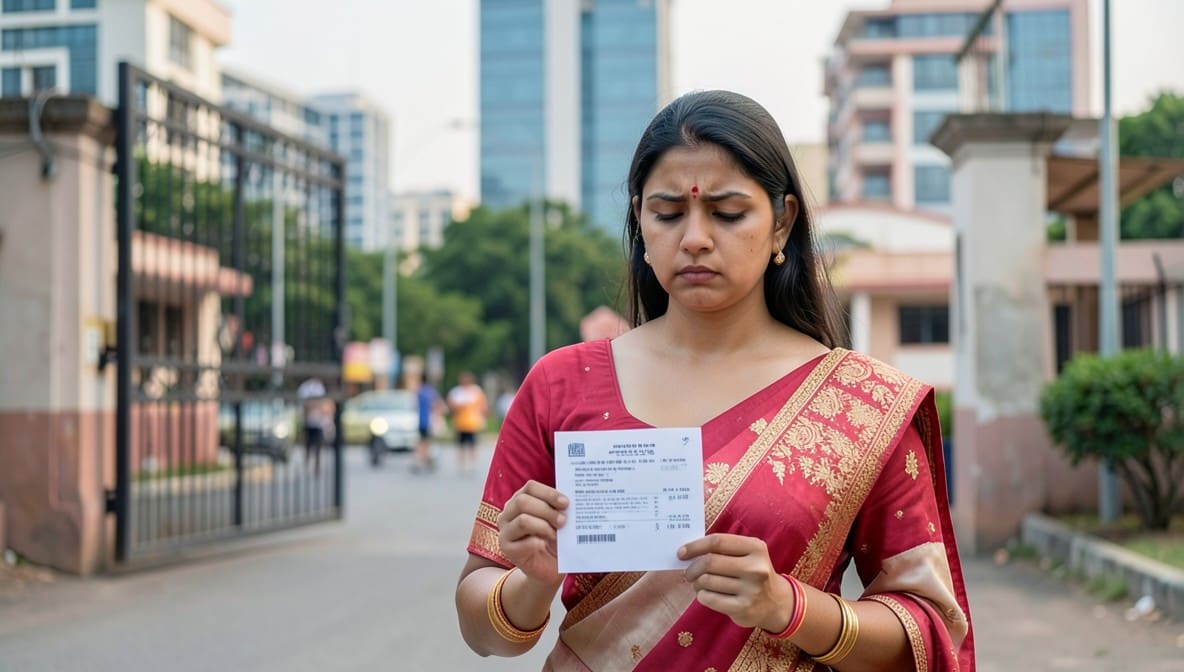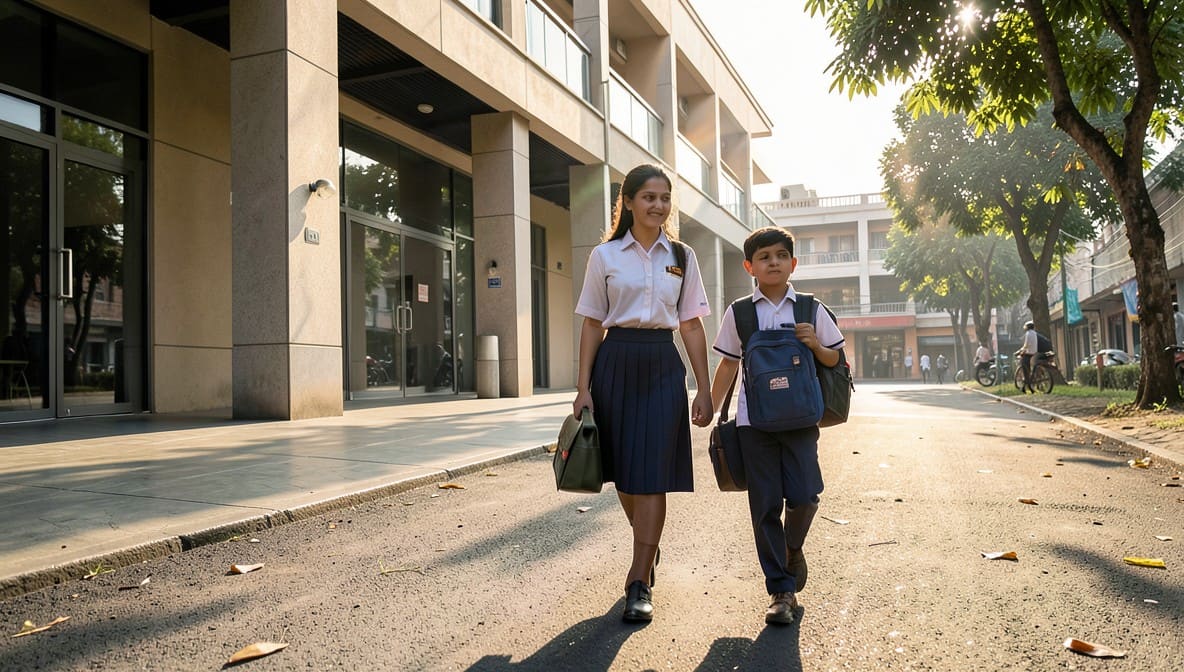
The Madhya Pradesh High Court has clarified that maintenance awards under Muslim personal law must account for the rising cost of education for minor children, particularly in urban settings. In a significant ruling, the Court enhanced monthly maintenance for two minor daughters to reflect their actual educational needs, reinforcing the principle that a husband’s obligation to provide for dependents cannot be diluted by claims of limited income.
Background & Facts
The Dispute
The dispute arose from a petition for maintenance filed by Shagufta Khan, wife of Sajid Khan, under the Family Courts Act, 1984. The marriage was solemnized on 10.11.2012 as per Muslim personal law. Two daughters were born during the marriage: the elder on 22.11.2013 and the younger on 15.08.2015. On 11.05.2017, the wife filed an application seeking maintenance of Rs.12,000 per month for herself and Rs.4,000 per month for each daughter, alleging that the husband had sufficient means and had neglected his familial obligations.
Key Facts
- The husband claimed he earned Rs.6,000 - 7,000 per month as a mechanic at Datar Motors.
- The wife claimed she earned Rs.20,000 per month through private tuition.
- The minor daughters are enrolled at Sacred Heart Co-Ed School, Mundla Nayata, By-pass Road, Indore.
- The wife submitted 62 documents (Ex.P-1 to P-62) and a compact disc (Article A-1) as evidence.
- The husband submitted two documents (Ex.D-1 to D-2) and testified as DW-1, supported by the owner of Datar Motors as DW-2.
- The trial court found no independent proof of the wife’s income and noted that the husband’s father, Naushad, owned an auto garage and had sufficient means to support the family.
Procedural History
- 11.05.2017: Maintenance application filed before the Family Court, Indore (MJCR No.470/2017).
- 30.07.2024: Family Court awarded Rs.5,000 per month to the wife and Rs.1,500 per month to each daughter (total Rs.8,000).
- 05.08.2024: Husband filed Criminal Revision No.492/2025 seeking reduction or setting aside of the order.
- 10.08.2024: Wife and daughters filed Criminal Revision No.4708/2024 seeking enhancement to Rs.20,000 for wife and Rs.10,000 each for daughters.
- 27.01.2026: Both revisions reserved for orders.
- 07.04.2026: Judgment pronounced by Justice Gajendra Singh.
The Parties' Positions
For the Husband (Petitioner in CRR 492/2025): Argued that his monthly income was only Rs.7,000 and that the wife was employed and earning Rs.20,000. He contended that his father’s financial capacity could not be imputed to him under the law.
For the Wife and Daughters (Petitioners in CRR 4708/2024): Argued that the maintenance award was inadequate to meet the children’s educational needs in Indore. They emphasized that the husband’s father owned a business and had a duty to support the family under Muslim personal law, especially since the husband’s income was insufficient.
Relief Sought
The wife sought enhancement of maintenance to Rs.20,000 per month for herself and Rs.10,000 per month for each daughter, effective from the date of application (11.05.2017). The husband sought reduction or setting aside of the maintenance order on grounds of insufficient income.
The Legal Issue
The central question was whether the Family Court’s maintenance award under Muslim personal law adequately accounted for the educational expenses of minor children in an urban setting, and whether the husband’s financial capacity could be assessed in light of his father’s means when the husband’s own income was demonstrably inadequate.
Arguments Presented
For the Appellant/Petitioner (Husband)
The husband contended that under Section 125 CrPC and Section 20 of the Family Courts Act, maintenance must be based solely on the petitioner’s own income. He cited Shabana Bano v. Imran Khan to argue that a husband’s obligation cannot be extended to his parents’ assets. He further claimed that the wife’s alleged income of Rs.20,000 was unverified and that the trial court erred in imputing his father’s financial capacity to him.
For the Respondent/State (Wife and Daughters)
The wife argued that the trial court correctly recognized the husband’s inability to meet the children’s educational needs and that the father’s ownership of a business indicated a family resource base. She relied on Mohd. Ahmed Khan v. Shah Bano Begum to assert that maintenance under Muslim law is a moral and legal obligation, not merely a statutory one. She emphasized that Article 51A(k) of the Constitution imposes a duty on parents to provide education, and that the award of Rs.8,000 was insufficient for three persons in Indore.
The Court's Analysis
The Court examined the trial court’s findings and noted that while the husband’s income was low, the wife’s claimed income of Rs.20,000 was not substantiated by any documentary evidence. The Court observed that the trial court had correctly declined to accept the husband’s claim that his father’s income could be directly attributed to him, but had also failed to appreciate the practical reality of raising two school-going children in a metropolitan city.
"Providing education to children is a fundamental duty as prescribed under Article 51A(k) of the Constitution of India. A husband must bear in mind that once he enters into marital life and incurs the responsibility of having children, he cannot evade his obligations on one ground or another."
The Court held that the maintenance amount of Rs.8,000 per month was manifestly inadequate. It noted that school fees, uniforms, books, transportation, and extracurricular activities in Indore routinely exceed Rs.15,000 per child annually. The Court emphasized that the object of maintenance is to prevent dependents from falling into destitution, and that the Family Court must adopt a realistic, not theoretical, approach.
The Court distinguished Shabana Bano by clarifying that while a father’s financial capacity cannot be directly imputed, the court must consider the family’s overall economic context when determining the husband’s capacity to pay. The Court found that the husband’s employment at a motor garage, coupled with his father’s ownership of an auto workshop, indicated a family unit with greater means than reflected in his salary alone.
The Verdict
The husband’s revision petition (CRR 492/2025) was dismissed. The wife’s revision petition (CRR 4708/2024) was partly allowed. The maintenance award was modified to Rs.7,500 per month for the wife and Rs.7,500 per month for each daughter, totaling Rs.22,500 per month. The enhanced amount is payable from the date of the original application, 11.05.2017. The order was directed to be communicated to the Family Court for compliance.
What This Means For Similar Cases
Educational Costs Are Non-Negotiable in Maintenance Calculations
- Practitioners must now submit detailed evidence of school fees, transportation, books, and extracurricular costs when seeking maintenance for school-going children.
- Courts are expected to take judicial notice of urban education costs, particularly in Tier-1 and Tier-2 cities.
- Maintenance awards below Rs.15,000 - 20,000 per month for two children in cities like Indore, Bhopal, or Jabalpur may now be deemed prima facie inadequate.
Imputation of Parental Means Is Contextual, Not Automatic
- While a father’s income cannot be directly attributed to the husband, the court may consider the family’s economic environment as a proxy for the husband’s capacity to pay.
- Evidence of family-owned businesses, property, or shared household expenses can be relevant to assess the husband’s standard of living and ability to contribute.
- The burden remains on the applicant to show that the husband’s income is insufficient to meet basic needs, but the court may infer greater means from the household context.
Muslim Personal Law and Constitutional Duties Are Interlinked
- Maintenance under Muslim law is no longer viewed as a purely religious obligation but as one intersecting with constitutional duties under Article 51A(k).
- Courts may now invoke constitutional principles to interpret personal law provisions more progressively.
- Lawyers should cite Shah Bano alongside Article 51A(k) to strengthen maintenance claims involving children’s education.