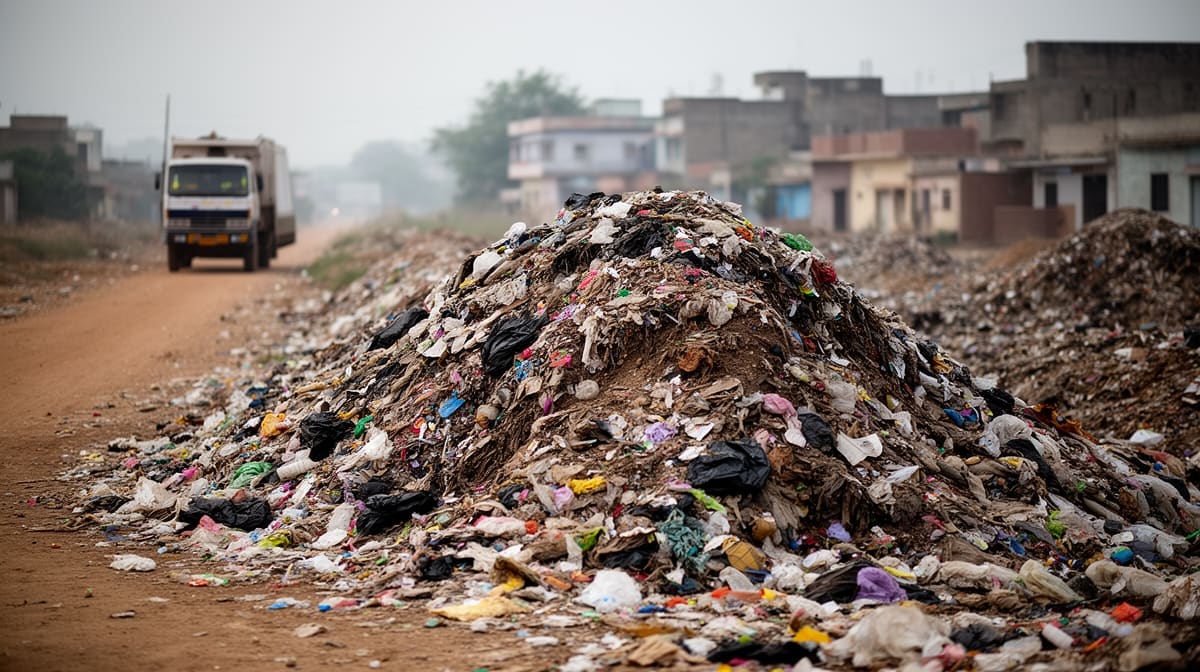
The National Green Tribunal has reaffirmed that municipal authorities cannot operate waste disposal sites in violation of the Solid Waste Management Rules, 2016. This order establishes that failure to segregate, collect, transport, or dispose of municipal solid waste according to prescribed standards constitutes a breach of statutory duty enforceable through environmental litigation.
Background & Facts
The Dispute
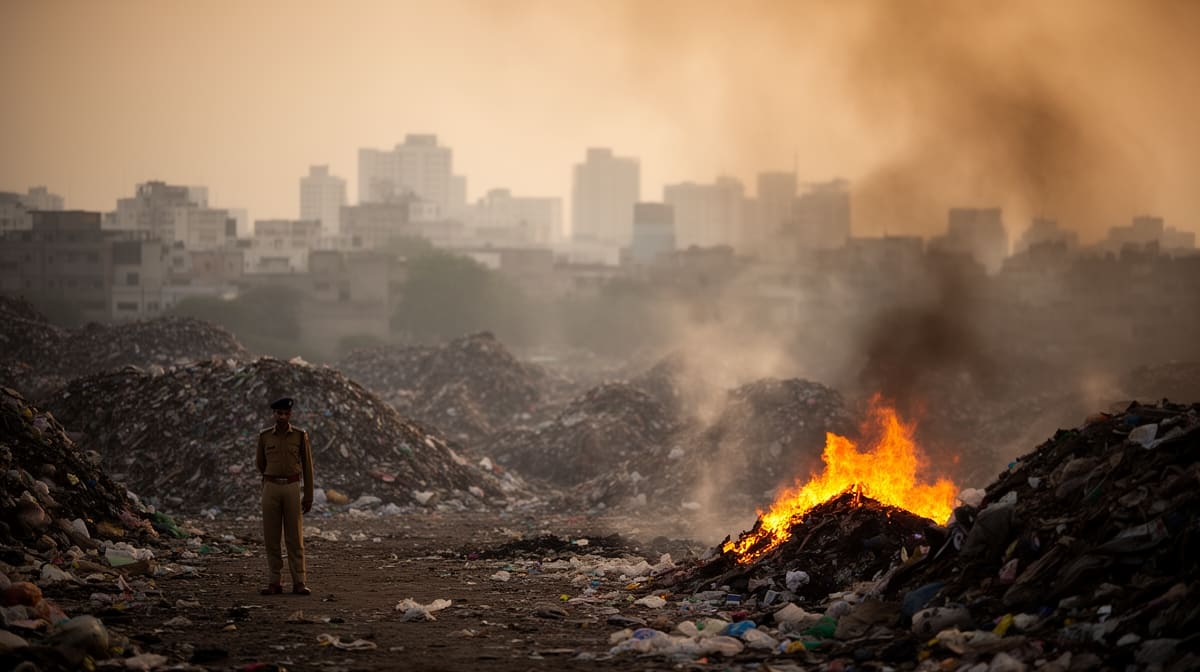
The applicant, Guddu Pathekar, alleged that the Nagar Palika Parishad in Multai, Betul District, has been using a 2.225-hectare plot - Khasra No. 957 - as an unregulated trenching ground for municipal solid waste since 1972-73. Despite daily generation of six tonnes of waste, the site lacks adequate disposal capacity, resulting in massive accumulation of legacy waste. The applicant further contended that the municipal authorities are not implementing mandatory segregation, transportation, or scientific disposal procedures as required under the Solid Waste Management Rules, 2016.
Procedural History
The matter was filed as an Original Application before the Central Zone Bench of the National Green Tribunal:
- Application filed: 2025
- Hearing date: 12 February 2026
- No prior adjudication on the specific site or violations
- No interim relief sought; applicant sought directive for compliance audit
Relief Sought
The applicant sought a direction to the Municipal Council to:
- Conduct a comprehensive audit of legacy and daily waste
- Submit a gap analysis between waste generation and disposal capacity
- Outline corrective actions to comply with the Solid Waste Management Rules, 2016
The Legal Issue
The central question was whether the Solid Waste Management Rules, 2016 impose enforceable obligations on municipal bodies to maintain scientific waste disposal sites, and whether failure to do so constitutes a violation actionable before the National Green Tribunal.
Arguments Presented
For the Petitioner
Ms. Sakshi Pawar, Advocate for the applicant, relied on Rule 4 and Rule 15 of the Solid Waste Management Rules, 2016, which mandate segregation at source, scientific landfilling, and prohibition of open dumping. She cited M.C. Mehta v. Union of India to argue that environmental degradation from unscientific waste disposal triggers the Tribunal’s jurisdiction under the National Green Tribunal Act, 2010. She emphasized that legacy waste accumulation constitutes ongoing harm, not a past violation.
For the Respondent
Mr. Prashant M. Harne, for the State, and other counsel for the Municipal Council and MPPCB, did not dispute the factual allegations. Instead, they requested time to file a detailed reply and submitted an Action Taken Report indicating preliminary steps had been initiated. No legal defense was mounted against the applicability of the Rules; the focus was on procedural timelines.
The Court's Analysis
The Tribunal held that the Solid Waste Management Rules, 2016 are not directory but mandatory, and their violation directly impacts public health and environmental integrity. The Court noted that the absence of segregation, scientific disposal, and capacity planning renders the site a de facto open dump, which is explicitly prohibited under Rule 15(1). The Tribunal rejected the notion that long-standing non-compliance could be excused by historical usage.
"The duty to manage municipal solid waste scientifically is not contingent upon budgetary allocations or administrative convenience. It is a statutory obligation arising from the very nature of urban governance."
The Court emphasized that the Tribunal’s jurisdiction under Section 14 of the NGT Act extends to enforcement of environmental laws, including rules framed under the Environment (Protection) Act, 1986. The failure to conduct a gap analysis or submit a remediation plan was deemed a continuing violation. The Tribunal found no merit in delaying compliance on procedural grounds, especially where public health is at stake.
The Verdict
The applicant succeeded. The National Green Tribunal directed the Municipal Council to submit a detailed report on legacy waste quantity, daily generation, disposal capacity, gap analysis, and corrective action plan within two weeks. The MPPCB’s Action Taken Report was accepted as a preliminary step but insufficient without a comprehensive compliance roadmap.
What This Means For Similar Cases
Municipal Waste Sites Are Not Exempt from Scientific Standards
- Practitioners must now treat any unscientific landfill or trenching site as a prima facie violation of Rule 15 of the Solid Waste Management Rules, 2016
- Legacy waste accumulation alone can sustain a petition before the NGT, even without evidence of recent dumping
- Municipal bodies cannot invoke historical usage to evade compliance
Compliance Audits Are Mandatory, Not Discretionary
- NGT will not accept vague assurances or partial reports
- Respondents must submit quantified data: daily generation, storage capacity, gap, and timeline for remediation
- Failure to file a compliant report within the stipulated time may trigger contempt proceedings
Environmental Enforcement Is Proactive, Not Reactive
- The Tribunal treats ongoing non-compliance as a continuing violation, not a one-time breach
- Petitioners need not prove immediate harm; the statutory breach itself is sufficient for relief
- NGOs and citizens may file applications under Section 19 of the NGT Act to compel audits in any municipality with visible waste mismanagement