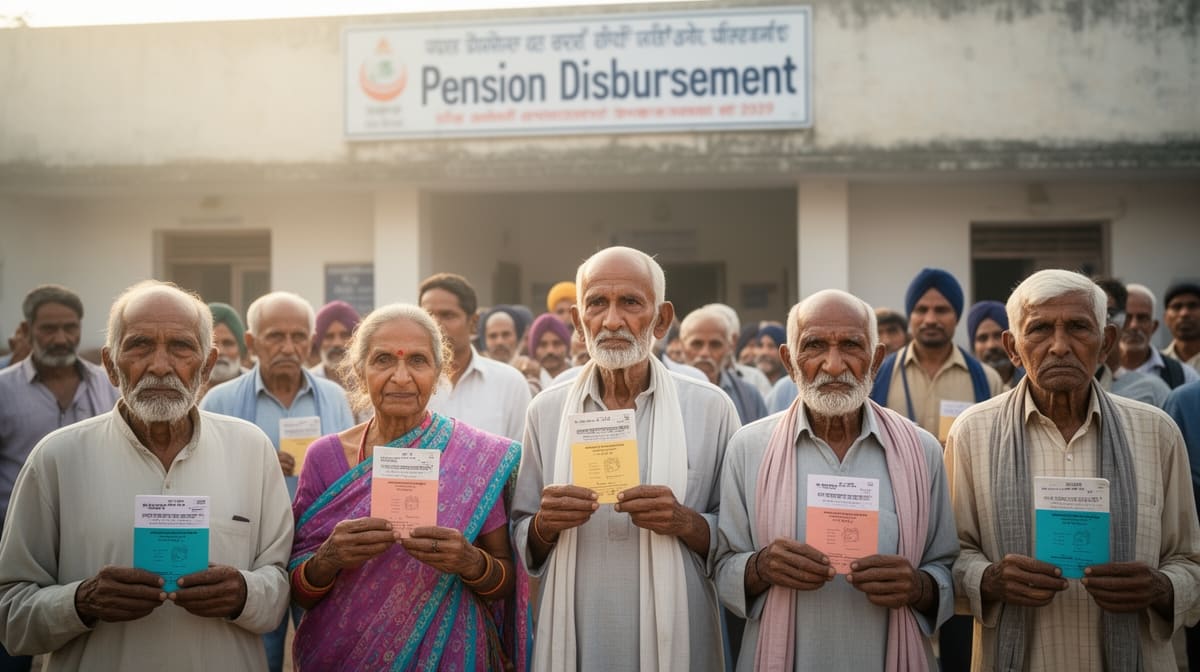
The Madhya Pradesh High Court has unequivocally affirmed that dearness allowance is an inseparable component of family pension for dependents of deceased government servants, rejecting any administrative discretion to withhold it. This ruling reinforces the principle that pensionary benefits are not mere gratuities but statutory entitlements rooted in social security obligations.
Background & Facts
The Dispute
Smt. Sashilata Jatav, the widow of a deceased government employee, was granted family pension following her husband’s demise. However, the State of Madhya Pradesh failed to include dearness allowance in the calculation of this pension, despite its mandatory inclusion under applicable service rules. The petitioner contended that this omission deprived her of a critical cost-of-living adjustment, effectively reducing the real value of her pension over time.
Procedural History
The petitioner initially approached the concerned administrative department for correction, but no action was taken. Faced with administrative inaction, she filed this writ petition under Article 226 of the Constitution seeking judicial intervention.
Relief Sought
The petitioner sought: (i) direction to grant dearness allowance on family pension; (ii) revision of the pension amount with retrospective effect from the date of entitlement; and (iii) payment of arrears with interest.
The Legal Issue
The central question was whether dearness allowance is a mandatory component of family pension payable to the dependents of deceased government servants, and whether its exclusion constitutes a violation of statutory and constitutional rights to equitable compensation.
Arguments Presented
For the Petitioner
The petitioner’s counsel, Ms. Puja Shukla, relied on the Central Civil Services (Pension) Rules, 1972, and subsequent amendments, which explicitly link dearness allowance to all pensionary payments, including family pension. She cited State of U.P. v. Raj Narain Singh to argue that pension is not a bounty but a right accrued through service, and that withholding dearness allowance amounts to discriminatory treatment of survivors.
For the Respondent/State
The Government Advocate, Shri Shiraz Qureshi, initially defended the non-payment on grounds of administrative oversight. However, during oral arguments, Shri Naveen Kumar Shakya, a senior official present in court, conceded that the petitioner was legally entitled to dearness allowance and acknowledged the error in non-payment.
The Court's Analysis
The Court examined the statutory framework governing pensions under the Central Civil Services (Pension) Rules and observed that dearness allowance is not an optional benefit but an integral part of the pension structure designed to mitigate inflationary erosion. The Court emphasized that family pension is a continuation of the deceased servant’s entitlement, and denying dearness allowance undermines the very purpose of pensionary protection.
"The purpose of dearness allowance is to preserve the real value of pensionary benefits. To deny it to family pensioners is to impose an unjustified hardship on those who have already suffered the loss of a breadwinner."
The Court rejected any notion that administrative delay or oversight could justify non-payment. It held that the State’s obligation is not merely procedural but substantive, and that failure to disburse dearness allowance constitutes a breach of the right to life and dignity under Article 21.
The Court further noted that the State official’s admission during hearing removed any factual dispute, leaving only the legal obligation to be enforced.
The Verdict
The petitioner succeeded. The Court held that dearness allowance is mandatory on family pension and directed the State to pay arrears from the date of entitlement, revise the pension accordingly, and impose 6% annual interest for delay. The entire exercise was mandated to be completed within three months.
What This Means For Similar Cases
Dearness Allowance Is Non-Discretionary
- Practitioners representing family pensioners must now treat non-payment of dearness allowance as a clear legal violation, not an administrative oversight
- Any delay in payment triggers automatic liability for interest under the Court’s precedent
- Administrative circulars attempting to limit or defer DA on family pensions are legally unsustainable
Retroactive Payment Is the Rule, Not the Exception
- Arrears must be calculated from the date the family pension was first sanctioned, not from the date of application or petition
- Courts will not accept "lapse of time" or "delay in filing" as grounds to deny arrears when the entitlement is statutory
- This ruling applies equally to state government employees, not just central ones, where similar rules exist
Judicial Enforcement of Pension Rights Is Absolute
- Writ petitions under Article 226 remain the most effective remedy for pensionary violations
- Presence of a conceding official during hearing can expedite relief and eliminate need for extensive evidence
- Interest at 6% per annum is now a standard remedy for delayed pensionary payments in service law matters