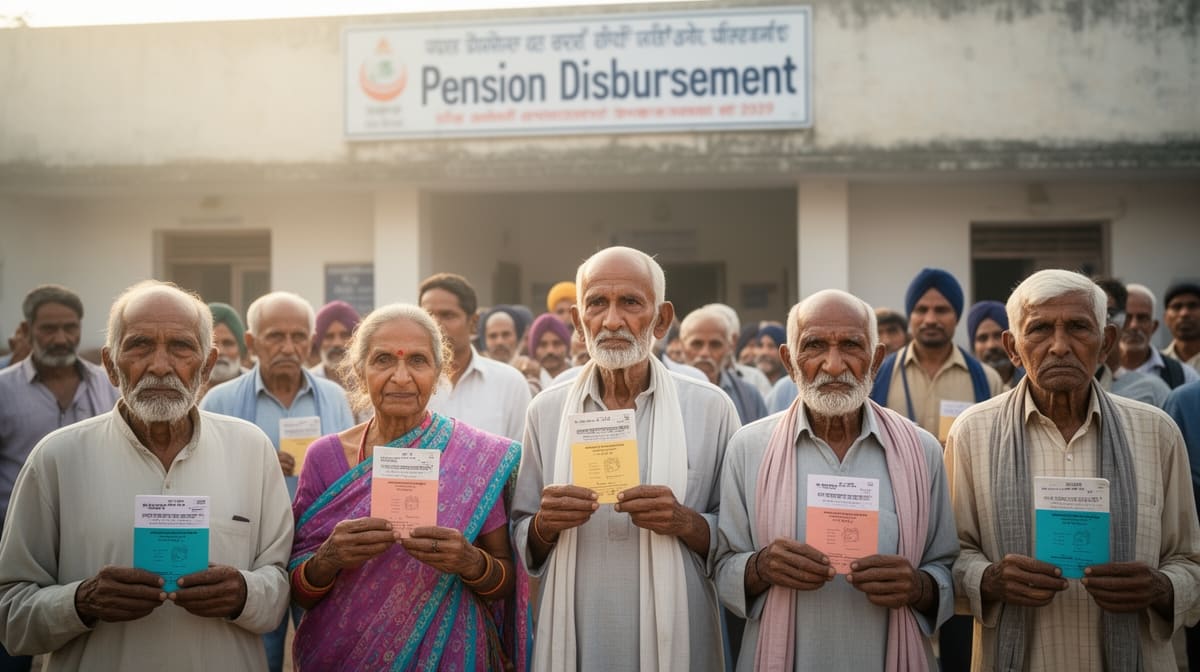
The Punjab and Haryana High Court has affirmed that Dearness Allowance (DA) is not a discretionary benefit but a legally enforceable constitutional right, and its delayed payment to pensioners constitutes a violation of the State’s duty to uphold social and economic justice. With over 35,000 pensioners having died while awaiting arrears, the Court issued a binding directive for immediate implementation of a Cabinet-approved payment plan, emphasizing that financial constraints cannot override statutory and constitutional obligations.
Background & Facts
The Dispute
The petitioners in these five connected writ petitions are retired employees of various State Boards and Corporations, including the Punjab State Power Corporation Limited (PSPCL). They seek payment of arrears of revised pension and Dearness Allowance (DA) w.e.f. 01.01.2016 to 30.06.2021, as recommended by the Sixth Punjab Pay Commission and notified under the Punjab Civil Services (Revised Pay) Rules, 2021. Despite the State Government accepting the recommendations and approving a payment schedule, no payments have been made to the vast majority of pensioners.
Key Facts
- The Sixth Punjab Pay Commission submitted its report on 30.05.2021.
- The Punjab Civil Services (Revised Pay) Rules, 2021, were notified on 05.07.2021, mandating revision of pension and DA w.e.f. 01.01.2016.
- The State Government issued a circular on 15.12.2016 (Annexure R-2) directing payment of DA arrears to pensioners above 75 and 80 years, following Mohinder Singh v. State of Punjab (25.07.2016).
- A Cabinet Sub-Committee was constituted on 19.08.2024 to examine DA and pension arrears.
- The Council of Ministers approved the payment schedule on 13.02.2025, detailing phased disbursement based on age and period of arrears.
- As of the judgment date, more than one year had passed since Cabinet approval, and over four years since the 2021 Rules were notified.
- Approximately 35,000 pensioners have died since 01.01.2016 without receiving revised benefits.
- The petitioners’ financial hardship is exacerbated by rising medical costs and inflation, with pensions failing to keep pace with the cost of living.
Procedural History
- 01.01.2016: Cut-off date for arrears of revised pension and DA.
- 30.05.2021: Sixth Pay Commission report submitted.
- 05.07.2021: Punjab Civil Services (Revised Pay) Rules, 2021, notified.
- 15.12.2016: Circular issued for DA arrears to elderly pensioners.
- 19.08.2024: Cabinet Sub-Committee constituted.
- 13.02.2025: Council of Ministers approved payment schedule.
- 03.04.2025: Finance Circular issued by PSPCL implementing the schedule.
- 2024 - 2025: Multiple writ petitions filed across different petitioners.
- 12.03.2026: Judgment delivered by the High Court.
The Parties' Positions
Petitioners: Argued that DA is a statutory and constitutional right, not a privilege. They cited Surinder Kumar Mehta v. State of Haryana, Parshotam Dass v. State of Punjab, and State of West Bengal v. Confederation of State Government Employees to establish that DA is a legally enforceable right. They emphasized that delay defeats the very purpose of DA and violates Articles 14, 21, and 43 of the Constitution.
Respondents: Submitted that a payment schedule was approved on 13.02.2025 and that implementation is being carried out in installments. They relied on the Finance Circular dated 03.04.2025 and argued that fiscal constraints necessitate phased payments.
Relief Sought
- Release of arrears of revised pension and DA w.e.f. 01.01.2016 to 30.06.2021.
- Payment of arrears of leave encashment.
- Interest on delayed payments.
- Directives to extend benefits to all similarly situated pensioners, whether or not they filed petitions.
The Legal Issue
Is the payment of Dearness Allowance arrears, once mandated by statutory rules and approved by the State Cabinet, a legally enforceable right that cannot be indefinitely deferred on grounds of financial constraints?
Arguments Presented
For the Petitioner
The petitioners relied on State of West Bengal v. Confederation of State Government Employees (2026 INSC 123), where the Supreme Court held that DA is a distinct Indian mechanism to counter inflation and is a legally enforceable right, not a discretionary grant. They argued that the State’s obligation arises from the 2021 Rules and the Cabinet’s approval, and that delay undermines the constitutional guarantee of dignity under Article 21. They further cited Mohinder Singh and Surinder Kumar Mehta to show that courts have consistently directed prompt payment of DA arrears with interest.
For the Respondent
The State contended that while the entitlement is recognized, implementation must be phased due to fiscal limitations. It pointed to the Cabinet-approved schedule and Finance Circular as evidence of good faith implementation. It argued that the Court should not interfere with the State’s fiscal planning and that the schedule, though delayed, is being followed.
The Court's Analysis
The Court rejected the State’s plea of financial constraints as legally untenable. It held that once a statutory framework and Cabinet decision establish a right, the State cannot evade its duty by citing budgetary limitations. The Court emphasized that DA is not a welfare concession but a compensatory mechanism to preserve real income against inflation, and its delayed payment defeats its very purpose.
"DA is inherently dynamic and must necessarily be linked to the All India Consumer Price Index (AICPI). While each State may assess its fiscal position, it cannot deviate from the statutory mechanism governing the calculation and payment of DA."
The Court further held that the Cabinet’s approval on 13.02.2025 created a binding obligation under the Rules of Business. Delay in implementation for over a year after approval amounted to a breach of public trust and violated the constitutional mandate of social and economic justice under the Preamble and Articles 14, 21, and 43.
The Court also invoked State of Uttar Pradesh v. Arvind Kumar Srivastava to hold that its judgment would operate as a judgment in rem, binding on all similarly situated pensioners, regardless of whether they had filed petitions. The Court stressed that service jurisprudence demands equal treatment of identically situated persons to prevent discrimination under Article 14.
The Verdict
The writ petitions are allowed. The State shall release all instalments due under the Cabinet-approved schedule up to 28.02.2025 on or before 30.04.2026, together with interest at 6% per annum on delayed payments. Arrears of leave encashment shall also be paid by April 2026. Any future default in payment under the schedule shall attract interest at 9% per annum until realization. The judgment extends to all eligible pensioners of the State, Boards, and Corporations, whether or not they are parties to the litigation. The Chief Secretary shall file a compliance affidavit within three months.
What This Means For Similar Cases
DA Is a Constitutional Right, Not a Discretionary Benefit
- Practitioners must now treat DA arrears as enforceable rights under Articles 14, 21, and 43, not as discretionary grants.
- Any delay in payment, even if structured in installments, must be justified by compelling public interest - not fiscal convenience.
- Financial constraints cannot override statutory or Cabinet-approved obligations.
Cabinet Decisions Are Legally Binding Once Approved
- Departments cannot delay implementation of Cabinet decisions indefinitely under the guise of administrative processing.
- The Rules of Business impose a statutory duty on Secretaries to act promptly upon Cabinet approval.
- Unexplained delays of more than one year after approval may now attract judicial intervention and contempt proceedings.
Judgment in Rem Extends Benefits to All Similarly Situated Pensioners
-
All pensioners, even those who did not file petitions, are entitled to the benefits of this judgment.
-
Authorities must proactively identify and pay all eligible pensioners without waiting for individual applications.
-
Failure to extend benefits to non-petitioners may constitute discrimination under Article 14 and invite contempt.
-
Practitioners representing pensioners should now file applications for compliance with this judgment in all State Boards and Corporations.
-
Legal notices should cite this judgment to compel immediate payment of DA arrears in pending cases.
-
The 9% interest rate for future defaults sets a new benchmark for enforcement in similar service matters.