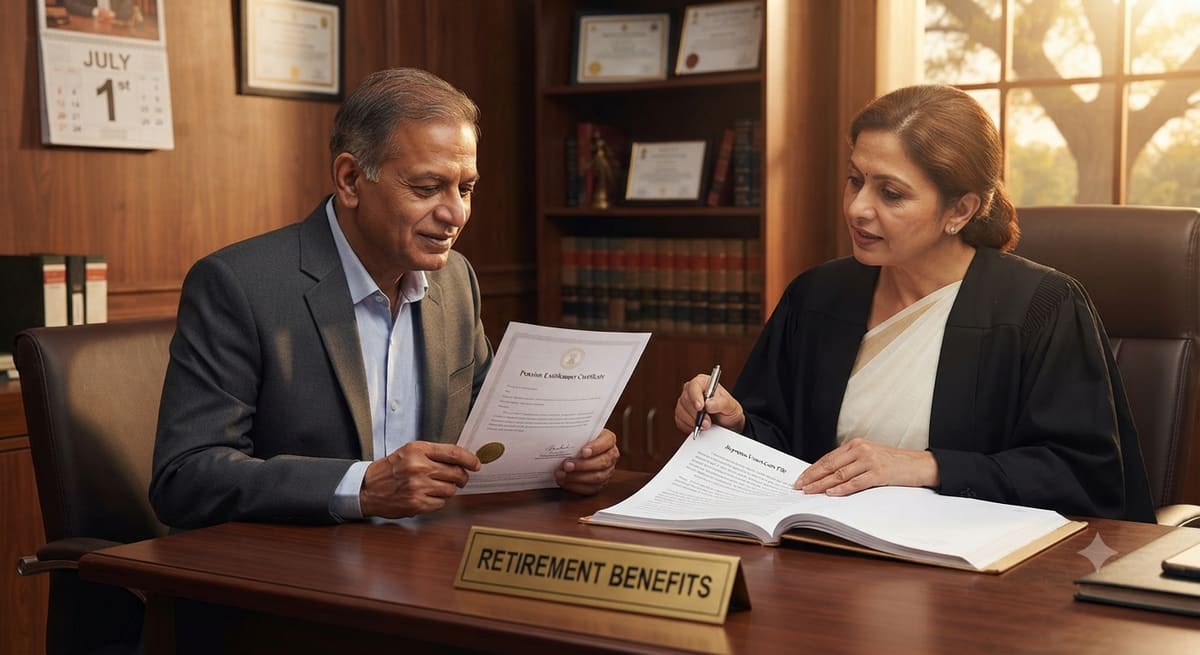
The Madhya Pradesh High Court has clarified that the entitlement to an annual increment for a government servant crystallizes upon completion of a full year of service with good conduct, even if the employee has superannuated. This ruling affirms the financial rights of retired employees and sets a binding precedent on the timing and computation of increments due post-retirement.
Background & Facts
The Dispute
The petitioner, Ram Lautan Pandey, was a government servant who superannuated from service on 30.06.2010. He claimed that he was entitled to an annual increment that became due on 01.07.2010, the day immediately following his retirement, as he had rendered a full year of service with good conduct up to his retirement date. Despite repeated representations, the State of Madhya Pradesh refused to grant the increment or its arrears, contending that no increment is payable after retirement.
Key Facts
- The petitioner was employed in the service of the State of Madhya Pradesh and completed 30 years of service
- He superannuated on 30.06.2010, his official date of retirement
- His last pay scale was in effect as per the 6th Pay Commission
- He had no disciplinary proceedings pending against him at the time of retirement
- He submitted representations on 15.08.2010 and 10.03.2012 seeking the increment, both of which remained unaddressed
- The petitioner filed the present writ petition on 12.05.2026, seeking the grant of annual increment from 01.07.2010 and consequential arrears
Procedural History
- 30.06.2010: Petitioner superannuated from service
- 15.08.2010: First representation made to the Department for grant of increment
- 10.03.2012: Second representation submitted, no response received
- 12.05.2026: Writ Petition No. 21493 of 2026 filed before the High Court of Madhya Pradesh at Jabalpur
- 23.06.2026: Hearing concluded before Justice Vivek Kumar Singh
Relief Sought
The petitioner sought:
- Declaration that he is entitled to annual increment due on 01.07.2010
- Payment of arrears of increment from 01.07.2010 till date of payment
- Interest at 9% per annum on arrears
- All consequential benefits including pension revision
The Legal Issue
The central question was whether a government servant who superannuates on 30th June is entitled to an annual increment that becomes due on 1st July of the same year, and if so, whether such entitlement is extinguished by retirement.
Arguments Presented
For the Petitioner
The petitioner relied on the Supreme Court judgment in Director (ADMN) and HR KPTCL v. C.P. Mundinamani, 2023 SCC OnLine SC 401, which held that the right to annual increment crystallizes upon completion of one year of qualifying service with good conduct, and becomes payable on the next day, irrespective of whether the employee is still in service. He argued that retirement does not extinguish a right that has already crystallized. He further cited the Finance Department Circular dated 15.03.2024, which mandates payment of increments to employees retiring on 30th June or 31st December.
For the Respondent/State
The learned Deputy Advocate General conceded that the Supreme Court’s judgment in C.P. Mundinamani is binding but argued that the petitioner’s delay in approaching the Court - 16 years since superannuation - renders him ineligible for full arrears. He submitted that the Circular dated 15.03.2024 applies prospectively and cannot be applied retrospectively to claims filed after such a long delay.
The Court's Analysis
The Court examined the judgment in Director (ADMN) and HR KPTCL v. C.P. Mundinamani and held that the entitlement to annual increment is not contingent on continued service beyond the date it crystallizes. The Court observed:
"The right to annual increment crystallises when the Government servant completes a requisite length of service with good conduct and becomes payable on the succeeding day."
It further noted that the petitioner had rendered a full year of service with good conduct up to 30.06.2010, thereby satisfying the conditions for increment crystallization. The Court held that the increment due on 01.07.2010 was a vested right and could not be denied merely because the employee retired on the preceding day.
However, the Court also considered the delay in filing the petition. It referred to Rushibhai Jagdishchandra Pathak vs. Bhavnagar Municipal Corporation, 2022 SCC online SC 641, which permits courts to restrict arrears to a period of three years preceding the filing of the petition in cases of undue delay. The Court found that the petitioner’s delay of over 15 years was unreasonable and could not be condoned in full. It therefore applied the principle of equitable limitation.
The Verdict
The petition was allowed. The Court directed the State to grant the annual increment due on 01.07.2010 with all consequential benefits, including revision of pension. The arrears of increment shall be calculated for the three years immediately preceding the filing of the petition, i.e., from 01.07.2023 to 30.06.2026. The State shall pay the amount with interest at 7% per annum from the date each increment became due, within six weeks. All other claims for arrears prior to 01.07.2023 are barred due to delay.
What This Means For Similar Cases
Increment Rights Survive Retirement
- Practitioners must now argue that annual increments crystallize on the completion of qualifying service, not on the date of actual payment
- Retirement does not extinguish a vested increment right that has already crystallized
- This applies to all government servants under CCS (Pension) Rules and similar service regulations
Delay Bars Full Arrears - Three-Year Limit Applies
-
Claims for arrears beyond three years prior to filing will be rejected unless exceptional circumstances are shown
-
The Rushibhai Pathak principle now governs increment-related delays in service litigation
-
Petitioners must file claims within a reasonable time - ideally within one year of denial - to avoid partial forfeiture
-
Always cite Director (ADMN) and HR KPTCL v. C.P. Mundinamani to establish crystallization
-
Always check the Finance Department’s circulars for department-specific directives
-
Always calculate arrears strictly from three years before petition filing, not from date of superannuation