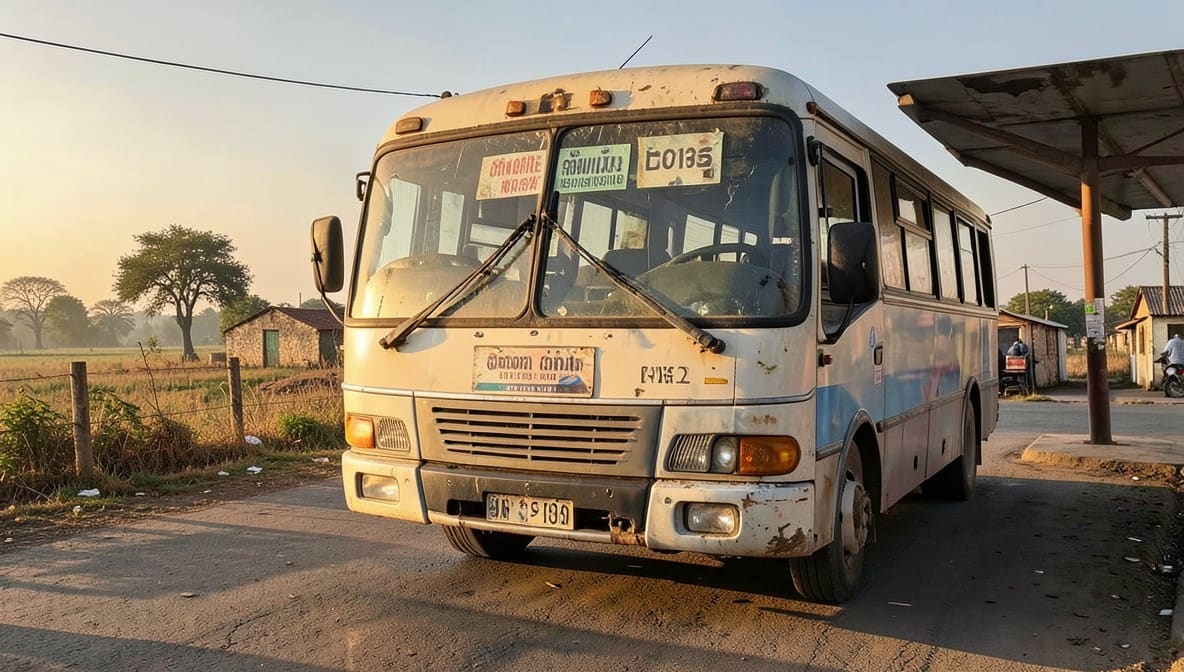
A transport permit under the Motor Vehicles Act is not a mere administrative convenience but a proprietary right capable of inheritance. The Madras High Court has clarified that the death of a permit holder does not ipso facto extinguish the permit, and denial of renewal solely on procedural grounds - without regard to pending succession disputes - violates fundamental principles of property law. This judgment provides critical clarity for families navigating inheritance of commercial transport assets amid protracted civil litigation.
Background & Facts
The Dispute
The dispute centers on the renewal and transfer of a stage carriage permit for a bus (TN-41/R-8343) operating on the route Pollachi to Dharapuram with independent shuttle trips to Coimbatore. The original permit holder, G. Selvaraj, died during the pendency of a partition suit involving multiple legal heirs. Both his son (the petitioner) and another heir, G. Vijayakumar (the second respondent), applied for renewal of the permit and for its transfer into their names. The Regional Transport Authority (RTA) rejected both applications, citing unresolved ownership disputes and failure to apply for transfer within three months of the permit holder’s death. The State Transport Appellate Tribunal (STAT) upheld this rejection, holding that the permit expired upon the permit holder’s death in 2018 due to non-application within the stipulated period.
Key Facts
- The permit was valid from 16.03.2016 to 15.03.2021.
- Applications for renewal were filed by both parties in February 2021, well before the expiry date.
- The deceased permit holder, G. Selvaraj, died prior to the expiry of the permit.
- A partition suit (A.S. Nos. 1046 and 1075 of 2012) was pending before the Madras High Court, seeking division of the bus and its permit among legal heirs.
- A preliminary decree dated 2012 granted the second respondent, G. Vijayakumar, a 1/7th share in the bus and permit.
- The remaining 6/7th share was vested in the deceased permit holder and his other legal heirs.
- The deceased permit holder had executed a will bequeathing his interest in the permit to the petitioner.
- No final decree had been passed in the partition suit as of the date of judgment.
- The second respondent did not file a separate appeal against the RTA’s rejection of his renewal application.
Procedural History
- 2012: Partition suit filed; preliminary decree passed granting 1/7th share to G. Vijayakumar.
- 15.03.2021: Permit expired.
- February 2021: Both parties filed applications for renewal of permit.
- 24.03.2021: RTA, Pollachi, rejected renewal applications citing unresolved ownership and delay in transfer application.
- 10.12.2021: STAT, Chennai, upheld rejection, holding permit expired upon death and could not be renewed after three months.
- 2021: Civil Revision Petition (CRP No. 3029 of 2021) filed under Article 227 challenging STAT’s order.
- 2019: Writ Petition No. 16648 of 2019 filed by petitioner seeking transfer of permit under Article 226.
- 2019: Writ Petition No. 19015 of 2019 filed by G. Vijayakumar seeking quashing of RTA’s order.
- 06.04.2022: G. Parvathy Kutty, widow of deceased, brought on record as legal representative in CRP No. 3029 of 2021.
- 08.04.2022: G. Parvathy Kutty substituted as legal representative in WP No. 16648 of 2019.
- 07.04.2026: Legal representatives of deceased G. Selvaraj formally substituted in WP No. 19015 of 2019.
- 30.04.2026: Judgment delivered by Justice K. Kumaresan Babu.
The Parties' Positions
Petitioner (G. Parvathy Kutty, as LRs of G. Selvaraj): Argued that the permit is a property right, not a personal privilege, and that its renewal cannot be denied merely because of delay in transfer application when succession is under judicial determination. Relied on the preliminary decree and the will to establish lawful claim.
Respondent (G. Vijayakumar): Contended that the permit expired upon the death of the holder and that no valid application was made within the mandatory three-month window under the rules. Sought quashing of the renewal application filed by the petitioner.
Respondent (RTA & STAT): Maintained that procedural compliance under the Motor Vehicles Act and Rules was mandatory and that failure to apply for transfer within three months of death rendered the permit void.
Relief Sought
- Set aside the order of STAT dated 10.12.2021.
- Direct the RTA to renew the permit in the name of the petitioner.
- Allow continuation of bus operations pending final adjudication of the partition suit.
- Quash the RTA’s order dated 24.03.2021.
The Legal Issue
Can a transport permit be denied renewal solely on the ground that no application for transfer was filed within three months of the permit holder’s death, when the ownership of the permit is the subject of a pending partition suit and a preliminary decree has already allocated a share to one of the heirs?
Arguments Presented
For the Appellant/Petitioner
The petitioner’s counsel, Mr. M. Krishnappan, Senior Counsel, argued that a transport permit is a proprietary asset, akin to movable property, and is inheritable under the general law of succession. Citing State of U.P. v. Rameshwar Prasad and K. Srinivasan v. State of Tamil Nadu, he emphasized that permits are not personal privileges but economic rights protected under Article 19(1)(g) of the Constitution. He contended that the three-month rule under Rule 11 of the Tamil Nadu Motor Vehicles Rules applies only where there is no dispute over succession. Where litigation is pending, the authority must preserve the status quo and allow renewal subject to final adjudication. The will executed by the deceased and the preliminary decree established a prima facie title in the petitioner’s favor.
For the Respondent/State
The Government Advocate, Mr. M. Murali, argued that the Motor Vehicles Act and Rules are mandatory and procedural compliance is non-negotiable. He relied on Rule 11 of the Tamil Nadu Motor Vehicles Rules, which requires an application for transfer of permit to be filed within three months of the death of the permit holder. Failure to comply, he submitted, results in automatic expiry of the permit. He further argued that the pending partition suit does not override statutory timelines and that the RTA acted within its powers by rejecting applications lacking procedural compliance.
The Court's Analysis
The Court undertook a detailed examination of the nature of a transport permit under the Motor Vehicles Act and its relationship with property law. It observed that while permits are granted by the state, they confer a valuable economic right that can be bought, sold, inherited, and mortgaged. The Court rejected the notion that a permit ceases to exist upon the death of the holder, stating:
"The finding of the Tribunal that the permit dies on the death of the permit holder, as no application had been filed for transfer within the required time, is wholly erroneous, and on that ground, the entire order is liable to be set aside."
The Court distinguished between the administrative process of transfer and the substantive right of inheritance. It held that the three-month rule is procedural and cannot override the substantive rights of heirs where succession is under judicial determination. The existence of a preliminary decree granting a 1/7th share to the second respondent confirmed that ownership was not in dispute but under adjudication. The Court emphasized that the RTA’s duty was to preserve the status quo and facilitate renewal pending final decree, not to extinguish rights on technical grounds.
The Court further noted that the second respondent had not challenged the RTA’s rejection of his own renewal application, thereby waiving any independent claim. The petitioner alone had pursued the remedy, and therefore, the renewal must be granted to him, subject to the outcome of the pending partition suits.
The Verdict
The Civil Revision Petition was allowed. The order of the State Transport Appellate Tribunal dated 10.12.2021 and the RTA’s order dated 24.03.2021 were set aside. The Regional Transport Authority, Pollachi, was directed to renew the permit in the name of the petitioner, G. Parvathy Kutty, as legal representative of G. Selvaraj. The petitioner is permitted to continue operating the bus immediately upon production of the web copy of this order, without waiting for the certified copy. The writ petition in WP No. 16648 of 2019 was allowed, and WP No. 19015 of 2019 was dismissed, subject to the final outcome of A.S. Nos. 1046 and 1075 of 2012. No costs were awarded.
What This Means For Similar Cases
Permit Renewal Cannot Be Denied on Technical Grounds During Succession Litigation
- Practitioners must now argue that statutory timelines for permit transfer are subordinate to substantive property rights when succession is under judicial review.
- RTAs and STATs must suspend denial of renewal if a preliminary decree or will establishes a prima facie claim by an heir.
- Applications for renewal filed during pendency of partition suits must be treated as provisional, pending final adjudication.
Preliminary Decrees Create Enforceable Interests in Permits
- A preliminary decree allocating a share in a permit constitutes a legally recognized interest, even before final decree.
- Authorities cannot ignore such decrees and must recognize the heir’s right to seek renewal of the permit in proportion to the allocated share.
- Legal heirs may apply for renewal jointly or individually, depending on the nature of the decree.
Procedural Compliance Must Yield to Substantive Justice
- The Motor Vehicles Act’s procedural rules are not absolute; they must be interpreted in light of constitutional rights to property and livelihood.
- Courts will now scrutinize whether denial of renewal was based on rigid adherence to rules or genuine public interest.
- Practitioners should file applications for interim relief to continue operations while litigation is pending, as permitted by this judgment.