
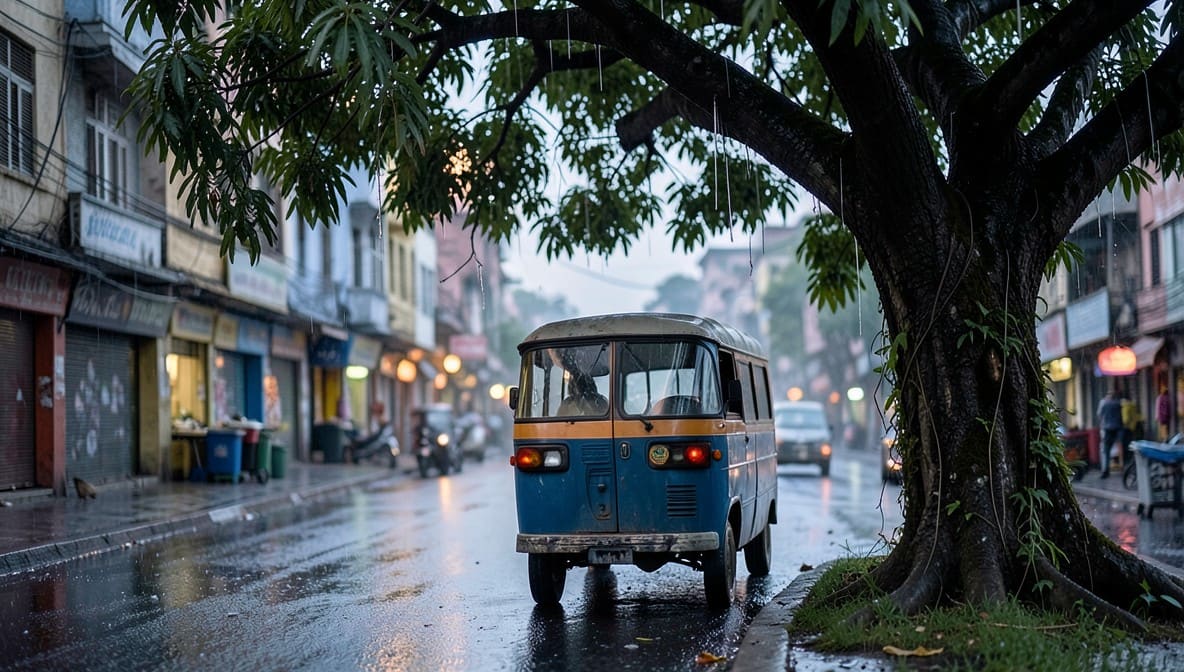
The Supreme Court has clarified that an injury caused by a falling tree branch while a vehicle is stationary does not qualify as an accident arising out of the 'use of a motor vehicle' under the Motor Vehicles Act, 1988. However, invoking its extraordinary powers under Article 142, the Court enhanced compensation to ensure justice for a victim left with permanent paraplegia.
Background & Facts
The Dispute
On 23rd June 2007, respondent no.1 was travelling in an autorickshaw from Queens Road to Chinnaswamy Stadium in Bangalore when heavy rainfall forced the driver to stop under a roadside tree for shelter. While the vehicle was stationary, a branch of an old tree detached and fell on the autorickshaw, causing grievous injuries to respondent no.1. He was admitted to Mallya Hospital and diagnosed with total paraplegia in both lower limbs, along with bladder and bowel incontinence, due to a spinal fracture.
Key Facts
- The autorickshaw was stationary at the time of the incident, having been pulled over due to heavy rain
- The tree was a century-old specimen located along a public road
- The branch that fell was not visibly decayed or structurally compromised at the time of the incident
- No prior complaints or notices had been lodged with the Bruhat Bengaluru Mahanagara Palike (BBMP) regarding the tree’s condition
- The respondent filed a claim petition on 10th April 2013 seeking Rs.50 lakhs in compensation
Procedural History
- 23.06.2007: Incident occurred - branch fell on stationary autorickshaw
- 10.04.2013: Motor Accidents Claim Tribunal, Bangalore dismissed the claim, holding it was an Act of God
- 2015: High Court of Karnataka dismissed the appeal on grounds of delay in filing
- 2017: Supreme Court granted special leave and remanded the matter for reconsideration on the issue of condonation of delay
- 2021: High Court allowed the appeal and awarded Rs.17,10,500/- with liability apportioned as follows: 25% to BBMP, 50% to the autorickshaw insurer, and 25% to the Horticulture Department, Government of Karnataka
- 2026: Appeal filed before the Supreme Court challenging BBMP’s liability
Relief Sought
The appellant, BBMP, sought to be absolved of liability under the Motor Vehicles Act, 1988. The respondent sought full compensation of Rs.50 lakhs, or at minimum, the apportioned amount with enhanced interest and timely payment.
The Legal Issue
The central question was whether the injury caused by the falling of a roadside tree on a stationary motor vehicle qualifies as an accident "arising out of the use of a motor vehicle" under Section 166 of the Motor Vehicles Act, 1988, thereby making the Municipal Corporation liable under the Act.
Arguments Presented
For the Appellant
The appellant, BBMP, contended that the incident was a classic case of vis major or Act of God - an unforeseeable, irresistible natural event beyond human control. Relying on Rajkot Municipal Corpn. v. Manjulben Jayantilal Nakum and Nichols v. Marsland, it argued that municipal authorities cannot be held liable for the natural decay of trees unless there was prior negligence or knowledge of a latent danger. It further submitted that the vehicle was not in active use at the time of the incident and thus could not trigger liability under Section 166.
For the Respondent
The respondents argued that the tree was under the control and maintenance of the Municipal Corporation, and its failure to conduct periodic inspections amounted to negligence. They relied on S. Vedantacharya v. Highways Deptt. to assert that public authorities have a duty to maintain infrastructure, including roadside vegetation, to prevent foreseeable harm. They also contended that the vehicle’s use extended to periods of temporary stoppage, as held in Shivaji Dayanu Patil v. Vatschala Uttam More.
The Court's Analysis
The Court undertook a two-pronged analysis: first, whether the incident fell within the ambit of the Motor Vehicles Act; and second, whether justice required compensation despite the absence of statutory liability.
On the first point, the Court examined the scope of the phrase "arising out of the use of a motor vehicle" under Section 165(1). It reaffirmed the liberal interpretation from Shivaji Dayanu Patil, which held that "use" includes periods when the vehicle is stationary due to weather or mechanical issues. However, the Court drew a critical distinction: while the vehicle’s use may extend to temporary halts, the accident must still have a causal nexus with the vehicle’s operation. Here, the vehicle played no role in causing the branch to fall. The injury resulted entirely from a natural event - the detachment of a tree branch - unrelated to the vehicle’s movement, control, or function.
"The motor vehicle itself does not play an active role in the accident. It is not part of the proximate cause of the accident."
The Court further noted that if the respondent had been a pedestrian standing under the same tree, no claim under the Motor Vehicles Act would lie. Extending liability to the Municipal Corporation under the MVA would blur statutory boundaries and impose obligations beyond the Act’s intended scope.
The Court acknowledged the Municipal Corporation’s duty under municipal law to maintain public trees, but held that this duty does not convert a natural calamity into a motor accident under the MVA. The doctrine of Act of God, as defined in Vohra Sadikbhai Rajakbhai v. State of Gujarat, applies where the event is extraordinary and unpreventable despite due care - a condition met here.
However, the Court emphasized that the victim’s condition - total paraplegia with lifelong dependency - demanded a humane response. The High Court’s award of Rs.17,10,500/- was deemed insufficient under settled principles of compensation for catastrophic injury. Invoking Article 142, the Court exercised its plenary power to do complete justice.
The Verdict
The appeal was dismissed in part. The Supreme Court held that the appellant, BBMP, is not liable under the Motor Vehicles Act, 1988 for the injury caused by the falling tree. However, the Court enhanced the total compensation to Rs.25,00,000/-, with interest at the rate determined by the High Court, calculated from the date of filing of the claim petition. The apportionment of liability - 25% to BBMP, 50% to the insurer, and 25% to the Horticulture Department - remains unchanged. The entire amount, including interest, must be deposited into the respondent’s bank account within four weeks of the judgment. No costs are awarded.
What This Means For Similar Cases
Liability Under MVA Requires Proximate Causal Link to Vehicle Use
- Practitioners must now establish that the injury has a direct, functional connection to the operation, movement, or control of the motor vehicle
- Incidents caused by external natural forces - falling trees, lightning, landslides - while a vehicle is stationary, will not attract MVA liability unless the vehicle itself contributed to the risk
- Claims under the MVA cannot be converted into general tort claims against municipalities merely because a vehicle was present
Article 142 as a Tool for Equitable Relief in Catastrophic Cases
-
Even where statutory liability is absent, the Supreme Court may invoke Article 142 to ensure justice for victims of life-altering injuries
-
Compensation amounts must reflect the severity of injury, not merely procedural apportionments
-
Courts should not allow technicalities to defeat substantive justice in cases involving permanent disability
-
In future claims involving natural events and stationary vehicles, counsel should consider filing parallel claims under tort law or the Consumer Protection Act, if applicable, to preserve avenues for redress
-
Municipal authorities must maintain records of tree inspections and maintenance to defend against non-MVA tort claims, even if MVA liability is excluded





