The Karnataka High Court has clarified that compensation awarded under the Motor Vehicles Act for grievous injuries must be itemized under specific heads, rejecting the practice of granting global sums that obscure the true extent of loss. This judgment establishes a doctrinal shift in how tribunals must assess damages in personal injury claims, ensuring that claimants receive fair, transparent, and quantified relief.
Background & Facts
The Dispute
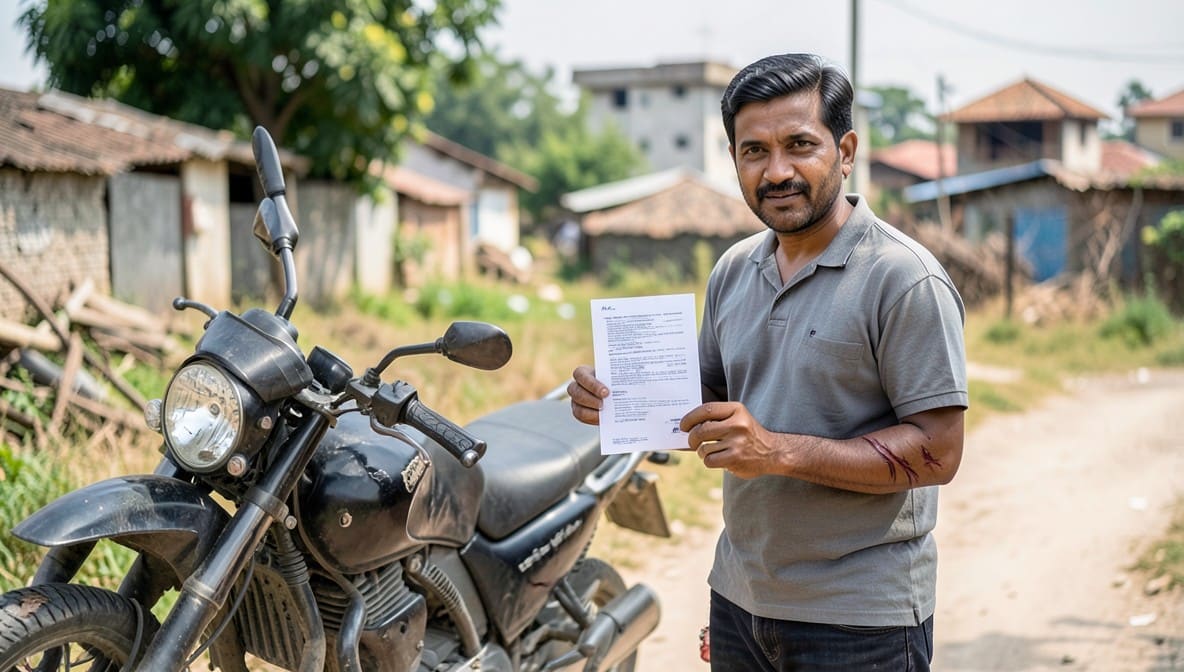
The appellant, Shri Piraji S/o Bhavaku Vetal, a 33-year-old mason from Kallehol, Belagavi, was involved in a road accident on 07.05.2014 at approximately 03:30 p.m. while riding his motorcycle bearing registration number KA-22/Y-2023 on the Belagavi-Kallehol road. The driver of a car bearing registration number KA-22/N-5799, owned by respondent no.1, Yallappa Dattu Kamble, allegedly drove in a rash and negligent manner and collided with the appellant’s motorcycle. The appellant sustained severe injuries and was admitted to BIMS Hospital, Belagavi, for inpatient treatment.
Key Facts
- The accident occurred on 07.05.2014 at approximately 03:30 p.m.
- The appellant was the sole rider of the motorcycle; a pillion rider also sustained injuries and filed a separate claim, which was clubbed with this petition.
- The owner of the vehicle (respondent no.1) did not appear before the Tribunal despite service of notice and was placed ex-parte.
- The insurer (respondent no.2), HDFC Ergo General Insurance Company Limited, contested the claim on all grounds.
- The appellant submitted medical records including:
- Discharge summary
- OPD slips
- Wound certificate
- X-ray reports
- Disability certificate
- Photographs of injuries
- Medical bills totaling ₹3,500/-
- The wound certificate recorded two lacerated wounds on the right leg: one measuring 10 x 5 cm and another 6 x 5 cm.
- The appellant was hospitalized for 36 days.
- Dr. Satish D. Patil, PW-4, issued a disability certificate assessing 20% permanent disability to the right lower limb.
- The insurer did not lead any oral evidence but marked the insurance policy as Exhibit R1.
- Exhibits P1 to P51 were marked by the claimant.
Procedural History
- 07.05.2014: Accident occurred.
- 2014: Claim petition (MVC No.1225/2014) filed before the XI Additional District Judge and Additional MACT, Belagavi.
- 31.07.2015: Tribunal passed award granting global compensation of ₹20,000/- with 6% interest from the date of petition.
- 10.03.2015: Notice to respondent no.1 (owner) was dispensed with.
- 2015: Appellant filed Miscellaneous First Appeal No.103062 of 2015 before the High Court of Karnataka, Dharwad Bench.
- 24.03.2026: Judgment delivered by Justice Ravi V. Hosmani.
Relief Sought
The appellant sought enhancement of compensation to reflect:
- Pain and suffering
- Loss of income during 36-day hospitalization
- Incidental expenses
- Disfigurement due to scarring and skin fusion
- Reimbursement of ₹3,500/- medical bills
- Interest at 6% from the date of filing the claim petition
The Legal Issue
The central question was whether the Tribunal erred in awarding a global sum of ₹20,000/- without itemizing compensation under distinct heads such as pain and suffering, disfigurement, loss of income, and incidental expenses, despite clear evidence of grievous injuries.
Arguments Presented
For the Appellant
Learned counsel for the appellant argued that the Tribunal ignored the medical evidence, including the wound certificate, discharge summary, and photographs, which clearly established grievous injuries under Section 320 IPC. The appellant, a mason by profession, suffered deep lacerations leading to permanent disfigurement and skin fusion on the right leg, directly impacting his earning capacity. The Tribunal’s failure to separately assess compensation under recognized heads rendered the award inadequate and unjust. Reliance was placed on precedents requiring itemized awards in cases of visible, lasting injuries.
For the Respondent
Learned counsel for the insurer contended that the Tribunal had properly appreciated the evidence and that the injuries, though lacerated, were not fractures and did not result in permanent disability. The global award of ₹20,000/- was reasonable and in line with similar cases. The insurer argued that the disability certificate was unreliable and that the Tribunal was justified in discounting it.
The Court's Analysis
The Court examined the medical evidence in detail and found that the Tribunal had erred in treating the injuries as minor and awarding a global sum. The wound certificate explicitly described the lacerations as grievous, with dimensions of 10 x 5 cm and 6 x 5 cm, involving deep tissue damage and skin fusion. The Court noted that while the disability certificate was rejected due to lack of corroborative imaging, the physical evidence of scarring and disfigurement was undeniable.
"Considering size and depth of injuries along with wound certificate, discharge card, photographs, medical bills, it is seen that claimant sustained grievous injuries, took inpatient treatment a period of 36 days and sustained skin depression and fusion at two points on his right leg... leaving ugly scars."
The Court held that under Section 166 of the Motor Vehicles Act, 1988, compensation must reflect the actual loss suffered, and the principle of just compensation requires itemization under recognized heads: pain and suffering, loss of income, medical expenses, incidental expenses, and disfigurement. The Tribunal’s failure to do so was a legal error.
The Court distinguished this case from those involving minor abrasions or temporary injuries, emphasizing that permanent scarring and skin fusion constitute disfigurement warranting separate compensation. The Court also upheld the Tribunal’s finding that there was no proof of permanent loss of earning capacity, as the appellant had not demonstrated long-term occupational impact beyond the hospitalization period.
The Verdict
The appeal was allowed in part. The Court set aside the Tribunal’s award of ₹20,000/- and substituted it with a total compensation of ₹58,500/-, broken down as follows: ₹15,000/- for pain and suffering, ₹15,000/- for incidental expenses, ₹3,500/- for medical bills, ₹15,000/- for disfigurement, and ₹10,000/- for loss of income during the 36-day hospitalization. The total sum of ₹58,500/- shall carry interest at 6% per annum from the date of filing the claim petition (07.05.2014) until actual deposit. The insurer is directed to deposit the amount before the Tribunal within six weeks, after which the Tribunal shall release the entire compensation to the claimant.
What This Means For Similar Cases
Itemization of Compensation Is Mandatory
- Practitioners must now insist on separate quantification of compensation under distinct heads: pain and suffering, disfigurement, loss of income, medical expenses, and incidental costs.
- Global awards without breakdown are legally unsustainable when grievous injuries are established.
- Medical evidence such as wound certificates, discharge summaries, and photographs must be systematically organized and highlighted to support each head of claim.
Disfigurement Warrants Independent Valuation
- Permanent scarring, skin fusion, or visible deformity resulting from lacerations qualifies as disfigurement, even without fracture or permanent disability.
- Age and occupation (e.g., manual laborers, public-facing roles) must be factored into the valuation of disfigurement.
- Courts will no longer accept minimal awards for visible, lasting injuries under the guise of "global compensation."
Disability Certificates Are Not the Sole Basis for Loss of Earning Capacity
- While disability certificates may be discounted due to lack of corroborative imaging, the actual functional impact of injuries must be assessed independently.
- A claimant’s profession and the nature of physical trauma (e.g., leg injuries to a mason) are sufficient to infer temporary loss of income during hospitalization.
- Permanent loss of earning capacity requires additional evidence of ongoing occupational impairment beyond the recovery period.