
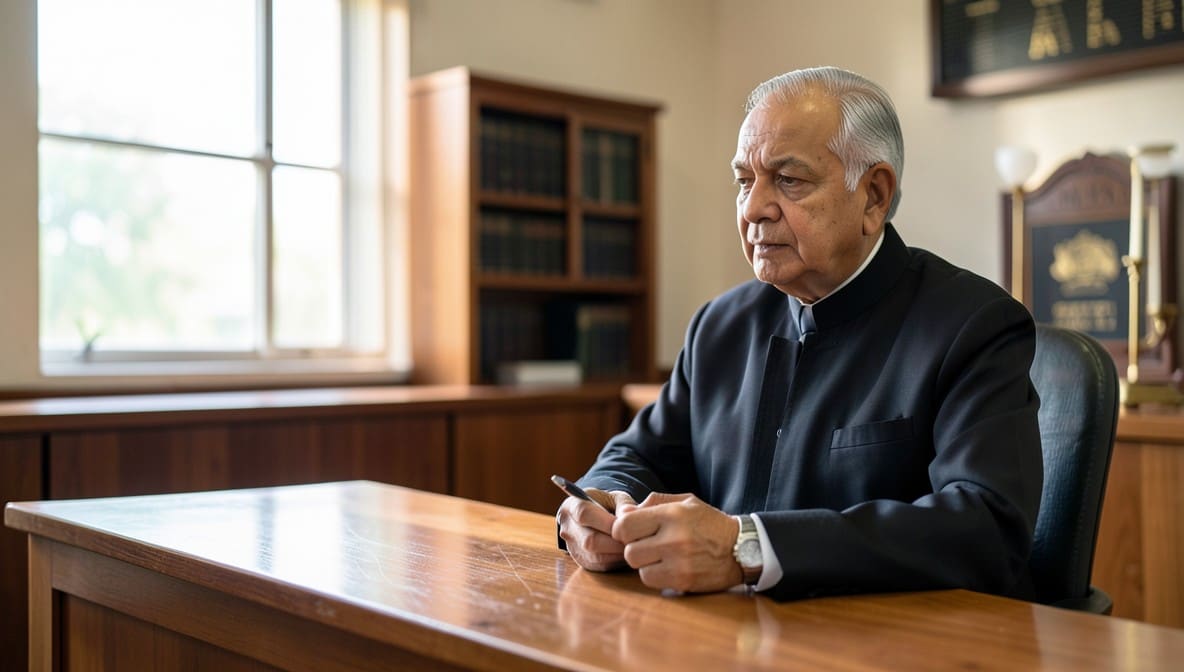
The Supreme Court clarified that a judicial officer reinstated after an unlawful discharge is entitled to the full spectrum of consequential benefits, including Selection Scale and Super Time Scale, even when the requisite number of Annual Confidential Reports (ACRs) are unavailable due to the employer’s own wrongful act.
Background & Facts
The Dispute
The applicant, a Judicial Officer of the District Judge cadre, was appointed on 15-07-2013. He was discharged on 27-01-2016. He challenged the discharge before the Rajasthan High Court, which dismissed his writ petition on 21-10-2019. He appealed to the Supreme Court (Civil Appeal No. 2029 of 2022). The Supreme Court, in its judgment dated 15-03-2022, quashed the discharge order, reinstated him with continuity of service, seniority and 50 % back wages payable within four months.
Key Facts
- Appointment: 15-07-2013 as Additional District Judge (Order No. F.19(8)Nyaya/2011).
- Discharge: 27-01-2016 following a recommendation of the Higher Judicial Committee.
- Reinstatement: 13-04-2022; seniority inserted at S.No. 255A in the Revised Seniority List dated 22-06-2020.
- ACRs available: 2013 (Very good), 2014 Part I (Very good), 2014 Part II (Good), 2022 (Very good). No ACRs for 2015-2021 because the officer was out of service.
- Higher Judiciary Committee recommendation: 19-05-2023 sought Supreme Court clarification on entitlement to Selection Scale/Super Time Scale.
- Full Court of Rajasthan HC meeting: 21-08-2024 concluded officer not suitable for scales, without stating reasons.
- Supreme Court hearing dates: 06-09-2024 and 25-10-2024 for parties’ submissions.
- Supreme Court judgment: 29-07-2026 (2026 INSC 762).
Procedural History
- 27-01-2016: Discharge order passed.
- 21-10-2019: Rajasthan High Court dismissed writ petition challenging discharge.
- 15-03-2022: Supreme Court allowed appeal, set aside discharge, ordered reinstatement with 50 % back wages.
- 13-04-2022: Officer reinstated.
- 19-05-2023: Higher Judiciary Committee sought Supreme Court clarification.
- 03-08-2024: Higher Judiciary Committee meeting on the matter.
- 21-08-2024: Full Court of Rajasthan HC considered grant of scales and found officer not suitable.
- 12-07-2024: Miscellaneous Application No. 2228 of 2026 filed by Rajasthan HC for clarification.
- 06-09-2024 & 25-10-2024: Parties appeared before Supreme Court.
- 29-07-2026: Supreme Court delivered judgment disposing of the miscellaneous application.
Relief Sought
The Rajasthan High Court sought clarification whether the consequential benefits awarded on 15-03-2022 include automatic grant of Selection Scale and Super Time Scale despite the absence of six ACRs.
The Legal Issue
Whether the “consequential benefits” awarded to the judicial officer in the Supreme Court judgment of 15-03-2022 encompass the grant of Selection Scale and Super Time Scale when the officer lacks the requisite number of Annual Confidential Reports for the preceding seven-year period.
Arguments Presented
For the Appellant/Judicial Officer
- The Supreme Court’s order reinstated the officer with “all consequential benefits”, which must include the scales.
- The missing ACRs are a direct result of the unlawful discharge; the employer cannot rely on its own wrong to deny benefits.
- Citing K.V. Jankiraman and Dragendra Singh Jadon, the Court held that an exonerated employee is entitled to salary and benefits of the higher post.
- Reliance on Prabhu Dayal Khandelwal and R.K. Jibanlata Devi that promotion may be considered on the basis of available ACRs when some are unavailable through no fault of the employee.
- Rule 54 of the Rajasthan Service Rules, 1951 treats periods of wrongful discharge as service for all purposes.
For the Respondent/Rajasthan High Court (administrative side)
- The Full Court’s resolution dated 15-01-2011 mandates at least five “good/very good/outstanding” entries in the preceding seven years for Selection Scale and specific criteria for Super Time Scale.
- The officer possesses only four ACRs (2013, 2014 I, 2014 II, 2022); therefore, the statutory threshold is not met.
- The High Court argues that the absence of six ACRs precludes automatic grant of the scales.
The Court's Analysis
The Court began by affirming that the core question is whether the lack of six ACRs, caused by the officer’s wrongful discharge, can defeat his entitlement to the scales. It observed that the principle articulated in K.V. Jankiraman - that an employee fully exonerated cannot be deprived of benefits that would have accrued but for the disciplinary action - applies squarely. The Court reiterated the maxim that “no party can derive advantage from its own wrong” and applied it to the employer’s wrongful termination.
"The absence of the requisite ACRs, therefore, is not attributable to any omission, default or deficiency on the part of the opponent, but is solely the direct consequence of the applicant’s wrongful action."
The Court examined Rules 49 and 50 of the Rajasthan Judicial Service (RJS) Rules, 2010, which govern Selection Scale and Super Time Scale respectively. Rule 49 requires a minimum of five years of service and merit-based selection amounting to 35 % of the effective strength. Rule 50 provides for Super Time Scale after three years in Selection Scale. The Court noted that the officer, having been reinstated with continuity of service and seniority, satisfied the service-year requirement as of 16-07-2018 (five years after his original appointment). It further observed that officers appointed alongside him had already been granted Selection Scale from July 2018 and Super Time Scale from July 2021.
The Court addressed the Full Court’s reliance on the 2011 resolution. While the resolution stipulates a minimum of five “good/very good/outstanding” entries, the Court held that this requirement cannot be enforced where the missing entries are the result of the employer’s own misconduct. Citing Prabhu Dayal and R.K. Jibanlata Devi, the Court emphasized that the evaluation must be based on the valid ACRs (2013 and 2014 Part I & II) and that the officer’s record for those years was “very good” and “good” with no adverse remarks on integrity.
The Court also rejected the argument that the “no work no pay” rule (Rule 17(1) of the RJS Rules) could be invoked, stating that the officer was willing to work but was prevented by the wrongful discharge. Consequently, the Court concluded that the officer is entitled to both scales, with arrears to be computed in line with the 50 % back-wages direction.
The Verdict
The Supreme Court held that the judicial officer is entitled to the grant of Selection Scale with effect from 16-07-2018 and Super Time Scale with effect from 16-07-2021. The arrears arising from these scales shall be computed by applying the 50 % back-wages direction of the 15-03-2022 judgment. The Rajasthan High Court is directed to revise the officer’s pay, incorporate the scales, and disburse the arrears within three months from the date of this judgment.
What This Means For Similar Cases
Employer Wrongful Discharge Cannot Preclude Promotion
- Courts will not allow an employer to rely on service-record gaps caused by its own wrongful termination to deny promotion or pay-scale benefits.
- The principle from K.V. Jankiraman and Dragendra Singh Jadon is now expressly applicable to judicial and other public service appointments.
Non-communicated or Missing ACRs Are Not Fatal
- When ACRs are unavailable due to employer’s fault, promotion decisions must be based on the remaining valid ACRs.
- Prabhu Dayal and R.K. Jibanlata Devi provide the precedent that the merit-based criteria can be satisfied with fewer entries if the missing ones are not the employee’s fault.
Mandatory Compliance With Service Rules
- Eligibility for Selection Scale and Super Time Scale remains governed by Rules 49 and 50 of the RJS Rules, 2010 and the Full Court resolution of 15-01-2011, but the statutory criteria are to be interpreted flexibly in cases of employer misconduct.
- Administrations must document reasons for denying scales; arbitrary denial without reasons, as observed in the Full Court minutes, is unacceptable.
Practical Takeaways for Practitioners
- When representing a public servant, gather evidence of wrongful discharge and the consequent lack of ACRs.
- Cite the Supreme Court’s reasoning that employer-induced gaps cannot be used to deny benefits.
- Ensure that any denial of scales is accompanied by a reasoned order complying with the Full Court’s resolution.





