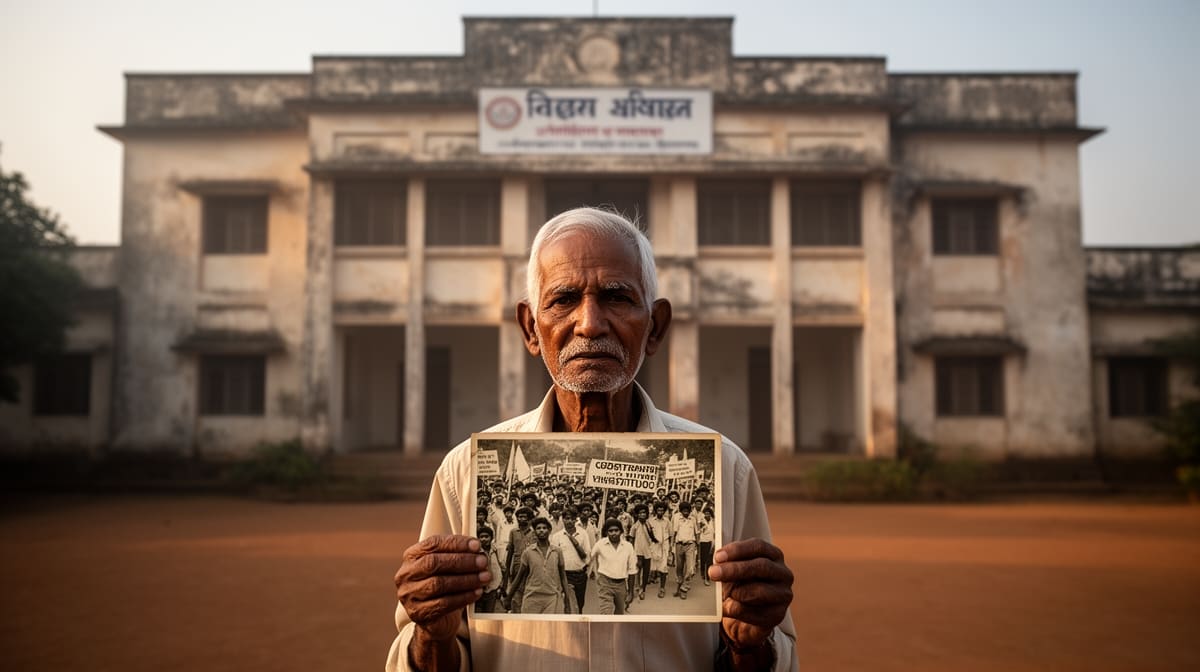
The Chhattisgarh High Court has clarified that eligibility for the Samman Nidhi under the Lok Nayak Jai Prakash Narayan (MISA/DIR Rajnaitik Ya Samajik Karno Se Niruddha Vyakti) Samman Nidhi Niyam, 2008, is strictly contingent upon detention during the Emergency being solely for political or social reasons, with no criminal antecedents. This ruling reinforces the statutory conditions laid down in Rule 6 and underscores the limited scope of judicial interference in administrative eligibility determinations.
Background & Facts
The Dispute
The appellant, Ramgulam Singh Thakur, a retired individual aged 74, claims entitlement to the Samman Nidhi - a financial benefit instituted by the State of Chhattisgarh - for his detention during the Emergency period (1975 - 1977) under the Maintenance of Internal Security Act, 1971 (MISA). He asserts that his detention was purely due to his participation as a student leader in socio-political movements, including the 1975 Kisan Movement, and that he meets the eligibility criteria under the 2008 Rules. The State, however, rejected his claim on the grounds that he had multiple criminal cases registered against him, rendering him ineligible under Rule 6.
Key Facts
- The appellant was a student at Government Hemraj Laxmichand Arts & Commerce College, Bagbahra, District Mahasamund, and served as President of the Student Union.
- He was arrested on 31.08.1975 during the Kisan Movement and detained under Section 3(1)(A)(2) of MISA until 10.01.1977.
- The State Government notified the Lok Nayak Jai Prakash Narayan (MISA/DIR Rajnaitik Ya Samajik Karno Se Niruddha Vyakti) Samman Nidhi Niyam, 2008, on 05.08.2008, to provide financial assistance to persons detained under MISA/DIR during 25.06.1975 to 31.03.1977.
- The appellant submitted an application for Samman Nidhi on 24.03.2009.
- On 09.12.2009, the Superintendent of Police, Raipur, submitted a report indicating 25 - 32 criminal cases registered against the appellant between 1974 and 1986.
- The Collector, Raipur, communicated rejection of the claim on 22.05.2010, citing Rule 6 of the 2008 Rules.
- The State Government rejected the appellant’s appeal against this communication on 06.05.2015.
- The appellant filed Writ Petition No. 1046/2015 before the Single Judge of the High Court, which was dismissed on 30.08.2024.
- The appellant filed the present intra-Court appeal on 15.09.2024.
- The State filed an affidavit on 14.11.2024, pursuant to Court directions, attaching police records from Mahasamund, Balodabazar Bhatapara, Raipur, and Rail Police, confirming 32 criminal cases.
- The appellant’s name is currently listed in the police surveillance register as of 14.08.2025.
- No conviction has been recorded against the appellant in any court.
- No criminal case is currently pending against him.
Procedural History
- 31.08.1975: Appellant detained under MISA during Emergency.
- 10.01.1977: Appellant released from detention.
- 05.08.2008: Samman Nidhi Rules, 2008, notified by State Government.
- 24.03.2009: Appellant applies for Samman Nidhi.
- 09.12.2009: Superintendent of Police, Raipur, submits report on criminal cases against appellant.
- 22.05.2010: Collector, Raipur, communicates rejection of claim.
- 06.05.2015: State Government rejects appeal against Collector’s communication.
- 2015: Writ Petition No. 1046/2015 filed before Single Judge.
- 30.08.2024: Single Judge dismisses writ petition.
- 15.09.2024: Intra-Court appeal filed before Division Bench.
- 14.11.2024: Court directs State to file affidavit clarifying nature and timing of criminal cases.
- 14.08.2025: Police surveillance list updated, appellant’s name included.
- 16.03.2026: Division Bench delivers judgment.
The Parties' Positions
Appellant’s Position: His detention was exclusively for political and social reasons as a student and farmer leader. The criminal cases cited either post-date his detention or lack documentation. No conviction exists. The expression "Rajnaitik ya Samajik Karno Se Niruddha Vyakti" is ultra vires MISA, which does not distinguish detainees by motive.
Respondents’ Position: Rule 6 of the 2008 Rules explicitly excludes persons with criminal antecedents. The Committee, after reviewing police records from multiple districts, concluded the appellant was involved in criminal and anti-social activities. The rejection was lawful, non-arbitrary, and based on official records.
Relief Sought
The appellant seeks:
- Setting aside of the order dated 30.08.2024.
- Direction to release Samman Nidhi from the date it was granted to other similarly situated detainees.
- Interest at 12% per annum from the date of entitlement until actual payment.
- Declaration that the phrase "Rajnaitik ya Samajik Karno Se Niruddha Vyakti" is ultra vires the MISA, 1971.
- Costs of proceedings.
The Legal Issue
The central question is whether a person detained under MISA during the Emergency is eligible for Samman Nidhi under the 2008 Rules if they have multiple criminal cases registered against them, even if no conviction resulted, and whether the exclusionary criterion in Rule 6 is ultra vires the parent statute.
Arguments Presented
For the Appellant
The appellant’s counsel argued that MISA, 1971, under Section 3(1)(a)(ii), authorized detention only for reasons relating to security of the State or maintenance of public order - not for political or social motives. The addition of the phrase "Rajnaitik ya Samajik Karno Se Niruddha Vyakti" in the 2008 Rules introduces a condition not found in MISA, rendering it ultra vires. He further contended that the criminal cases cited were either filed after his release (1977 - 1986) or are undocumented, and that the absence of any conviction or pending case proves his detention was purely political. He cited principles of natural justice and non-discrimination, asserting that the State’s selective grant of Samman Nidhi to others without similar scrutiny is arbitrary.
For the Respondent
The State, through the Additional Advocate General, submitted that Rule 6 of the 2008 Rules clearly limits eligibility to persons detained solely for political or social reasons and who have no criminal antecedents. The Committee, constituted under the Rules, is the statutory authority to evaluate eligibility. The police records from five districts confirm 32 criminal cases registered between 1974 and 1986, including charges under IPC Sections 147, 148, 323, 307, and 506. The appellant’s name remains on the surveillance list, indicating ongoing criminal disposition. The State emphasized that the Rules are a legislative exercise of discretion, and judicial review cannot substitute the Committee’s factual determination absent mala fide or illegality.
The Court's Analysis
The Court examined the statutory framework of the 2008 Rules and the nature of the Committee’s decision. It noted that Rule 6 explicitly states that the Samman Nidhi is to be conferred only upon persons detained under MISA/DIR "purely for political or social reasons" and who "do not have any criminal antecedents or involvement in anti-social activities." The Court held that the Committee’s evaluation, based on police records from multiple districts, constitutes a reasoned administrative determination.
"The eligibility for Samman Nidhi under Rule 2008 is not determined solely by the timing or availability of records but by the considered opinion of the competent Committee regarding compliance with the statutory criteria."
The Court observed that the appellant did not challenge the Committee’s decision directly but only the Collector’s communication, which was merely an intimation of the Committee’s ruling. The Court emphasized that judicial review cannot substitute the opinion of a statutory authority absent proof of arbitrariness, mala fide, or violation of natural justice. The appellant’s argument that the phrase "Rajnaitik ya Samajik Karno Se Niruddha Vyakti" is ultra vires MISA was noted but deemed irrelevant to the specific claim, as the appeal was not a challenge to the Rules’ validity but to the denial of benefit.
The Court further held that the existence of criminal cases, even without conviction, is sufficient under Rule 6 to disqualify a claimant, as the Rule focuses on antecedents and disposition, not adjudication. The fact that no case is currently pending does not negate the historical record relied upon by the Committee. The Court found no evidence of discriminatory treatment, as the State had applied the same criteria to all applicants.
The Verdict
The writ appeal was dismissed. The Court upheld the order dated 30.08.2024 dismissing the writ petition. The appellant’s claim for Samman Nidhi was rejected on the grounds that he failed to satisfy the eligibility condition under Rule 6 of the Lok Nayak Jai Prakash Narayan (MISA/DIR Rajnaitik Ya Samajik Karno Se Niruddha Vyakti) Samman Nidhi Niyam, 2008. No interest or costs were awarded. The State’s decision to deny the benefit stands.
What This Means For Similar Cases
Eligibility Turns on Statutory Criteria, Not Moral Equivalence
- Practitioners must demonstrate strict compliance with Rule 6 - absence of criminal antecedents is non-negotiable, even if no conviction occurred.
- Claims based on moral justification or political symbolism will not override statutory disqualifiers.
- The burden lies on the claimant to rebut the official police records, not on the State to prove innocence.
Administrative Committees Hold Discretionary Authority
- Decisions of statutory committees under welfare schemes are entitled to deference unless mala fide or procedurally flawed.
- Challenges must be directed at the committee’s order, not merely administrative communications.
- Courts will not re-appreciate evidence or substitute their view for that of the expert body.
Historical Criminal Records Are Material Even If Dated
- Cases registered before, during, or after detention are relevant if they reflect criminal disposition.
- Destruction or unavailability of records does not erase the Committee’s reliance on available evidence.
- Surveillance listing post-dating the Emergency may reinforce the finding of criminal disposition.