The Chhattisgarh High Court has clarified that contributory negligence in motor accident claims cannot be established solely on the uncorroborated statement of a vehicle owner who was not present at the scene. This judgment reinforces the principle that factual determinations must be grounded in direct, credible evidence, not speculative inferences from interested parties.
Background & Facts
The Dispute
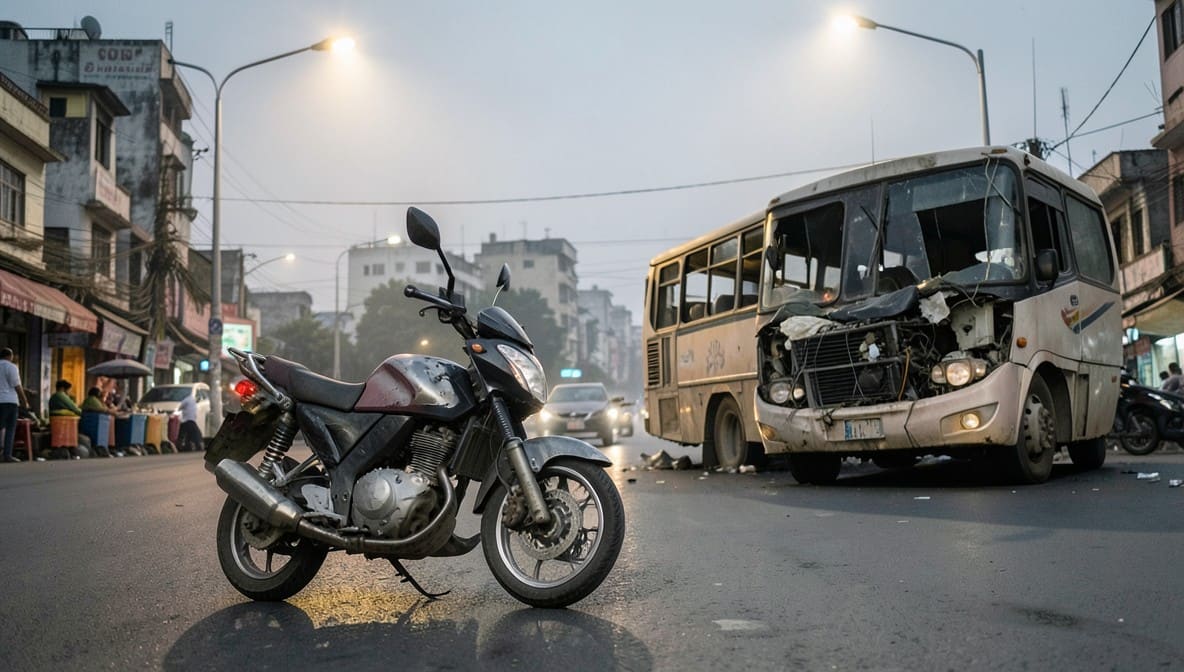
The appellant, Jagjeevan Rajwade, was injured in a motorcycle collision on 02.03.2016 while returning home from work at Balrampur Colliery. He filed a claim petition before the 3rd Additional Motor Accident Claims Tribunal, Surajpur, seeking compensation for injuries sustained to his head, hands, and legs. The respondent No. 1, Krishna Kumar Ravi, was the driver of the offending motorcycle. Respondent No. 2, Vinita Sinha, was the registered owner of the offending motorcycle but was not present at the time of the accident.
Key Facts
- The accident occurred on 02.03.2016 at approximately 6:30 PM near Village Namadgiri, Surajpur District
- The appellant was driving his own motorcycle and was returning from work
- Respondent No. 1 was driving the offending motorcycle in a rash and negligent manner, according to the appellant’s testimony
- The appellant sustained multiple injuries requiring hospitalization
- The claim petition was filed on 03.08.2018
- Respondent No. 2, Vinita Sinha, was not present at the accident site and did not witness the incident
- The Claims Tribunal relied on Vinita Sinha’s statement to conclude that the appellant had committed contributory negligence
Procedural History
- 02.03.2016: Accident occurred
- 03.08.2018: Claim petition filed before Motor Accident Claims Tribunal (MACC No. 130/2016)
- 15.01.2019: Tribunal awarded compensation of Rs. 2,04,795/- but deducted 50% on account of contributory negligence, leaving Rs. 1,02,398/-
- 20.06.2019: Appellant filed appeal under Section 173 of the Motor Vehicles Act, 1988 (MAC No. 311/2019)
- 25.07.2019: Respondent No. 2 filed cross-objection under Order 41 Rule 22 CPC challenging the award in toto
- 05.05.2026: Judgment delivered by the High Court
The Parties' Positions
For the Appellant
- Argued that he was the sole eye-witness and consistently testified that the accident was caused solely by the rash driving of respondent No. 1
- Emphasized that no evidence was adduced by respondents to substantiate contributory negligence
- Contended that the Tribunal erred in relying on the statement of respondent No. 2, who was not present at the scene
For Respondent No. 1
- Supported the Tribunal’s award and sought dismissal of the appeal
For Respondent No. 2
- Argued that she was not liable as she was not driving the vehicle and had no control over its operation
- Challenged the Tribunal’s imposition of liability on her as owner
Relief Sought
- Appellant sought enhancement of compensation to the full amount of Rs. 2,04,795/- without deduction for contributory negligence
- Appellant also sought interest on the enhanced amount from the date of filing the claim petition (03.08.2018)
- Respondent No. 2 sought complete dismissal of the claim against her
The Legal Issue
The central question was whether contributory negligence can be inferred against a claimant based solely on the statement of a vehicle owner who was not present at the accident scene and has no direct knowledge of the incident.
Arguments Presented
For the Appellant
The appellant’s counsel relied on the principle that the burden of proving contributory negligence lies on the party alleging it. He argued that respondent No. 2’s statement was hearsay and inadmissible as substantive evidence since she was not an eye-witness. He cited Karnal Motor Service v. Harbhajan Singh to assert that mere ownership of a vehicle does not equate to knowledge of the accident’s circumstances. He emphasized that the claimant’s testimony, which remained unshaken under cross-examination, was the only credible account of the incident.
For the Respondent
Respondent No. 1 supported the Tribunal’s finding, arguing that the deduction of 50% was a reasonable apportionment based on the totality of evidence. Respondent No. 2 contended that she could not be held vicariously liable as the vehicle was being driven by respondent No. 1, and the Tribunal’s finding against her was erroneous. However, she did not dispute the contributory negligence finding against the claimant.
The Court's Analysis
The Court conducted a meticulous review of the evidence and found that the Claims Tribunal committed a material error in law by relying on the statement of respondent No. 2 to establish contributory negligence. The Court observed that respondent No. 2 was neither present at the scene nor had any firsthand knowledge of the events leading to the accident. Her statement, therefore, could not constitute admissible evidence to rebut the claimant’s consistent and unimpeached testimony.
"The Claims Tribunal has placed reliance upon the statement of respondent No. 2, owner of the offending motorcycle, who admittedly was not present at the spot and is not an eye-witness to the accident."
The Court held that the claimant, as the sole eye-witness, had provided a clear, coherent, and uncontradicted account of the accident. No cross-examination elicited any fact suggesting his negligence. The Tribunal’s inference of contributory negligence was thus speculative and devoid of evidentiary basis. The Court emphasized that in motor accident claims, the burden of proving contributory negligence rests squarely on the respondents, and it cannot be discharged by relying on the unsubstantiated assertions of an interested party with no direct knowledge.
The Court further noted that the doctrine of contributory negligence must be applied with caution, particularly where the claimant’s version is credible and unchallenged. The Tribunal’s decision to deduct 50% compensation was arbitrary, perverse, and contrary to settled principles of evidence.
The Verdict
The appeal was allowed. The Court set aside the finding of contributory negligence and held the appellant entitled to the full compensation of Rs. 2,04,795/-. Respondent No. 2 was directed to deposit the enhanced amount within three months from receipt of the order. The additional compensation shall carry interest at 9% per annum from 03.08.2018 until realization. The cross-objection filed by respondent No. 2 was dismissed. All other terms of the original award remained unchanged.
What This Means For Similar Cases
Eye-Witness Testimony Is Paramount
- Practitioners must prioritize securing and preserving the testimony of direct eye-witnesses in motor accident claims
- Where the claimant is the sole eye-witness and his testimony is consistent and unshaken, courts must not substitute it with hearsay from non-witnesses
- Any attempt to infer negligence from the statement of a vehicle owner not present at the scene is legally unsustainable
Burden of Proof Remains on Respondents
- The burden to prove contributory negligence is not discharged by vague or speculative allegations
- Respondents must lead specific, credible, and direct evidence - such as independent witnesses, forensic reports, or traffic camera footage - to establish negligence on the claimant’s part
- Tribunals must not rely on the testimony of interested parties to shift liability
Owner Liability Requires Separate Basis
- Ownership of a vehicle does not, by itself, attract liability for the driver’s negligence
- Liability against the owner must be established under Section 140 or Section 141 of the Motor Vehicles Act, 1988, through proof of negligence, entrustment, or vicarious responsibility - none of which were alleged here