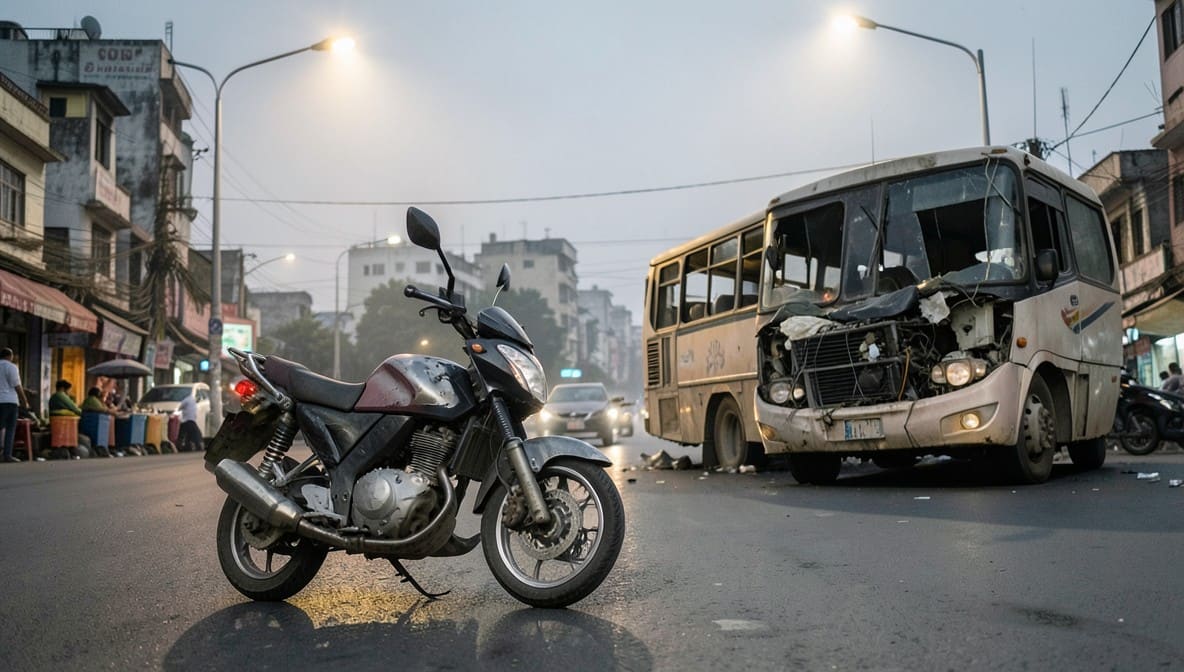
The Bombay High Court’s Aurangabad Bench has partially allowed an appeal against the dismissal of a motor accident claim, holding that both the claimant and the bus driver were equally responsible for the accident. The Court assessed compensation at Rs. 2,65,355, reduced by 50% for contributory negligence, and awarded Rs. 1,32,677 with 9% interest from the date of the claim petition.
Background & Facts
The Dispute
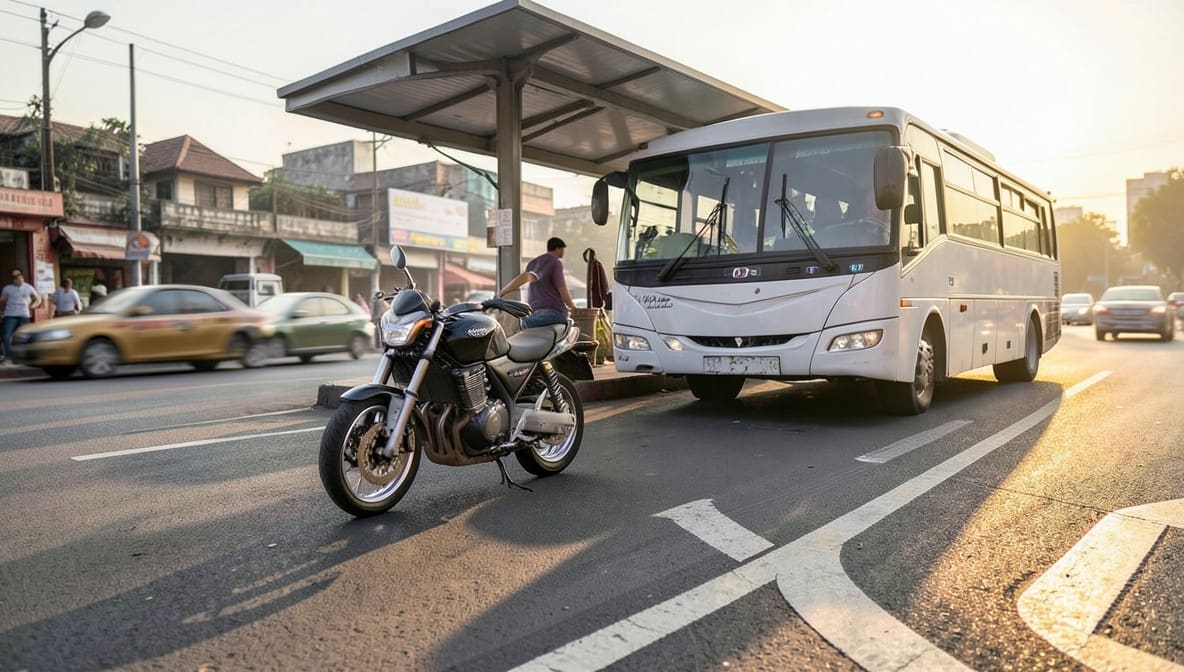
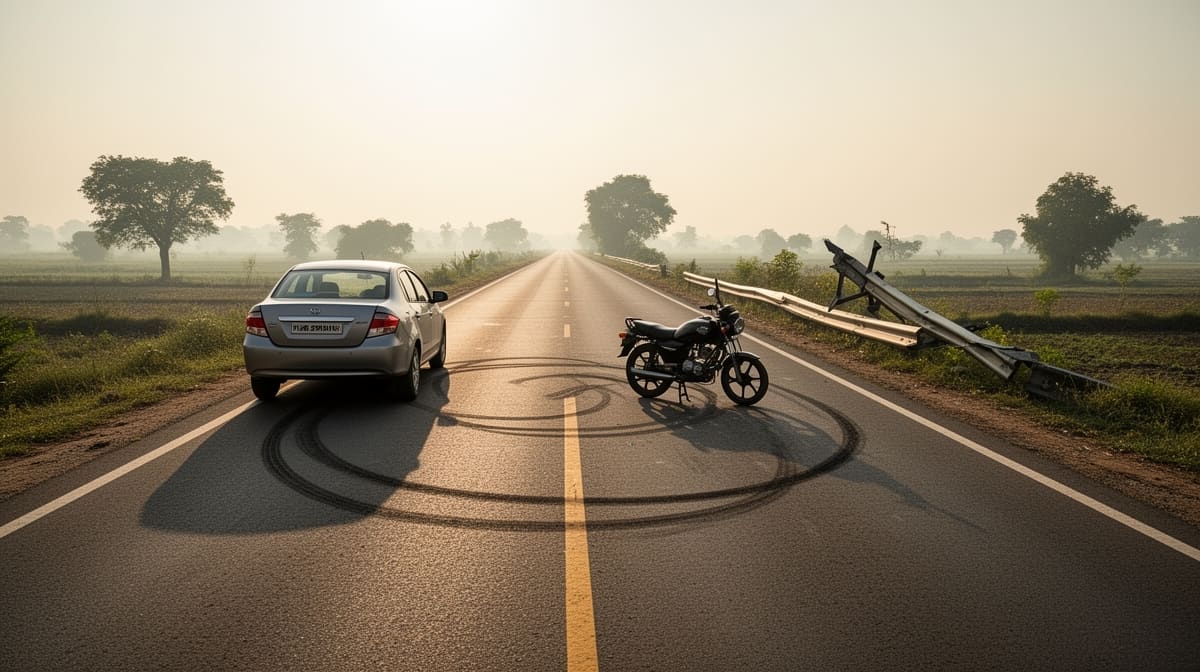
The appellant, a 25-year-old bank employee, filed a motor accident claim petition under Section 166 of the Motor Vehicles Act, 1988 seeking compensation of Rs. 14,00,000 for injuries sustained in a collision with a parked bus on 04.02.2005. The Motor Accident Claims Tribunal, Aurangabad, dismissed the claim, holding the appellant solely responsible for the accident.
Key Facts
- The appellant was riding his motorcycle from Savarkar Chowk, CIDCO, towards T.V. Center at approximately 3.30 a.m. on 04.02.2005.
- His motorcycle collided with a parked bus bearing Registration No. MH-20-A-2045, owned by respondent no.2 and insured with respondent no.3.
- The appellant suffered multiple fractures, including left tibial fibula, thigh, and left hand shoulder joint, and was treated at Government Medical College and Hospital and Kamalnayan Bajaj Hospital, Aurangabad.
- The appellant alleged the bus was illegally parked without reflectors or indicators, causing the collision.
- The bus driver did not testify, and the respondents did not adduce evidence to counter the appellant’s version.
Procedural History
- 04.02.2005: Accident occurred; M.L.C. No.44 of 2005 recorded by Police Station CIDCO, Aurangabad.
- 25.06.2009: Motor Accident Claims Tribunal, Aurangabad, dismissed the claim petition (Motor Accident Claim Petition No.65 of 2006).
- 10.07.2026: First Appeal No.344 of 2010 reserved for judgment.
- 23.07.2026: Judgment pronounced by the Bombay High Court (Aurangabad Bench).
Relief Sought
The appellant sought setting aside of the Tribunal’s order, restoration of the claim petition, and award of compensation of Rs. 14,00,000 with interest.
The Legal Issue
The central question was whether the appellant was solely responsible for the accident or whether contributory negligence applied, reducing the compensation payable.
Arguments Presented
For the Appellant
The appellant argued that the accident occurred due to the bus being illegally parked without reflectors or indicators, and that he had deposed as a witness, supported by medical records and a disability certificate. The appellant contended that the Tribunal erred in dismissing the claim without considering the evidence.
For the Respondent
The insurance company argued that the appellant was at fault for colliding with a parked bus and that no FIR was registered. The respondents contended that the appellant’s own negligence barred his claim for compensation.
The Court's Analysis
The Court examined the evidence on record, including the M.L.C., spot panchnama, and medical records. The Court observed that the spot panchnama recorded damage to both vehicles and suggested the bus was parked on the road rather than the footpath. The Court noted that the accident occurred in the early hours, and the absence of streetlights made it hazardous for the bus to be parked without reflectors or indicators.
The Court held that the appellant’s testimony, supported by medical evidence, established that the bus driver’s negligence contributed to the accident. The Court further noted that the bus driver did not testify, and the respondents did not adduce evidence to counter the appellant’s version. The Court concluded that both parties were equally responsible for the accident, applying the principle of contributory negligence.
The Court relied on R. D. Hattangadi v. Pest Control (India) Pvt. Ltd. to assess compensation under various heads, including medical expenses, loss of earnings during hospitalization, special diet, attendant charges, transportation charges, permanent disability, pain and suffering, discomfort in life, and loss of marriage prospects. The Court awarded Rs. 2,65,355, reduced by 50% for contributory negligence, resulting in a net compensation of Rs. 1,32,677 with 9% interest from the date of the claim petition.
The Verdict
The Court partly allowed the appeal. The respondents were directed to jointly and severally pay compensation of Rs. 1,32,677 to the appellant with interest at 9% per annum from the date of the claim petition. The insurance company was directed to deposit the compensation within ten weeks, failing which the award would be drawn accordingly. The Court set aside the Tribunal’s order and directed compliance with the directions.
What This Means For Similar Cases
Contributory Negligence Reduces Compensation
- Courts must assess the degree of negligence of each party and apportion liability accordingly.
- Claimants cannot be denied compensation entirely if their negligence is not the sole cause of the accident.
Documentary Evidence Is Crucial
- Medical records, disability certificates, and spot panchnamas are critical to establish the extent of injuries and the circumstances of the accident.
- The absence of testimony from the opposing party (e.g., bus driver) can strengthen the claimant’s case.
Compensation Must Be Itemized
- Courts must assess compensation under specific heads, including medical expenses, loss of earnings, pain and suffering, and permanent disability.
- Future loss of earnings is not compensable if the claimant continues to be employed post-accident.