
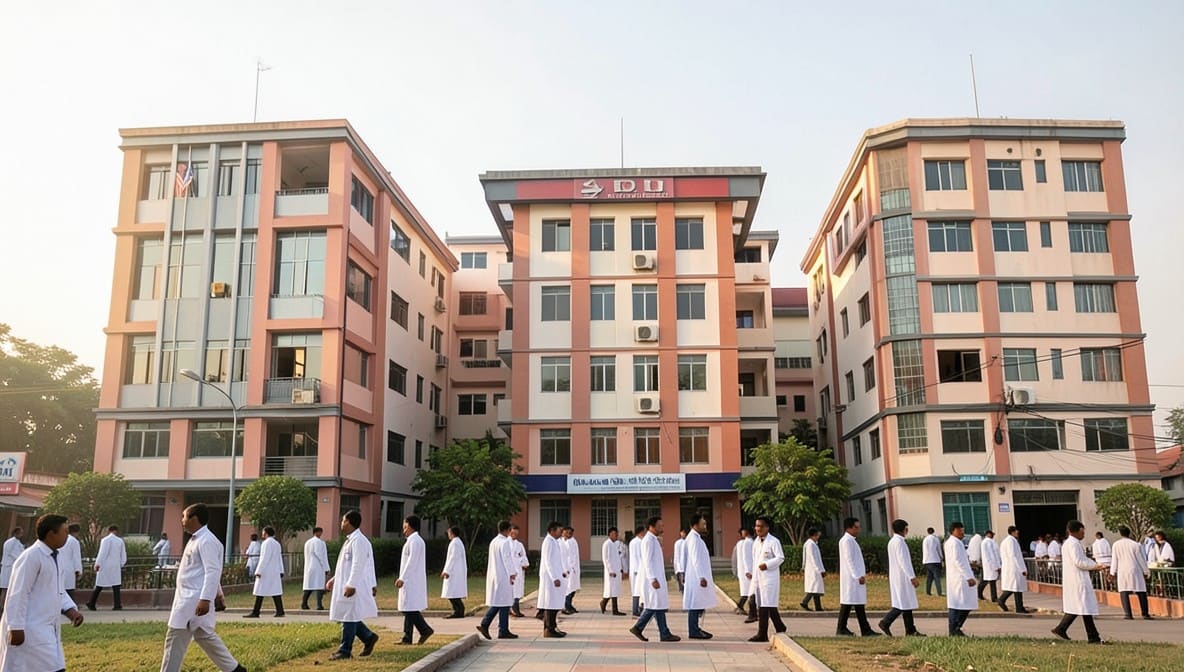
The Supreme Court has laid down a definitive principle on financial accountability in medical education: when a private medical college is found non-compliant with regulatory standards and students are forcibly relocated, the defaulting institution must bear the full cost of their continued education in transferee institutions. This judgment resolves a protracted dispute involving 122 students, clarifying that judicial intervention to preserve academic continuity does not absolve the defaulting entity of its financial obligations.
Background & Facts
The Dispute
The dispute arose from the non-renewal of recognition of Sardar Rajas Medical College, Hospital and Research Centre (SRMCH), Jaring, Kalahandi, Odisha, operated by the Selvam Educational and Charitable Trust. The Medical Council of India (MCI), now the National Medical Commission (NMC), identified serious deficiencies in infrastructure, teaching faculty, and regulatory compliance during inspections in the academic years 2013-2014 and 2014-2015. These deficiencies led to the denial of renewal of recognition for the 2014-2015 batch, and by extension, placed the academic future of the 2013-2014 batch in jeopardy.
Key Facts
- SRMCH admitted 124 students across two batches: 2013-2014 (84 students) and 2014-2015 (40 students)
- Fees charged by SRMCH were approximately Rs.4,25,000 per student per annum, significantly higher than Government medical college rates
- On 18.09.2014, the Supreme Court issued interim directions in Hind Charitable Trust v. Union of India, mandating that all students admitted in institutions facing recognition issues be charged fees at Government rates (approximately Rs.30,000 per annum)
- The Selvam Trust collected Rs.4,25,000 per student from the 2014-2015 batch but was directed to refund Rs.3,95,000 per student, which it failed to do
- On 08.08.2014, the Supreme Court dismissed SRMCH’s writ petition (W.P.(C) No.681 of 2014) challenging the MCI’s non-renewal decision, affirming the regulatory findings
- On 19.04.2016, the Selvam Trust deposited Rs.2 crores with the Supreme Court Registry as security
- The Trust had also furnished a bank guarantee of approximately Rs.10 crores to the MCI/NMC
- In 2015-2016, the High Court of Orissa directed relocation of students to recognized private medical colleges
- Three transferee colleges - Kalinga Institute of Medical Sciences (KIMS), Institute of Medical Sciences & SUM Hospital (IMS), and Hi-Tech Medical College & Hospital - accepted 122 students (41, 41, and 40 respectively)
- Students paid only Government-rate fees (Rs.30,000 per annum) to transferee colleges, despite the colleges’ standard fees being approximately Rs.3,00,000 per semester
- Transferee colleges submitted detailed fee charts showing that, at SRMCH’s rates, the total fee liability for 122 students would be approximately Rs.5,39,75,000 for the 2013-2014 batch and Rs.1,19,00,000 for the 2014-2015 batch, aggregating to Rs.6,58,75,000
Procedural History
- 2013-2014 & 2014-2015: Academic sessions at SRMCH
- 18.09.2014: Supreme Court issues interim order in Hind Charitable Trust mandating Government-rate fees for affected students
- 08.08.2014: Supreme Court dismisses SRMCH’s W.P.(C) No.681 of 2014, affirming MCI’s non-renewal
- 20.01.2015: Directorate of Medical Education, Odisha directs SRMCH to refund excess fees
- 18.11.2015 & 09.12.2015: High Court of Orissa passes orders directing student relocation
- 2016: Supreme Court issues interim orders permitting relocation to private colleges under State-supervised counselling
- 08.01.2016: Supreme Court expresses reservations about quota-based relocation
- 12.01.2016: Supreme Court permits continuation of students in private colleges
- 2019-2022: Transferee colleges file interlocutory applications (I.A. Nos. 73763/2019, 69514/2019, 151684/2022) seeking fee reimbursement
- 14.05.2026: Supreme Court delivers judgment
The Parties' Positions
Appellants (Students & Selvam Trust): Argued that students should not be burdened with additional fees as they were relocated due to no fault of theirs; Selvam Trust contended that regulatory findings are still under challenge and liability cannot be determined without adjudicating those disputes.
Respondents (Transferee Colleges): Contended they provided full medical education at substantial cost, accepted students under Court orders without protest, and are entitled to reimbursement at SRMCH’s fee rates, not Government rates.
NMC & State of Odisha: Supported quota-based fee classification but acknowledged the absence of Government quota vacancies in transferee colleges.
Relief Sought
The transferee colleges sought:
- Reimbursement of differential fees at SRMCH’s rates (not Government rates)
- Payment of outstanding fees for 122 students
- Interest on delayed payments
- Direction to release Rs.10 crore bank guarantee and Rs.2 crore deposit with the Supreme Court Registry
The Legal Issue
The central question was whether students transferred to private medical colleges due to the defaulting institution’s regulatory non-compliance are liable to pay only Government-rate fees, or whether the defaulting institution must bear the cost of the differential fees, and whether the bank guarantee and deposit funds can be applied to compensate the transferee colleges.
Arguments Presented
For the Appellant/Petitioner
The students and Selvam Trust argued that the interim directions of the Supreme Court, which mandated Government-rate fees, created a binding obligation that could not be altered retroactively. They contended that students had no control over the closure of SRMCH and should not be held liable for additional fees after completing their courses. The Trust further argued that the MCI’s findings were still subject to challenge and that the Court should not adjudicate liability without a full trial on regulatory defaults.
For the Respondent/State
The transferee colleges argued that they undertook the burden of educating students under Court orders, providing full infrastructure and faculty, and were entitled to reimbursement at the fee rates applicable to the institution from which the students were transferred - SRMCH. They submitted that the Government-rate fee was an emergency measure, not a permanent entitlement, and that the differential amount - amounting to approximately Rs.16.2 crores - was a legitimate debt owed to them. They emphasized that the Selvam Trust retained the excess fees collected from students and had not refunded them.
The Court's Analysis
The Court began by rejecting the argument that students should continue to pay only Government-rate fees. It held that the interim direction to charge Government rates was a temporary measure to preserve academic continuity during a crisis, not a permanent alteration of contractual obligations. The students had originally contracted to pay higher fees at SRMCH, a private institution, and the Court’s intervention did not extinguish that underlying liability.
"It cannot be denied that admissions to private medical colleges, particularly under the management/private quota would carry a substantially higher fee structure than that applicable to Government Medical Colleges. The students had initially taken admission in SRMCH, which indisputably was a private medical institution... Thus, these students had consciously contracted to pay at the higher fee standards charged by the private medical college."
The Court emphasized the principle of commodum ex injuria sua nemo habere debet - no one should benefit from their own wrong. The Selvam Trust’s failure to maintain regulatory standards caused the crisis, and it could not be permitted to evade financial responsibility. The Court noted that the Trust had collected Rs.4,25,000 per student and failed to refund the excess Rs.3,95,000 per student, thereby retaining unjust enrichment.
The Court further held that the Rs.10 crore bank guarantee and Rs.2 crore deposit were not subject to exclusive claims by the NMC, as no statutory lien or priority was established. The funds were held as security for regulatory compliance, and since the Trust had defaulted, the funds could be applied to compensate the transferee colleges who bore the cost of education.
The Court acknowledged that the transferee colleges had already conceded to accept reimbursement at SRMCH’s fee rates (not their own higher rates), reducing the claim from approximately Rs.22 crores to Rs.16.2 crores. The total available funds - Rs.10 crore guarantee + Rs.2 crore deposit + accrued interest - amounted to approximately Rs.14 crores, leaving a shortfall. The Court directed that the entire Rs.12 crores (Rs.10 crore guarantee + Rs.2 crore deposit) be distributed equally among the three transferee colleges.
The Verdict
The appellants’ appeals were dismissed. The Supreme Court directed that:
- The Rs.10 crore bank guarantee furnished by the Selvam Trust to the NMC shall be released in full and distributed equally (Rs.3,33,33,333 each) to KIMS, IMS, and Hi-Tech Medical College within three months
- The Rs.2 crore deposit with the Supreme Court Registry, along with accrued interest, shall be divided equally (Rs.66,66,666 each) among the three transferee colleges within two weeks of submission of bank details
- The transferee colleges may submit claims to the NMC for the remaining shortfall (approximately Rs.2.2 crores) from the students, who are liable to pay the balance of fees calculated at SRMCH’s rates
- Students who pay their outstanding dues shall be entitled to immediate issuance of course completion certificates
- All interlocutory applications are disposed of
What This Means For Similar Cases
Defaulting Institutions Bear Financial Consequences
- Practitioners must now argue that when a private medical college loses recognition due to regulatory non-compliance, it cannot shift the cost of student relocation to transferee institutions or students
- The financial burden of remedying institutional failure rests squarely on the defaulting entity
- Bank guarantees and deposits made with regulatory bodies can be accessed to compensate third parties harmed by the default
Interim Relief Does Not Erase Contractual Liability
- Court-ordered interim fee caps (e.g., Government rates) are emergency measures, not permanent waivers of contractual obligations
- Students who benefit from such relief remain liable for the difference between the capped rate and the original contractual rate
- Institutions cannot use judicial intervention as a shield to avoid payment obligations
Regulatory Funds Are Not Immune from Civil Claims
- Funds deposited with regulatory authorities (e.g., MCI/NMC) for compliance purposes are not automatically reserved for penalties or state coffers
- Where such funds are held as security and a third party incurs direct financial loss due to the default, equitable distribution to compensate that party is permissible
- Legal counsel should immediately identify and seek attachment of such funds in similar cases





