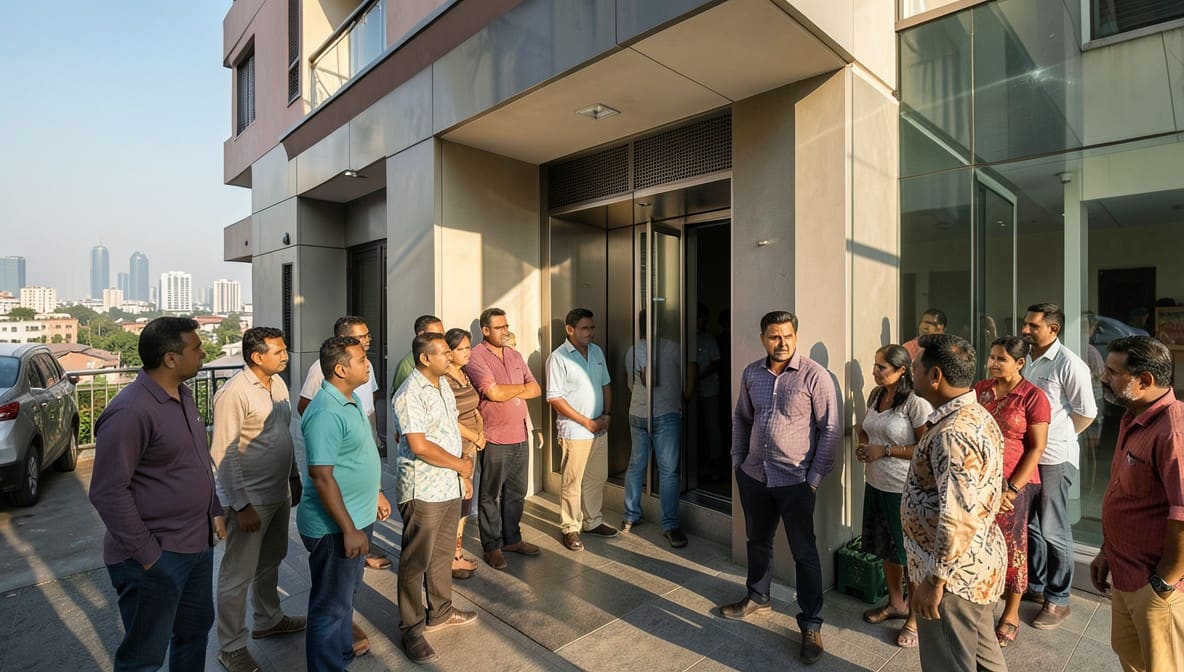
The Bombay High Court has clarified that the exclusive jurisdiction of the Court of Small Causes under the Maharashtra Rent Control Act, 1999, does not bar civil courts from entertaining suits where the defendant denies the existence of a landlord-tenant relationship and asserts the plaintiff's status as a trespasser. This ruling reinforces the principle that jurisdiction is determined by the pleadings in the plaint, not by the defendant's contradictory assertions.
Background & Facts
The Dispute
The dispute centers on Rutton Manor, a ten-story building at Garden Road, Apollo Reclamation, Colaba, Mumbai, originally leased by Pervin Ginwalla. After her death, ownership and tenancy rights became contested among her children and their spouses. Dr. Rustom Farhad Ginwalla (Defendant No.1) claims to be the sole surviving joint tenant of the head lessor, Mumbai Port Trust, and thus the undisputed landlord. Plaintiff No.1, Dr. Rustom Ginwalla’s brother, claims ownership of 55% of the building through a registered Gift Deed dated 11.10.2017 executed by their late father, Farhad Ginwalla, who allegedly held a 55% interest. Plaintiff No.1 further asserts that he ceased to be a tenant from that date and became a co-owner.
Key Facts
- Rutton Manor comprises ground plus four floors with 10 flats and two garages
- Pervin Ginwalla was the original lessee of the underlying land from Mumbai Port Trust
- Farhad Ginwalla (father of Plaintiff No.1 and Defendant No.1) died in 2017
- A registered Gift Deed dated 11.10.2017 transferred Farhad’s 55% interest and leasehold rights to Plaintiff No.1 and Rashna Ginwalla
- Defendant No.1 denies the validity of the Gift Deed and claims the tenancies granted by Farhad were fraudulent
- Defendant No.1 filed multiple suits: eviction suits against Plaintiff Nos.1, 4, 7, 8, 9, 10 before the Court of Small Causes; and Civil Suit No.405/2023 before the Bombay High Court seeking declaration that Plaintiffs are trespassers
- Plaintiff Nos.2, 3, 5, 6, 10 are not claimed by Defendant No.1 to be tenants; Defendant asserts they are illegal occupants
- Plaintiff No.3 is identified as a maid servant; Plaintiff No.11 is a resident of the USA
Procedural History
- 11.10.2017: Registered Gift Deed executed by Farhad Ginwalla
- 2015: Defendant No.1 files SC Suit No.2927/2015 before City Civil Court seeking reliefs against Plaintiff No.1
- 2018: Plaintiffs file Suit No.790/2018 before Bombay High Court alleging harassment; interim relief granted; appeal dismissed
- 2021: Plaintiff Nos.8 and 9 file written statement in RAE Suit No.714/2021 admitting landlord-tenant relationship
- 2021: Plaintiff No.1 applies to deposit rent in Court of Small Causes in RAE Suit No.70/2015
- 2023: Defendant No.1 files Civil Suit No.405/2023 in Bombay High Court alleging Plaintiffs are trespassers and seeking possession
- 2023: Plaintiffs file SC Suit No.2905/2022 before City Civil Court seeking injunction against obstruction of lift, terrace, water tanks, and common areas
- 29.05.2024: City Civil Court dismisses Defendant No.1’s Notice of Motion under Order VII Rule 11 CPC seeking rejection of plaint on jurisdictional grounds
- 24.03.2026: Bombay High Court dismisses Civil Revision Application No.388/2024 challenging the above order
The Parties' Positions
Defendants (Applicants): Argue that the suit is barred under Section 33 of the Maharashtra Rent Control Act, 1999, as it relates to landlord-tenant disputes. They rely on pending eviction suits before the Court of Small Causes and contend that the suit is a disguised attempt to circumvent exclusive jurisdiction. They assert that Plaintiffs Nos.1, 4, 7, 8, 9, 10 are tenants and that even claims for essential services fall under Section 29 of the Rent Act.
Plaintiffs (Respondents): Argue that the suit is a tortious claim for nuisance and harassment, not a tenancy dispute. They assert that Defendant No.1 has disowned the landlord-tenant relationship by filing Suit No.405/2023 alleging trespass. They claim that Plaintiffs Nos.2, 3, 5, 6, 10 have no tenancy relationship with Defendant No.1 and thus the suit falls squarely within the residuary jurisdiction of the Civil Court.
Relief Sought
Plaintiffs seek a permanent injunction restraining Defendants from:
- Obstructing use of the lift, water tanks, meter room, pump room, and common terrace
- Preventing installation of CCTV cameras
- Hindering ingress/egress to the building
- Interfering with repairs and maintenance of common areas
Defendants sought rejection of the plaint under Order VII Rule 11(d) CPC on grounds of lack of jurisdiction.
The Legal Issue
Whether the exclusive jurisdiction of the Court of Small Causes under Section 33 of the Maharashtra Rent Control Act, 1999, bars the City Civil Court from entertaining a suit for injunction against obstruction of common amenities when the defendant denies tenancy and alleges the plaintiffs are trespassers.
Arguments Presented
For the Appellant/Petitioner
Mr. Amrut Joshi argued that the suit is barred under Section 33 of the Maharashtra Rent Control Act, 1999, which confers exclusive jurisdiction on the Court of Small Causes for disputes between landlord and tenant relating to possession or rent. He relied on Banatwala and Company v. LIC and Nirmal Ujwal Credit Co-operative Society v. Narendra Mohanlal Choudhary to contend that claims for restoration of essential services like lift and water supply are expressly covered under Section 29 of the Act and must be agitated before the Court of Small Causes. He emphasized that Plaintiffs had previously admitted tenancy in other proceedings and that the suit was a cleverly drafted attempt to bypass exclusive jurisdiction. He cited T. Arivandandam v. T.V. Satyapal and Popat and Kotecha Property v. State Bank of India Staff Association to argue that courts must look beyond the form of the plaint to its substance.
For the Respondent/State
Mr. Sameer Pandit countered that jurisdiction is determined by the averments in the plaint, not the defendant’s defense. He relied on Natraj Studios v. Navrang Studios and Mansukhlal Dhanraj Jain v. Eknath Vithal Ogale to argue that where the defendant denies tenancy and claims the plaintiff is a trespasser, the suit lies in the Civil Court. He highlighted that Defendant No.1 had filed Suit No.405/2023 before the High Court seeking a declaration that Plaintiffs are trespassers and that tenancies were void ab-initio. He invoked Abdulla Bin Ali v. Calappa to assert that a party cannot approbate and reprobate - denying tenancy in one suit and asserting it in another to invoke exclusive jurisdiction.
The Court's Analysis
The Court undertook a meticulous analysis of the pleadings, the nature of the relief sought, and the conflicting positions taken by the parties across multiple proceedings. It emphasized that jurisdiction is determined by the averments in the plaint and not by the defendant’s plea. The Court observed:
"If the jurisdictional question is eventually decided in favour of the Court of exclusive jurisdiction, a suit or proceeding before the ordinary court must terminate to the extent its jurisdiction is ousted."
The Court noted that Defendant No.1 had categorically denied the existence of a landlord-tenant relationship with Plaintiffs Nos.2, 3, 5, 6, and 10, asserting them to be illegal occupants. With respect to Plaintiff No.1, Defendant No.1 had filed a suit before the High Court alleging that the Gift Deed was fraudulent and that Plaintiff No.1 was a trespasser. The Court held that such a stance precluded Defendant No.1 from later invoking the exclusive jurisdiction of the Court of Small Causes based on a tenancy relationship she herself had repudiated.
The Court distinguished Nirmal Ujwal and Banatwala, noting that those cases involved parties who acknowledged tenancy. Here, the very foundation of tenancy was denied. The Court further held that the relief sought - injunction against obstruction of common amenities - was not a claim for recovery of possession or rent, but a tortious claim for nuisance and harassment, which falls within the residuary jurisdiction of the Civil Court.
The Court also rejected the argument that Section 29 of the Rent Act automatically ousts civil court jurisdiction, observing:
"The primary requirement is that the suit or proceeding must be between the landlord and tenant... If this jural relationship is clearly demonstrated, then the nature of the reliefs claimed... becomes relevant."
Since the jural relationship was not established - and in fact, actively denied - the bar under Section 33 did not apply. The Court affirmed that a party cannot approbate and reprobate: "A party cannot be permitted to approbate and reprobate."
The Verdict
The Civil Revision Application was dismissed. The order of the City Civil Court dated 29.05.2024 dismissing the Notice of Motion under Order VII Rule 11 CPC was upheld. The suit before the City Civil Court shall proceed to trial on its merits. Interim Application No.10681/2024 was disposed of as incidental. No costs were awarded.
What This Means For Similar Cases
Denial of Tenancy Opens Civil Court Jurisdiction
- Practitioners must now argue that if a defendant denies tenancy and alleges trespass, the suit cannot be barred under the Rent Control Act, even if eviction suits are pending
- The burden shifts to the defendant to prove the existence of tenancy at the time of filing the jurisdictional objection
- Plaintiffs may strategically plead ownership or trespass to preserve access to civil court remedies
Avoiding Jurisdictional Traps in Drafting
- Drafters must ensure pleadings are consistent across forums - contradictory assertions may be deemed approbation and reprobation
- Claims for essential services (lift, water, electricity) are not automatically within Rent Act jurisdiction if the landlord denies tenancy
- Courts will examine the substance of the suit, not just the form - a claim framed as nuisance may survive even if it overlaps with tenancy issues
Residuary Jurisdiction of Civil Courts Is Preserved
- The Civil Court’s plenary jurisdiction is not ousted unless the suit clearly falls within the four corners of a special enactment
- The presumption remains in favor of civil court jurisdiction unless the bar is express and unambiguous
- Where multiple defendants exist, and jurisdiction is disputed only as to some, the suit may proceed against those against whom no tenancy is alleged