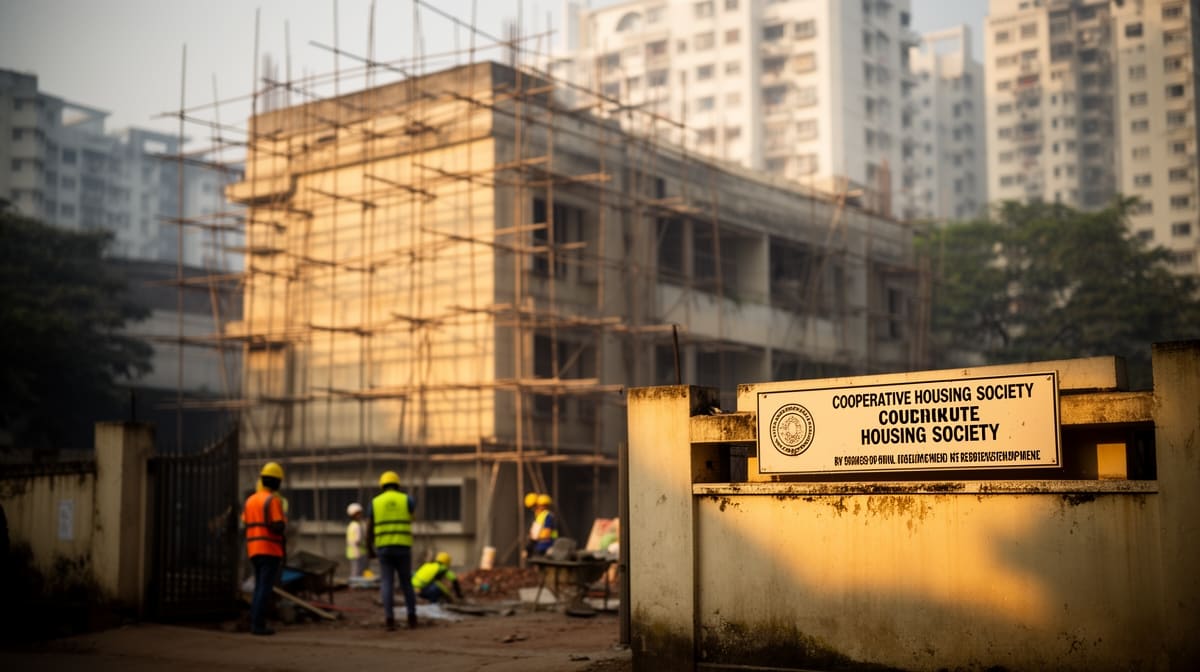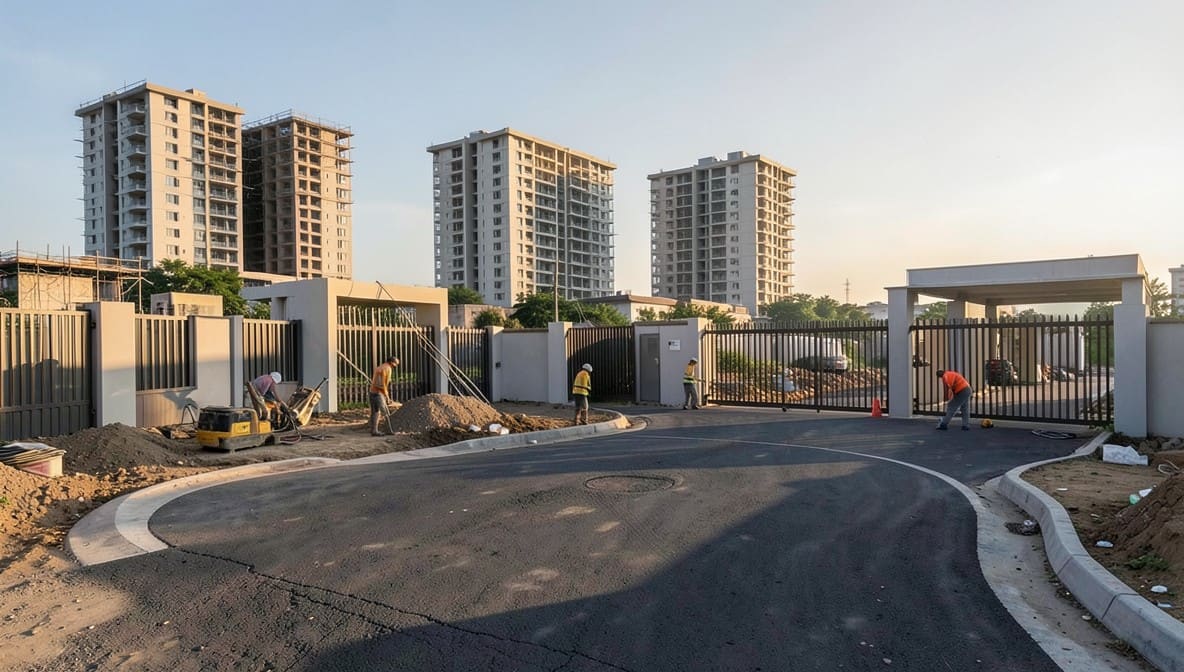
A Residents Welfare Association without contractual standing or authorization from building-wise owners' associations cannot maintain a writ petition challenging construction activities in a private township. The Madras High Court has clarified that such associations lack the legal capacity to enforce collective rights over common amenities when they are neither the Apex Federation nor a duly constituted Owners Association under the Tamil Nadu Apartment Ownership Act, 1994.
Background & Facts
The Dispute
The petitioner, Hirandanani Residents Welfare Association, is a registered society under the Tamil Nadu Societies Registration Act, 1975, formed in 2021. It filed a writ petition under Article 226 of the Constitution seeking a writ of mandamus against the Directorate of Town and Country Planning (DTCP), the State Housing Department, and Hiranandani Realtors Pvt. Ltd. The petitioner alleged that the third respondent was constructing unauthorized pump rooms and tank rooms on the internal circular access road in Phase II of the Hiranandani Gardens township, obstructing free circulation and violating the approved layout plans.
Key Facts
- The Hiranandani township spans 119.47 acres and is being developed in eight phases.
- Phase I is complete; Phase II is substantially complete with the clubhouse and three towers (Octavius, Verona, Seagull) remaining.
- The third respondent obtained approved layout plans in 2012, 2016, and 2020.
- The 2020 plan reduced residential units from 6,882 to 5,839 and eliminated commercial components.
- The petitioner challenged the 2020 revised plan in W.P.No.3935 of 2023, which was dismissed by the Single Judge on 04.07.2023.
- The Division Bench allowed W.A.No.3328 of 2023 on 08.04.2024, quashing the 2020 approval.
- The third respondent filed SLP(C) No.29239 of 2024 in the Supreme Court, which granted status quo on 02.12.2024.
- On 23.04.2025, the Supreme Court directed completion of the Phase II clubhouse by 31.03.2026 and permitted construction of two towers at the promoter’s risk, while restraining further plan modifications.
- On 10.11.2025, the Supreme Court reiterated that construction beyond the scope of the SLP was permitted at the promoter’s risk.
- The petitioner sent a representation dated 21.10.2025 to the DTCP seeking action against the alleged unauthorized structures.
- The third respondent claims the structures are underground STP, pump rooms, water tanks, DG sets, and transformers essential for residential towers.
- The petitioner claims to represent 600 members; the third respondent asserts only 200 are enrolled.
- Total allottees in the township exceed 2,248, each bound by individual Agreements for Sale, Construction Agreements, and Deeds of Sale.
Procedural History
- 2012: First approved layout plan for the township
- 2016: Revised layout plan approved, increasing density
- 2020: Revised plan approved, reducing density and eliminating commercial use
- 2021: Petitioner registered as a society under Tamil Nadu Societies Registration Act
- 2023: W.P.No.3935 filed challenging 2020 plan revision
- 04.07.2023: Single Judge dismissed W.P.No.3935
- 08.04.2024: Division Bench allowed W.A.No.3328, quashing 2020 approval
- 02.12.2024: Supreme Court granted status quo in SLP(C) No.29239 of 2024
- 23.04.2025: Supreme Court ordered completion of clubhouse by 31.03.2026 and permitted construction of two towers at promoter’s risk
- 10.11.2025: Supreme Court clarified liberty to proceed with construction beyond SLP scope
- 21.10.2025: Petitioner sent representation to DTCP seeking action
- 16.04.2026: Writ petition reserved for judgment
- 30.04.2026: Judgment delivered
The Parties' Positions
For the Petitioner
The petitioner argued that the third respondent was constructing unauthorized structures on the circular access road, violating the approved 2012 plan and the quashed 2020 plan. It contended that the Supreme Court’s orders did not permit illegal construction and that the DTCP had a statutory duty under Sections 56 and 57 of the Tamil Nadu Town and Country Planning Act, 1971 to act on its representation.
For the Respondents
The third respondent argued that the petitioner was not a legally recognized Owners Association under the Tamil Nadu Apartment Ownership Act, 1994. It emphasized that each allottee is bound by contractual clauses that vest rights over common amenities in building-wise associations and their Apex Federation, none of which have authorized the petitioner. The respondent further stated that the structures in question are essential service facilities and that the Supreme Court’s order of 10.11.2025 expressly permitted construction beyond the SLP scope.
Relief Sought
The petitioner sought a writ of mandamus directing the DTCP to take immediate action to stop unauthorized construction on the circular access road and to enforce compliance with the approved plans under Sections 56 and 57 of the Town and Country Planning Act, 1971.
The Legal Issue
Can a Residents Welfare Association, not constituted as a building-wise Owners Association or Apex Federation under the Tamil Nadu Apartment Ownership Act, 1994, maintain a writ petition challenging construction activities in a private township where it lacks contractual standing and has not been authorized by the actual rights-holders?
Arguments Presented
For the Petitioner
The petitioner relied on its statutory registration under the Tamil Nadu Societies Registration Act, 1975, and claimed representational standing as a welfare body. It argued that the DTCP had a statutory duty to prevent unauthorized construction under Sections 56 and 57 of the Town and Country Planning Act, 1971, irrespective of the petitioner’s contractual status. It contended that the Supreme Court’s orders did not override statutory obligations of the planning authority.
For the Respondent
The third respondent argued that the petitioner had no locus standi because it was neither a building-wise Owners Association nor the Apex Federation contemplated under Clause 9(d) of the Construction Agreement. It cited Clauses 3.1, 5.1, 5.8, and 8.6 of the Agreement for Sale, which explicitly bar allottees from objecting to development in other phases and confer rights over common areas exclusively on the legally constituted associations. The respondent emphasized that the Supreme Court’s orders of 23.04.2025 and 10.11.2025 expressly permitted construction beyond the SLP scope, and that the petitioner’s grievance was not only contractually barred but also legally moot.
The Court's Analysis
The Court undertook a detailed examination of the contractual framework governing the township. It noted that each allottee enters into three registered instruments: an Agreement for Sale, a Construction Agreement, and a Deed of Sale for undivided share of land. Clause 9(e) of the Construction Agreement mandates the formation of building-wise Owners Associations under the Tamil Nadu Apartment Ownership Act, 1994. Clause 9(d) further requires these associations to form an Apex Federation at the township level. Clause 3.1 of the Agreement for Sale vests joint ownership of common amenities in these associations, not in individual allottees or unaffiliated welfare groups.
"The petitioner is not a building-wise Owners Association of any specific residential building within the township. It is not the Apex Association or Federation formed by the building associations."
The Court held that the petitioner’s status as a general welfare association registered under the Societies Registration Act conferred no legal authority to enforce rights over common areas or to challenge construction in phases not subject to pending litigation. The Court emphasized that Clauses 5.1, 5.8, and 8.6 of the Agreement for Sale expressly prohibit allottees from obstructing construction in other phases and deny them any interest in such developments.
The Court further clarified that the Supreme Court’s orders of 23.04.2025 and 10.11.2025 were unambiguous: they permitted construction of the clubhouse and two towers in Phase II at the promoter’s risk, and expressly reserved liberty to proceed with Phases 3 to 8 beyond the scope of the SLP. The Court rejected the petitioner’s attempt to construe these orders as limiting statutory approvals, stating:
"No one is entitled to read into those orders anything beyond what has been expressly stated."
The Court observed that the alleged structures were ancillary service facilities (STP, pump rooms, water tanks, DG sets) essential for residential towers and compliant with TNCB norms. It held that the petitioner’s grievance was not only without locus but also inconsistent with binding judicial directions.
The Verdict
The writ petition is dismissed. The Court holds that the petitioner lacks locus standi to challenge construction activities in the township. The third respondent is permitted to proceed with construction in Phases 3 to 8 and to complete Phase II infrastructure, including the clubhouse and service facilities, in accordance with law. The DTCP and other regulatory authorities are directed to process applications and grant approvals without being impeded by representations inconsistent with the Supreme Court’s orders. There shall be no order as to costs.
What This Means For Similar Cases
Locus Standi Requires Contractual or Statutory Authorization
- Practitioners must verify whether a petitioner is a legally constituted Owners Association under the Tamil Nadu Apartment Ownership Act, 1994, or an Apex Federation before accepting a writ petition on behalf of residents.
- General welfare associations registered under the Societies Registration Act cannot claim representational standing over common amenities unless expressly authorized by the building-wise associations.
Judicial Orders Bind Regulatory Authorities
- Planning authorities must act on the basis of binding judicial orders and cannot withhold approvals based on third-party complaints that contradict those orders.
- Regulatory bodies like DTCP, TRERA, and TNCB must process applications for completion certificates and permissions without delay when construction is permitted by higher courts.
Contractual Clauses Define Rights in Private Townships
- Agreements for Sale and Construction Agreements that vest rights in Owners Associations override general public interest claims.
- Any challenge to development must originate from the legally recognized entity holding rights over the amenity, not from unaffiliated resident groups.