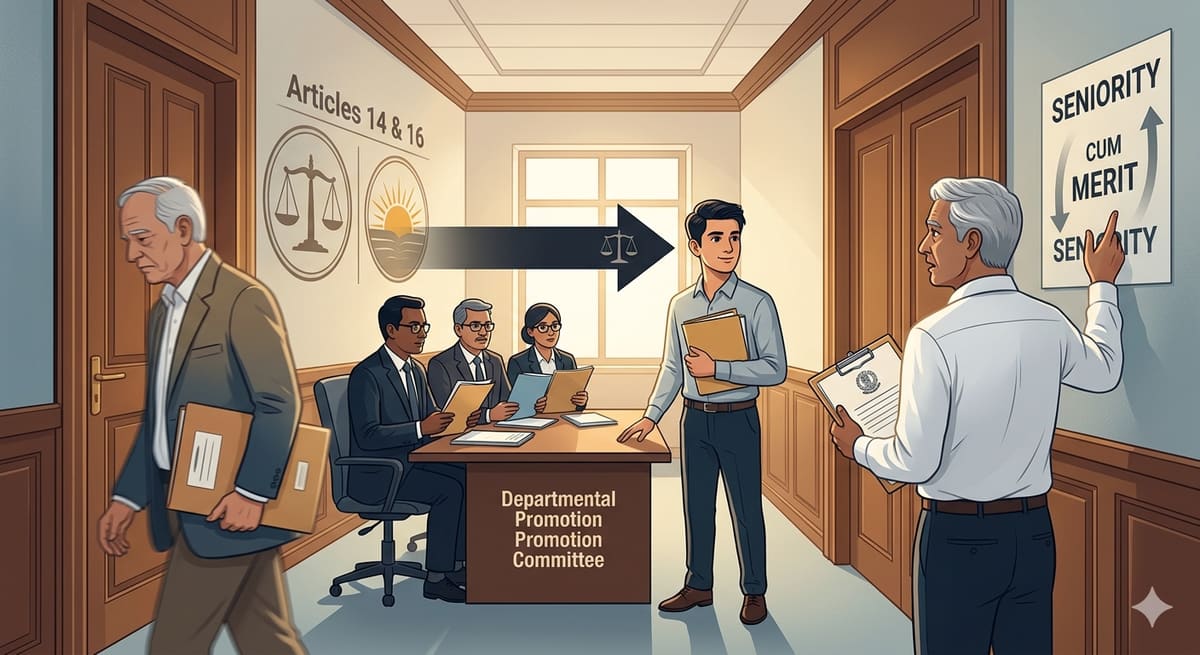
The Bombay High Court has reaffirmed the principle that legitimate expectation and non-arbitrariness under Articles 14 and 16 of the Constitution protect employees when a promotion process is near completion. The Court set aside the Pune Municipal Corporation’s (PMC) decision to cancel a promotional exercise that had progressed to the draft seniority list stage, holding that the PMC Service Rules, 2014 must govern the process, not the subsequently amended rules. This judgment underscores the binding nature of extant rules during an ongoing recruitment process and the unconstitutionality of midway changes to eligibility criteria or selection methods.
Background & Facts
The Dispute
The petitioners, employees of the Pune Municipal Corporation (PMC) holding Class IV posts, challenged the PMC’s decision to cancel the Select List for promotion to the post of Junior Engineer (Civil) after the recruitment process had substantially progressed. The cancellation was effected to align with the amended PMC Service Rules, 2023, which altered the quota, eligibility criteria, and selection method for promotions.
Key Facts
PMC Service Rules, 2014 provided for 75% quota for direct recruitment and 25% quota for promotion to the post of Junior Engineer (Civil).
Educational qualifications for both direct recruitment and promotion were identical: Degree or Diploma in Civil Engineering.
Experience requirements: Three years for direct recruitment; five years of service in PMC for promotion.
Selection method: Promotion was to be based on seniority-cum-merit.
Circular dated 29 January, 2021: PMC invited applications from Class-III and Class-IV employees for promotion to Junior Engineer (Civil). Eligibility: Employees appointed before 31 December, 2015, with five years of uninterrupted service.
Draft Seniority List dated 3 December, 2021: Published by PMC, including the petitioners’ names.
Further Draft Seniority List dated 31 May, 2023: Published for 20 eligible candidates.
Government Resolution dated 14 December, 2023: Amended the PMC Service Rules, 2014, reducing the promotion quota from 25% to 15%, changing the educational qualification to Full-Time Degree/Diploma in Civil Engineering, and altering the selection method from seniority-cum-merit to merit through examination.
Circular dated 20 December, 2023: PMC announced a written examination for promotion to Junior Engineer (Civil), scheduled for 28 January, 2024.
Impugned Order dated 11 June, 2025: PMC cancelled the promotion process initiated by the Circular dated 29 January, 2021, citing the need to comply with the amended 2023 Rules.
Procedural History
17 November, 2022: Pune Mahanagarpalika Kamgar Union filed Writ Petition No. 15966 of 2022, seeking direction to PMC to complete the promotion process under the 2014 Rules.
17 June, 2023: PMC filed a reply affidavit in WP No. 15966/2022, stating it was in the process of making promotions under due process.
11 January, 2024: The High Court disposed of WP No. 15966/2022, keeping all contentions open.
2024: Affected employees filed Writ Petition No. 1096 of 2024, challenging the Government Resolution dated 14 December, 2023 and seeking completion of the promotion process under the 2014 Rules.
30 June, 2026: The present batch of petitions was heard and reserved for judgment.
2 July, 2026: Judgment pronounced.
The Parties' Positions
Petitioners’ Contention
The promotion process commenced on 29 January, 2021 and reached an advanced stage with the publication of draft seniority lists on 3 December, 2021 and 31 May, 2023.
The amendment to the Service Rules on 14 December, 2023 could not retrospectively apply to an ongoing process.
Reliance was placed on the Constitution Bench decision in Tej Prakash Pathak & Ors. v. Rajasthan High Court & Ors., which held that eligibility criteria cannot be altered midway through a recruitment process.
The impugned cancellation was arbitrary and violated Articles 14 and 16 of the Constitution.
PMC had filled 135 posts by direct recruitment and issued advertisements for 169 additional posts, leaving no vacancies for promotion under the 25% quota.
Respondents’ Contention
The PMC contended that the promotion process was not finalized, and no appointment orders were issued.
The amended 2023 Rules were applicable as the vacancies remained unfilled.
Reliance was placed on the Supreme Court decision in State of Himachal Pradesh v. Raj Kumar & Ors., which held that vacancies occurring prior to amendment need not be filled under old rules if a policy decision is taken to apply new rules.
Relief Sought
The petitioners sought:
Quashing of the impugned order dated 11 June, 2025, cancelling the promotion process.
Declaration that the Government Resolution dated 14 December, 2023 is inapplicable to the promotion process initiated by the Circular dated 29 January, 2021.
Injunction restraining PMC from filling posts by direct recruitment until the promotion process is completed.
Direction to PMC to complete the promotion process under the unamended 2014 Rules.
The Legal Issue
The central question was whether PMC could cancel a near-complete promotion process initiated under the PMC Service Rules, 2014, and apply the amended 2023 Rules, which altered the quota, eligibility criteria, and selection method, thereby depriving the petitioners of their legitimate expectation and right to equal opportunity under Articles 14 and 16 of the Constitution.
Arguments Presented
For the Petitioners
Reliance on Tej Prakash Pathak & Ors.: The Constitution Bench held that eligibility criteria cannot be changed midway through a recruitment process, as it violates Articles 14 and 16.
Legitimate Expectation: The petitioners had a legitimate expectation that the process would be completed under the 2014 Rules, especially after the publication of draft seniority lists.
Arbitrariness: The impugned cancellation was arbitrary, as PMC failed to justify the delay or the decision to apply the 2023 Rules.
RTI Revelation: A legal opinion obtained by PMC under the Right to Information Act, 2005 advised against cancelling the process, yet PMC proceeded arbitrarily.
For the Respondents
No Final Appointment Orders: The promotion process was not finalized, and vacancies remained unfilled.
Applicability of New Rules: The amended 2023 Rules applied as the vacancies were not filled under the 2014 Rules.
Reliance on State of Himachal Pradesh v. Raj Kumar & Ors.: The Supreme Court held that vacancies need not be filled under old rules if a policy decision is taken to apply new rules.
Policy Decision: The decision to apply the 2023 Rules was a valid policy decision and could not be challenged.
The Court's Analysis
The Court conducted a detailed analysis of the legal principles governing the case, focusing on legitimate expectation, non-arbitrariness, and the binding nature of extant rules during an ongoing recruitment process.
Admitted Facts
The promotion process commenced on 29 January, 2021 under the PMC Service Rules, 2014.
The petitioners were eligible under the 2014 Rules, which provided for 25% quota for promotion based on seniority-cum-merit.
Draft seniority lists were published on 3 December, 2021 and 31 May, 2023, including the petitioners’ names.
The impugned order dated 11 June, 2025 cancelled the process to apply the amended 2023 Rules, which reduced the quota to 15%, changed the eligibility criteria to Full-Time Degree/Diploma, and altered the selection method to merit through examination.
Legitimate Expectation and Non-Arbitrariness
The Court held that the petitioners had a legitimate expectation that the process would be completed under the 2014 Rules, especially after the publication of draft seniority lists. The impugned cancellation was arbitrary, as PMC failed to justify the delay of nearly four years or the decision to apply the 2023 Rules.
"It was a legitimate expectation of the petitioners that the PMC Service Rules, 2014 would be applied and that such completion of the selection exercise, would not be governed by any new rules which, in any case, at the relevant time were not in existence."
Binding Nature of Extant Rules
The Court relied on the Constitution Bench decision in Tej Prakash Pathak & Ors., which held:
Recruitment process commences with the issuance of the advertisement and ends with the filling of vacancies.
Eligibility criteria cannot be changed midway unless the extant rules permit it, and even then, the change must meet the test of non-arbitrariness under Article 14.
Extant rules having statutory force are binding on the recruiting body in terms of procedure and eligibility.
Placement in the select list does not confer an indefeasible right to appointment, but if vacancies exist, the State cannot arbitrarily deny appointment to a candidate within the zone of consideration.
The Court held that the 2014 Rules were binding on PMC, and the impugned cancellation violated the principles of non-arbitrariness and legitimate expectation.
Distinguishing State of Himachal Pradesh v. Raj Kumar & Ors.
The Court distinguished the Supreme Court decision in State of Himachal Pradesh v. Raj Kumar & Ors., which held that vacancies need not be filled under old rules if a policy decision is taken to apply new rules. The Court observed that the present case was governed by Tej Prakash Pathak & Ors., as the promotion process was near completion, and the amended 2023 Rules could not retrospectively apply.
The Verdict
The Court allowed the petitions and passed the following directions:
Quashed and set aside the impugned order dated 11 June, 2025, cancelling the promotion process.
Declared that the promotion process initiated under the Circular dated 29 January, 2021 shall be governed by the PMC Service Rules, 2014 in regard to eligibility criteria and selection method.
Directed PMC to conclude the promotion process within three weeks, issuing appointment orders with seniority conferred from the relevant date.
What This Means For Similar Cases
Legitimate Expectation Protects Employees in Near-Complete Processes
Practitioners must argue that legitimate expectation arises when a recruitment process reaches an advanced stage, such as the publication of draft seniority lists.
Courts are likely to protect employees when the process is near completion, and extant rules are binding unless a valid justification is provided for midway changes.
Extant Rules Are Binding During Ongoing Recruitment
Recruitment processes initiated under specific rules must be completed under those rules, unless the rules themselves permit midway changes.
Changes to eligibility criteria, quota, or selection method midway through a process are arbitrary and unconstitutional unless justified under Article 14.
Policy Decisions Must Be Fair and Non-Arbitrary
Public authorities must ensure that policy decisions are fair, transparent, and non-arbitrary.
Delays in completing recruitment processes without justification will be viewed skeptically by courts, especially when direct recruitment is prioritized over promotions.
Legal opinions obtained by authorities must be followed, and deviations must be adequately justified to avoid arbitrariness.
Actionable Takeaways for Practitioners
Challenge midway changes to recruitment rules by relying on legitimate expectation and non-arbitrariness under Articles 14 and 16.
Highlight delays in completing recruitment processes, especially when direct recruitment is prioritized over promotions.
Argue for the binding nature of extant rules during ongoing processes, citing Constitution Bench decisions like Tej Prakash Pathak & Ors..
Seek injunctions to prevent authorities from filling posts by direct recruitment until promotion processes are completed under extant rules.