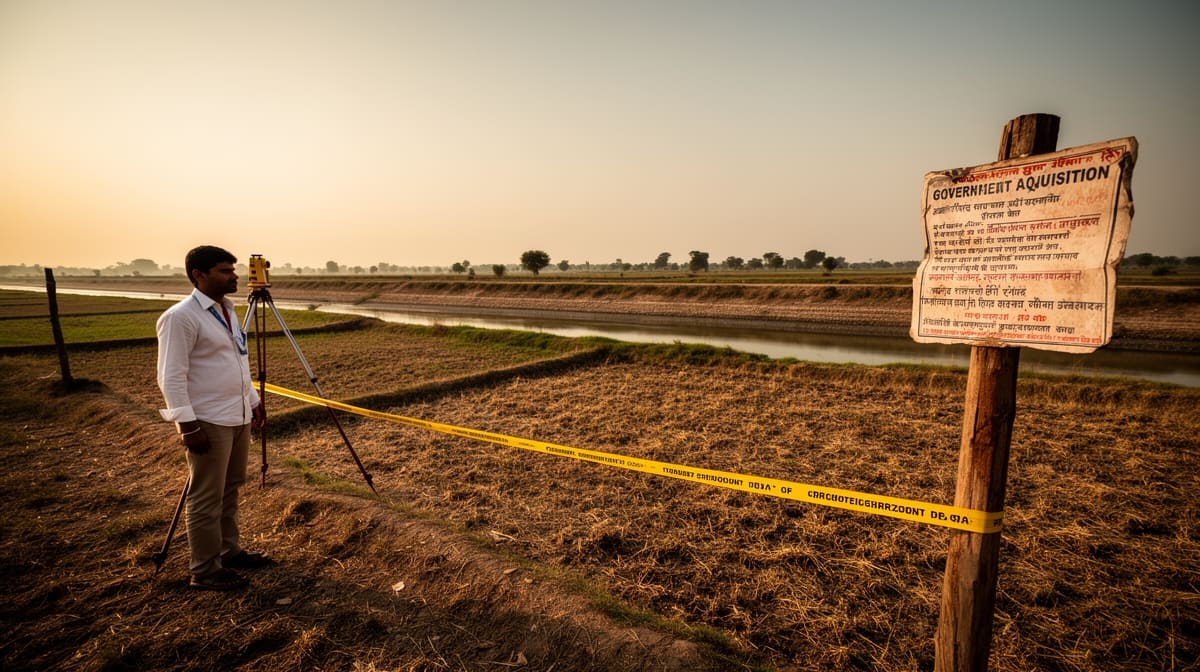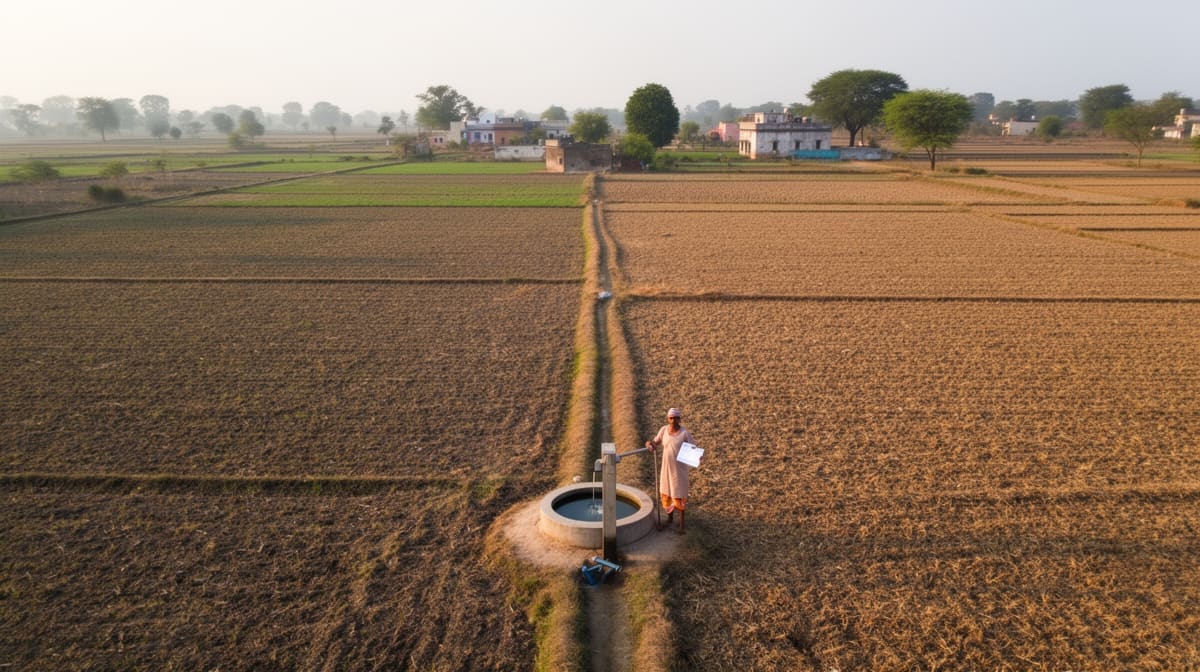
The Bombay High Court has clarified that a defective notification under the National Highways Act, 1956 - particularly one failing to identify the precise portion of land to be acquired - cannot be cured by mere delay or completion of the project. The Court directed compensation at a fixed rate of Rs. 4,240 per sq. mtr., matching that granted to similarly situated landowners, to balance legal rights with public interest.
Background & Facts
The Dispute
The petitioners, farmers from village Pangarwadi (Shivar), Tal. Sinnar, Dist. Nashik, challenged the acquisition of their agricultural land in Gut No. 897 for the construction of National Highway No. 50 between Pune and Nashik. The acquisition was initiated under Section 3A of the National Highways Act, 1956, but the notification described the land merely as "agricultural land - dry" from Gut No. 897(P), measuring 0.88 R, without specifying which portion of the 8H 35R total land in the Gut was targeted. The petitioners contended that the actual land acquired included four wells, the sole source of irrigation for their farms, contradicting the notification’s description.
Key Facts
- The petitioners’ land in Gut No. 897 totaled 8H 35R (approx. 9.35 acres), as per 7/12 revenue records.
- The notification dated 2007 under Section 3A of the National Highways Act, 1956, described the land as "agricultural land - dry" and specified only 0.88 R (approx. 0.22 acres) to be acquired, without any plan or boundary delineation.
- The petitioners raised objections during the acquisition process, including in 2012, 2013, and 2015, asserting that the alignment was altered to favor politically influential landowners in adjoining Guts 896 and 908.
- On 25th November, 2011, the award was issued, but the petitioners refused compensation, citing defective identification of land.
- On 2nd August, 2016, the Dy. Superintendent of Land Records, Sinnar, wrote to NHAI acknowledging that joint measurements for Guts 896, 897, and 908 were conducted hastily under police protection, with boundary lines not properly identified.
- On 8th July, 2016, the same officer recommended rectification of measurements for Guts 896 and 908.
- On 20th November, 2017, NHAI offered enhanced compensation of Rs. 4,240 per sq. mtr. to landowners in Gut No. 896, acknowledging a defect: instead of 0.28 R, 0.81 R had been utilized.
- On 21st November, 2017, Sale Deeds were executed with Gut No. 896 landowners at Rs. 4,240 per sq. mtr.
- No such rectification or enhanced offer was made to the petitioners in Gut No. 897.
- Possession of the petitioners’ land was taken forcibly on 24th May, 2017, while they were at the Collector’s office raising grievances.
- The highway construction was completed in 2022.
Procedural History
- 2007: Notification issued under Section 3A of the National Highways Act, 1956.
- 25.11.2011: Land Acquisition Award issued.
- 2012 - 2016: Repeated representations by petitioners to authorities regarding defective description and discriminatory treatment.
- 02.08.2016: Dy. Superintendent of Land Records admits joint measurement defects in Guts 896, 897, and 908.
- 20.11.2017: NHAI offers Rs. 4,240/sq. mtr. to Gut No. 896 landowners.
- 21.11.2017: Sale Deeds executed with Gut No. 896 landowners.
- 24.05.2017: Possession of petitioners’ land taken.
- 05.02.2017: Writ Petition No. 4786 of 2018 filed before Bombay High Court.
- 23.03.2026: Judgment reserved.
- 05.05.2026: Judgment pronounced.
The Parties' Positions
Petitioners: Argued that the notification under Section 3A was legally defective for failing to identify the specific portion of land, violating statutory requirements. They claimed discrimination as adjoining landowners received enhanced compensation while they were denied the same. They sought compensation at Rs. 4,240 per sq. mtr., matching Gut No. 896.
Respondents (NHAI, Dy. Collector, etc.): Contended that the petition was barred by delay and laches, as the award was issued in 2011. They argued that compensation had been deposited and that the petitioners had not approached the Arbitrator under the 1956 Act. They denied discrimination, asserting that Gut No. 896 landowners were not similarly situated.
Relief Sought
The petitioners sought:
- Declaration that the acquisition notification was invalid due to defective description.
- Compensation at Rs. 4,240 per sq. mtr. for the land acquired.
- Payment of compensation within a specified timeframe.
- Direction to treat the date of possession (24.05.2017) as the relevant date for compensation calculation.
The Legal Issue
The central question was whether a notification under Section 3A of the National Highways Act, 1956, which fails to identify the specific portion of land to be acquired from a larger survey number, is legally invalid, and whether the remedy lies in quashing the notification or in adjusting compensation to reflect market value as of the date of possession and parity with similarly situated landowners.
Arguments Presented
For the Petitioner
Counsel relied on Barangore Jute Factory and Others v. Competent Authority (2005) 13 SCC 477, arguing that the notification’s failure to specify which part of Gut No. 897 was being acquired rendered it vague and non-compliant with statutory mandates. The petitioners emphasized that the description "agricultural land - dry" was misleading, as the actual land taken included wells. They cited the letter from the Dy. Superintendent of Land Records dated 02.08.2016, proving the defect was known to authorities. They further argued that discrimination occurred when landowners in Gut No. 896 received enhanced compensation at Rs. 4,240 per sq. mtr. on the same basis, and that the petitioners had continuously raised objections since 2012, negating any claim of laches.
For the Respondent
The AGP contended that the petition was time-barred, as the award was passed in 2011 and the petition filed in 2017. They argued that the petitioners had not availed themselves of the remedy under the 1956 Act to approach the Arbitrator for enhanced compensation. They denied discrimination, asserting that the rectification in Gut No. 896 was based on a factual finding of additional land used (0.53 R extra), which did not apply to the petitioners. They also emphasized the national importance of the highway and its completion in 2022, arguing that quashing the award would cause public harm.
The Court's Analysis
The Court undertook a detailed analysis of Barangore Jute Factory, a precedent directly on point. The Supreme Court in that case held that when only a portion of a larger land parcel is acquired, the notification must clearly identify the specific portion. A mere description like "agricultural land - dry" without a plan or boundary delineation renders the notification legally defective, as it deprives landowners of the ability to object or claim accurate compensation.
"The absence of information as to which part of the land is being acquired makes the description insufficient, rather vague. The owners are not in a position to identify the land under acquisition. It also renders it impossible to make claim regarding compensation..."
The Court found that the notification in the present case suffered from the same fatal defect: it failed to specify which 0.88 R portion of the 8H 35R land in Gut No. 897 was targeted. The petitioners’ 7/12 extract confirmed the total land area, yet the notification provided no map, plan, or boundary description.
The Court rejected the respondents’ plea of delay, citing Barangore Jute Factory’s holding that a statutory defect goes to the root of the notification’s validity and cannot be cured by lapse of time. The petitioners had continuously raised objections since 2012 and were still in possession until May 2017.
The Court further found merit in the claim of discrimination. The authorities acknowledged the measurement defect in Guts 896 and 908, rectified it, and granted enhanced compensation. Yet, no such action was taken for the petitioners in Gut No. 897, despite identical factual circumstances. The Court noted that the letter dated 20.11.2017 from NHAI itself conceded the defect extended to the petitioners’ land.
While acknowledging that quashing the notification would disrupt a completed national project, the Court followed the Barangore Jute Factory approach: instead of invalidating the acquisition, it opted for equitable relief. The Court accepted the petitioners’ specific request - made on their instructions - to be compensated at the same rate of Rs. 4,240 per sq. mtr. granted to the similarly situated landowners in Gut No. 896, calling it a just and practical resolution.
The Verdict
The petitioners succeeded. The Court directed the respondents to pay compensation to the petitioners at the rate of Rs. 4,240 per square meter for the extent of land acquired and utilized for the highway. The amount shall be calculated and paid within eight weeks from the date of judgment. All pending applications stand disposed of.
What This Means For Similar Cases
Defective Notifications Cannot Be Ignored by Delay
- Practitioners must challenge acquisition notifications under Section 3A of the National Highways Act, 1956 if they lack precise land description, even years after the award.
- Delay is not a bar if the defect is fundamental - courts will not allow authorities to benefit from their own statutory non-compliance.
- Landowners should preserve all correspondence and revenue records (e.g., 7/12 extracts) to prove the discrepancy between notification and actual land.
Parity in Compensation Is a Legal Right
- Where authorities grant enhanced compensation to one group of landowners due to measurement errors, they cannot deny the same to others in identical circumstances.
- Discriminatory treatment in land acquisition violates Article 14 of the Constitution and may be challenged even post-possession.
- Evidence of comparable compensation offers (e.g., letters, sale deeds) must be immediately secured and produced in litigation.
Compensation Date May Shift to Possession
- While market value as of notification date is the norm, courts may shift the relevant date to possession if the notification is defective and possession occurs much later.
- This principle, established in Barangore Jute Factory, now applies in Maharashtra and beyond for highway acquisitions.
- Practitioners should argue for the date of actual dispossession as the valuation date when the initial notification is legally flawed.