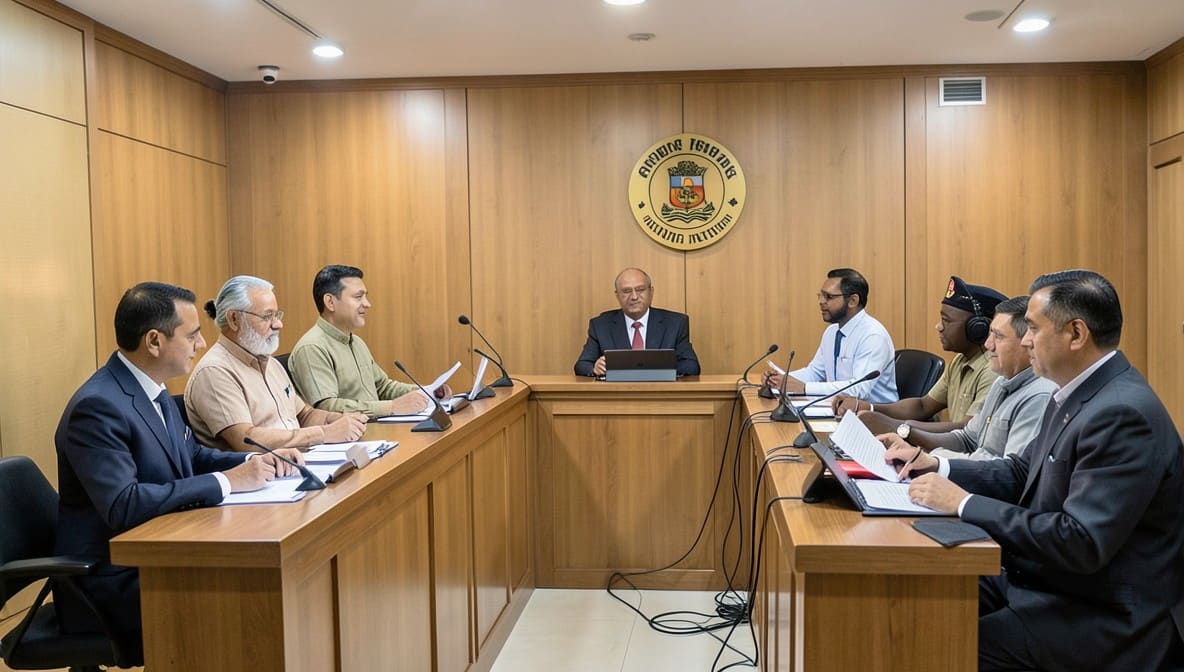
The Karnataka High Court has underscored the importance of natural justice in administrative proceedings, directing authorities to afford the petitioner an opportunity to respond before imposing a One-Time Settlement (OTS) Penalty of Rs. 12,85,61,302 under the Karnataka Minor Mineral Concession Rules, 1994. The judgment reinforces that even in regulatory matters, procedural fairness must precede punitive action.
Background & Facts
The Dispute
The petitioner, Sri C.K. Devaraju, a resident of Mandya, Karnataka, challenged a notice dated 18.05.2026 issued by the Senior Geologist (Respondent No. 3) under Rule 44A of the Karnataka Minor Mineral Concession Rules, 1994 (KMMC Rules). The impugned notice directed the petitioner to pay an OTS Penalty of Rs. 12,85,61,302 in four equal installments within six months (45 days per installment).
Key Facts
- The petitioner was engaged in mining-related activities subject to the KMMC Rules
- The OTS Penalty was imposed without prior notice or opportunity to respond
- The penalty amount was calculated based on undisclosed material
- The petitioner contended the notice violated Articles 14 and 21 of the Constitution of India
Procedural History
- 18.05.2026: Notice issued by Respondent No. 3 under Rule 44A of KMMC Rules
- 2026: Writ Petition (WP No. 17252 of 2026) filed before the Karnataka High Court
- 12.06.2026: Preliminary hearing held before the Division Bench
Relief Sought
The petitioner sought:
- Quashing of the notice dated 18.05.2026 (Annexure-A)
- A declaration that the notice violated Articles 14 and 21 of the Constitution
- Directions to the respondents to comply with principles of natural justice before imposing any penalty
The Legal Issue
The central question was whether the OTS Penalty under Rule 44A of the KMMC Rules could be imposed without:
- Disclosing the material basis for the penalty
- Affording the petitioner an opportunity of being heard
Arguments Presented
For the Petitioner
- The impugned notice was issued without any prior show-cause notice or opportunity to respond
- The OTS Penalty was calculated based on undisclosed material, violating natural justice principles
- The action was arbitrary, contravening Article 14 of the Constitution
- Reliance was placed on Maneka Gandhi v. Union of India to argue that procedural fairness is intrinsic to Article 21
For the Respondent
- The Additional Government Advocate submitted that the impugned notice could be treated as a show-cause notice
- Requested the court to permit the petitioner to submit objections within two weeks
- Assured that the authorities would consider the petitioner’s response and take an informed decision after a hearing
The Court's Analysis
The Court observed that the OTS Penalty was imposed without adhering to procedural fairness, which is a fundamental requirement under Article 14 and Article 21 of the Constitution. The judgment emphasized:
"The petitioner was neither provided with any material on the basis of which the said demand is premised, nor afforded any opportunity of being heard."
The Court relied on the principle that administrative actions must comply with natural justice, even in regulatory matters. It noted that the Additional Government Advocate’s submission - to treat the impugned notice as a show-cause notice - was a pragmatic solution to ensure fairness. The Court directed:
- The petitioner to respond to the notice within two weeks
- The authorities to consider the petitioner’s objections and take an informed decision after affording a hearing
The Court clarified that all contentions of the parties are kept open, ensuring that the petitioner’s rights are not prejudiced by the disposal of the writ petition.
The Verdict
The Court disposed of the writ petition with the following directions:
- The impugned notice dated 18.05.2026 shall be treated as a show-cause notice
- The petitioner shall submit objections within two weeks from the date of the judgment
- The respondents shall consider the petitioner’s response and take an informed decision after affording a hearing
- All contentions of the parties are kept open for future adjudication
What This Means For Similar Cases
Natural Justice Is Non-Negotiable in Administrative Actions
- Practitioners must emphasize that even regulatory penalties require compliance with natural justice principles
- The judgment reinforces that Article 14 and Article 21 mandate procedural fairness, regardless of the nature of the dispute
Show-Cause Notices Must Precede Punitive Action
- Authorities cannot impose OTS Penalties or similar demands without first issuing a show-cause notice
- The judgment sets a precedent that undisclosed material cannot form the basis of a penalty
- If a notice is issued without prior opportunity, courts may direct authorities to reconsider the matter after hearing objections
Strategic Use of Government Advocate’s Submissions
- The Additional Government Advocate’s submission played a pivotal role in resolving the dispute
- Practitioners can leverage similar submissions in future cases to convert punitive notices into show-cause notices
- This approach ensures that procedural safeguards are not bypassed, even in regulatory matters