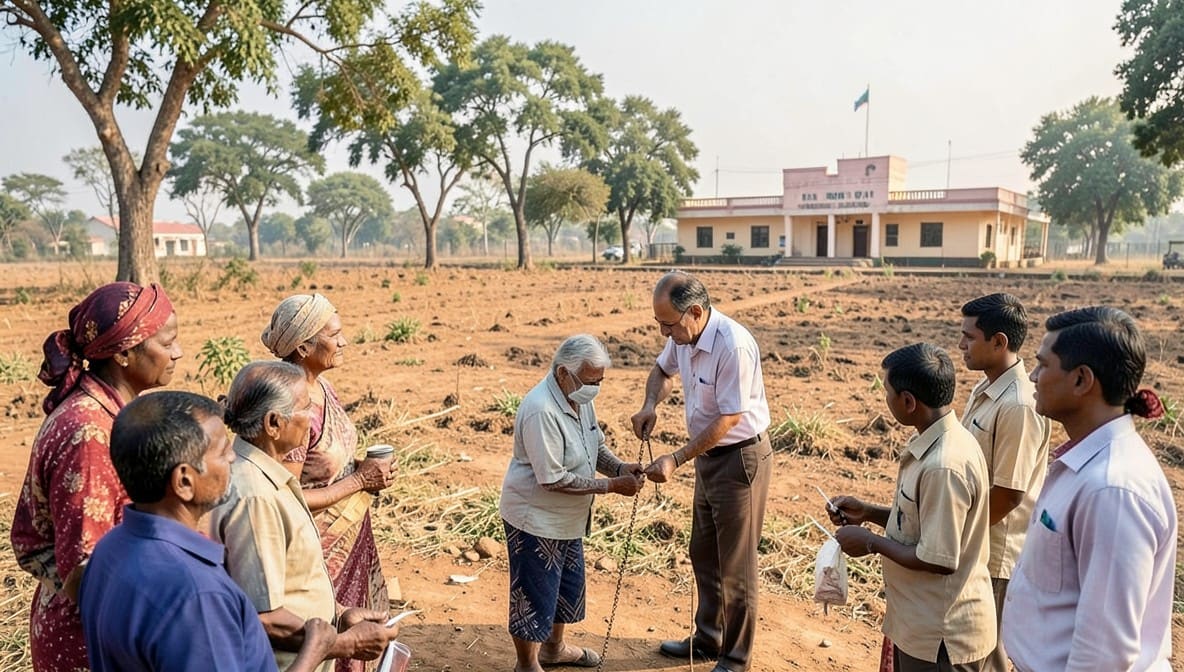
The Karnataka High Court has affirmed that a religious institution’s lawful grant of government land cannot be overturned by claimants who failed to file a valid statutory application, lacked locus standi, and pursued mutually inconsistent legal positions across multiple forums. The judgment underscores that long-standing unauthorised possession, without statutory compliance, does not create enforceable rights against the State.
Background & Facts
The Dispute
The dispute centres on two survey numbers - Sy.No.35 (1 acre 2 guntas) and Sy.No.37 (1 acre 31 guntas) - located in Bichali village, Raichur Taluk, Karnataka. These lands, classified as Government land (Kharij Khata/Parampok), have been occupied since at least the 1950s by the family of late Sri Badada Appannacharya, who is claimed to have established an Ekshila Brindavana of Sri Raghavendra Swamy on the site following the saint’s visit in 1658 A.D. The appellants, descendants of Appannacharya, assert a hereditary right to manage the religious site and seek grant of the land for its better administration. The respondents, including the State of Karnataka and the Sri Raghavendra Swamy Mutt, contend that the appellants have no legal title and that the Mutt, as the institutional custodian of the saint’s legacy, lawfully obtained the grant.
Key Facts
- The appellants are seven individuals, including hereditary archakas and their legal representatives, residing in Bichali village and Hyderabad.
- The Sri Raghavendra Swamy Mutt, based in Nanjangud, Mysore, is a recognised religious institution managing the spiritual legacy of Sri Raghavendra Swamy.
- The appellants submitted an informal letter dated 24.06.2006 to the Assistant Commissioner, Raichur Circle, requesting grant of Sy.No.37 only, citing ancestral religious use.
- No application was filed in Form 57 under Section 94-A of the Karnataka Land Revenue Act, 1964, nor was any fee of Rs.100 paid.
- A registered Trust, Japadakatti Bichali Appanacharya Seva Trust, filed an application for regularisation under Section 94-A on 15.01.2021, but this Trust was not a party to the writ petition.
- The Mutt submitted a formal application under Rule 21 of the Karnataka Land Grant Rules, 1969, on 10.01.2021, supported by documents.
- The Deputy Commissioner conducted a field inspection on 18.01.2021 and recommended the grant.
- The State Government accorded prior approval on 24.02.2022.
- The Deputy Commissioner issued the final grant order on 28.03.2022, fixing the price at 50% of market value under Rule 22-A(1)(i)(4).
- The appellants filed a Public Interest Litigation (W.P.No.20968/2021) on 15.12.2021, which was dismissed on 07.03.2022 after the State disclosed the proposed grant.
- Three days later, on 10.03.2022, the appellants filed O.S.No.59/2022 seeking declaration of title by adverse possession and a declaration that any future grant would not bind them.
- O.S.No.113/2016, filed by appellants 1 and 3 against appellants 2 and 4, alleged disputes over hereditary pooja rights, with defendants accusing appellants of fraudulently collecting donations and misusing flood compensation.
- O.S.No.59/2022 was dismissed on 15.03.2026.
Procedural History
- 24.06.2006: Informal letter submitted by appellants to Assistant Commissioner, Raichur Circle.
- 10.01.2021: Mutt submits formal application under Rule 21 of Karnataka Land Grant Rules, 1969.
- 15.01.2021: Japadakatti Bichali Appanacharya Seva Trust files application under Section 94-A of Karnataka Land Revenue Act.
- 18.01.2021: Deputy Commissioner conducts field inspection of the land.
- 24.02.2022: State Government issues prior approval for grant to Mutt.
- 28.03.2022: Deputy Commissioner issues final grant order in favour of Mutt.
- 15.12.2021: W.P.No.20968/2021 (PIL) filed by appellants.
- 07.03.2022: PIL dismissed by High Court after disclosure of proposed grant.
- 10.03.2022: O.S.No.59/2022 filed by appellants seeking adverse possession and injunction against future grants.
- 21.03.2022: W.P.No.200817/2022 filed by appellants challenging Government Order dated 24.02.2022.
- 02.04.2026: Single Judge dismisses W.P.No.200817/2022.
- 29.04.2026: Division Bench hears Writ Appeal No.200116/2026 and delivers judgment.
The Parties' Positions
The appellants claim ancestral, hereditary religious possession since 1658 A.D., asserting that their family has maintained the Brindavana and conducted daily rituals. They argue that their 2006 letter constituted a valid application and that the authorities were obligated to consider it before granting land to the Mutt. They further contend that the Mutt is not a charitable institution and thus ineligible under Rule 21.
The respondents, including the State and the Mutt, argue that the appellants’ 2006 letter is an informal, non-statutory communication, not filed with the prescribed authority or in the prescribed form. They assert that the Mutt’s application was complete, lawful, and processed under Rule 21, and that the appellants’ conduct across multiple suits reveals inconsistent, contradictory, and mala fide claims.
Relief Sought
The appellants sought:
- Quashing of Government Order dated 24.02.2022 and final grant order dated 28.03.2022.
- Direction to the State to consider their 2006 application and grant them the land.
- Declaration that their possession is lawful and that the Mutt’s grant is invalid.
The Legal Issue
The central questions were: (1) Whether the appellants’ 2006 letter constituted a valid statutory application for regularisation under Section 94-A of the Karnataka Land Revenue Act, 1964; (2) Whether the writ petition was maintainable when the appellants lacked locus standi and failed to challenge the final grant order; and (3) Whether the Mutt’s grant under Rule 21 of the Karnataka Land Grant Rules, 1969, was legally valid despite the invocation of Rule 108-N of the Karnataka Land Revenue Rules.
Arguments Presented
For the Appellant/Petitioner
Sri Dhyan Chinnappa, Senior Counsel, argued that the 2006 letter, though informal, was a substantive claim predating the Trust’s formation and should be treated as an application under Section 94-A. He contended that the appellants’ decades-long possession conferred locus standi and that the authorities were duty-bound to consider their prior claim before granting land to the Mutt. He further argued that Rule 108-F(iv) (requiring the applicant to be a bona fide agriculturist) was inapplicable since the land was used for religious purposes, not agriculture. He also challenged the invocation of Rule 108-N, asserting it could not be used to grant land under Rule 21, as the two schemes are distinct.
For the Respondent/State
Dr. Archana P. Tiwari, Additional Advocate General, countered that the 2006 letter was not an application under any statutory provision - it was addressed to the wrong authority, not in Form 57, unpaid, and covered only one survey number. She submitted that the Trust’s application could not be attributed to the individual appellants, who were not parties to it. She highlighted the appellants’ inconsistent pleadings: claiming adverse possession in O.S.No.59/2022, hereditary rights in O.S.No.113/2016, and regularisation here. She argued that the Mutt’s grant was lawful under Rule 21, which includes temples as eligible institutions, and that Rule 108-N’s mention was incidental and did not vitiate the grant.
The Court's Analysis
The Court conducted a meticulous analysis of each legal issue, grounding its reasoning in statutory interpretation and procedural compliance.
"The requirements go to jurisdiction, not mere formality. A letter that was never filed before the prescribed authority, in the prescribed form, through the prescribed channel, is not an application under the scheme at all, there is no substance to which any form could be given."
On Point I, the Court held that Rule 108-CCC mandates that applications for regularisation under Section 94-A must be filed with the Tahsildar in Form 57 with a fee of Rs.100. The appellants’ 2006 letter, addressed to the Assistant Commissioner, lacking fee and form, was not a statutory application. The Court rejected the argument that substance should prevail over form, noting that these are jurisdictional prerequisites.
On Point II, the Court found the writ petition non-maintainable on three independent grounds: (1) lack of locus standi, as the appellants had no valid application pending; (2) failure to challenge the final grant order dated 28.03.2022, which had merged with the prior approval dated 24.02.2022; and (3) the appellants’ conduct, particularly the second relief in O.S.No.59/2022, which explicitly sought to nullify the grant they now claimed to be unaware of.
"A person who files a suit to neutralise a known grant cannot maintain in a contemporaneous Writ Petition that he was unaware of that grant."
On Point III, the Court agreed that Rule 108-N of the KLR Rules applies only to the regularisation scheme and not to Rule 21 grants. However, it held that the grant was substantively valid under Rule 21, and the incidental reference to Rule 108-N did not invalidate the order. The Court further held that the Mutt qualified as a religious and charitable institution under Rule 21, as its activities - including Annadana and healthcare - fell within the legislative intent of the proviso.
On Point IV, the Court rejected the appellants’ argument that Rule 108-F(iv) was inapplicable. It held that Section 94-A and its rules are designed exclusively for agricultural regularisation. Since the appellants admitted the land was used for religious purposes and they were not agriculturists, they were entirely outside the scheme’s scope.
On Point V, the Court found that the Mutt’s application followed every step under Rule 21: formal application, field inspection, prior Government approval, final grant order, and correct pricing under Rule 22-A(1)(i)(4). No procedural flaw was established.
On Point VI, the Court concluded that the Single Judge’s order was legally sound, factually grounded, and free from error. The reliance on pleadings from O.S.No.113/2016 was permissible as conduct evidence, and the dismissal of O.S.No.59/2022 confirmed the correctness of the assessment.
The Verdict
The Writ Appeal was dismissed. The order dated 02.04.2026 of the Single Judge was affirmed. The Government Order dated 24.02.2022 and the final grant order dated 28.03.2022 in favour of the Sri Raghavendra Swamy Mutt for Sy.Nos.35 and 37 are upheld and shall continue in full force. The appellants are cautioned that any further attempt to obstruct the Mutt’s possession of the land without legal basis will be treated as abuse of process.
What This Means For Similar Cases
Statutory Compliance Is Non-Negotiable
- Practitioners must ensure applications under land regularisation schemes strictly comply with form, fee, and authority requirements under the Karnataka Land Revenue Act and Rules.
- Informal letters, even if supported by long possession, cannot substitute statutory applications.
- Failure to file in Form 57 or pay the prescribed fee renders an application void ab initio.
Locus Standi Requires a Valid Legal Claim
- Mere occupation, however longstanding, does not confer standing to challenge a State grant.
- A party must have a pending, valid statutory application to challenge a competing grant.
- Trust members cannot derive standing from a Trust’s application unless the Trust is a party to the proceeding.
Inconsistent Pleadings Undermine Credibility
- Courts treat contradictory claims across multiple proceedings as evidence of mala fides.
- Claims of adverse possession and regularisation of unauthorised occupation are legally incompatible and cannot be advanced simultaneously.
- Admissions in pleadings, even if later compromised, remain admissible as conduct evidence.
Religious Institutions May Qualify Under Rule 21 Without Explicit Charity
- Institutions like temples, mathas, and mutts that serve the public through Annadana, education, or healthcare qualify as "religious and charitable" under Rule 21.
- The legislative intent, not narrow semantics, governs eligibility.
- Grants to such institutions are protected if procedurally compliant, even if ancillary statutory references are erroneous.