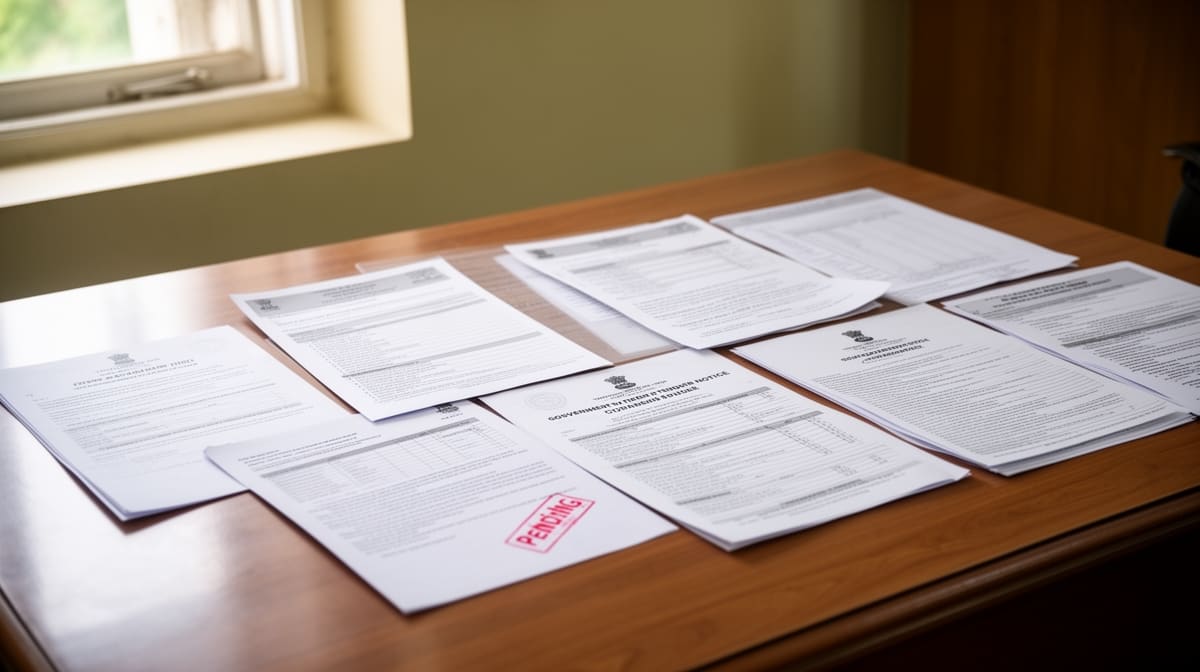
The Allahabad High Court set aside an indefinite blacklisting order against a multi-state cooperative society, holding that such punitive measures must be preceded by a valid show-cause notice and cannot be perpetual without violating the principles of natural justice and Article 14 of the Constitution.
Background & Facts
The Dispute
The petitioner, Aarambh Agro Purposes Co-Operative Society Ltd (registered under the Multi State Cooperative Societies Act, 2002, Reg. No. MSCS/CR/1024/2014), challenged an order dated 05.10.2019 issued by the Regional Food Controller (R.F.C.), Moradabad, which blacklisted the society for an indefinite period. The blacklisting was predicated on alleged procurement of wheat by private respondents who, the petitioners claim, forged agreements and acted without authority.
Key Facts
- 15.03.2019: Fresh elections were held; Ritu Meena was elected President of the Society and recognised by the Central Registrar.
- 02.04.2019: An agreement was purportedly executed between the erstwhile President Durga Shankar Balwant Singh and private respondent No. 9, Mohd Sadab Husain, authorising wheat procurement on behalf of the Society.
- 10.04.2019: Joint affidavit filed by Respondent No. 4 (Regional Food and Civil Supply Officer) and Respondent No. 10 (Mohd Yaseen) supporting the agreement.
- 24.04.2019: District Magistrate, Rampur, approved 11 wheat-procurement centres for the Society.
- 26.08.2019: Show-cause notice issued to Respondent No. 9 (as “Sachiv/Adhyaksh”) demanding explanation for the proposed blacklisting.
- 05.10.2019: Impugned order of blacklisting/debarring the Society for an indefinite period was passed.
- 23.01.2020: FIR (Case Crime No. 14/2020) lodged by President Ritu Meena under IPC §§ 420, 467, 468, 471 against private respondents 9-12.
- 06.03.2021: Demand notice issued by Secretary, Krishi Utpadan Mandi Samiti, Rampur, for Mandi fee Rs. 2,58,991 and development cess Rs. 1,47,200 (total Rs. 4,08,191.60).
- Additional claims: Shaukat Ali claimed Rs. 11,22,176; M/S Kemary Transport demanded Rs. 28,09,440.
- Wheat procurement: Total 2,568.60 metric tonnes purchased; 1,335 mt supplied to FCI; 1,203.6 mt found sub-standard and rejected; 131.4 mt sub-standard not supplied.
Procedural History
- 12.06.2022: Writ Petition (WRIT-C No. 6335 of 2022) filed before Allahabad High Court.
- Various hearings: Counsel for petitioners (Bipin Bihari, Neeraj Kumar, Rupesh Kumar Ram) and respondents (C.S.C., Mohd Naushad Siddiqui, Rajesh Kumar Yadav, Saiyad Iqbal Ahmed, Sudhanshu Srivastava) appeared.
- Private respondents Nos. 9-12 failed to appear despite service of notice.
- 24.08.2019: Show-cause notice issued to the Society itself (different from the notice to respondent 9).
- 17.08.2026: Judgment delivered by Hon’ble Indrajeet Shukla, J. (with Hon’ble J.J. Munir, J.) quashing the blacklisting order.
Parties' Positions
- Petitioner: Argues that the blacklisting order was issued without a valid notice to the Society, that the former President had no authority to execute the 02.04.2019 agreement after the 15.03.2019 elections, and that the Society never procured wheat. Seeks quash of the order and relief from the demand notice.
- State Respondents: contend that the agreement dated 02.04.2019 conferred authority on respondent 9, that the Society was duly allotted purchase centres, and that the Society is liable for Mandi fee and development cess.
Relief Sought
The petitioners prayed for (i) quashing of the indefinite blacklisting order dated 05.10.2019, (ii) declaration that the Society is not liable for the demand notice of Rs. 4,08,191.60, and (iii) direction to the Regional Food Controller to liquidate any claim made by the Mandi Samiti.
The Legal Issue
Whether an order of blacklisting or debarment can be imposed for an indefinite period without a valid show-cause notice and in violation of the principles of natural justice, particularly audi alteram partem and Article 14 of the Constitution.
Arguments Presented
For the Petitioner
- The Society was not served with a notice; the show-cause notice was addressed to private respondent 9, not to the Society.
- The erstwhile President had no authority after the 15.03.2019 elections; thus the 02.04.2019 agreement is void.
- Precedents (M/S Vindhyawasini Transport v. State of U.P., Erusian Equipment & Chemicals Ltd. v. State of W.B., Kulja Industries Ltd. v. Chief General Manager BSNL) require a specific period and a notice before blacklisting.
- Blacklisting without notice infringes Article 14 and the doctrine of proportionality.
For the Respondent
- The agreement dated 02.04.2019 authorized respondent 9 to act on behalf of the Society.
- The District Magistrate’s order of 24.04.2019 and the procurement policy of 06.03.2019 legitimize the Society’s participation.
- The Society purchased wheat and therefore owes Mandi fee and development cess.
- The State officials acted in good faith based on the documents before them.
The Court's Analysis
The Court first examined the statutory framework governing procurement of wheat under the Government Order dated 06.03.2019 and the associated procurement policy. It noted that the policy expressly requires that a society which is blacklisted or against whom an FIR is lodged cannot be permitted to procure wheat. However, the Court emphasized that any punitive administrative action must conform to the principles of natural justice.
"The impugned order of blacklisting/debarring the petitioner for indefinite period is hereby quashed."
The Court observed that the elections held on 15.03.2019 resulted in Ritu Meena becoming the duly recognised President. Consequently, the former President Durga Shankar Balwant Singh had no authority to execute the 02.04.2019 agreement after that date. The Court held that the existence of a forged agreement could not override the statutory requirement of a valid notice.
Relying on M/S Vindhyawasini Transport v. State of U.P. (2018) and Erusian Equipment & Chemicals Ltd. v. State of W.B. (1975), the Court reiterated that debarment cannot be permanent; the order must specify a duration and be preceded by a clear show-cause notice. The Court further quoted Kulja Industries Ltd. v. Chief General Manager BSNL (2014) to underscore that the power to blacklist must be exercised fairly, reasonably and proportionately, with an opportunity to be heard.
The Court also examined the procedural record: the show-cause notice dated 26.08.2019 was addressed to respondent 9, not to the Society, and therefore could not satisfy the audi alteram partem requirement. The later notice dated 28.08.2019 to the Society was issued after the blacklisting order, rendering it ineffective.
In light of the above, the Court concluded that the blacklisting order violated Article 14 (equality before law) and Article 144 (obligation of all authorities to act in aid of the Supreme Court). The Court therefore quashed the indefinite blacklisting and directed the Regional Food Controller to liquidate the claim made under the demand notice of 06.03.2021.
The Verdict
The Allahabad High Court set aside the blacklisting/debarring order dated 05.10.2019, held that the Society could not be held liable for the Mandi fee and development cess, and directed Respondent No. 4 (Regional Food Controller, Rampur) to liquidate the claim made under the notice dated 06.03.2021 in favour of the Krishi Utpadan Mandi Samiti. No order as to costs was made.
What This Means For Similar Cases
Blacklisting Requires a Valid Show-Cause Notice
- Administrations must serve a notice expressly stating the intention to blacklist, naming the correct party, and providing a reasonable time to respond.
- Failure to do so renders the order violative of natural justice and liable to be set aside.
Indefinite Debarment Is Unlawful
- Courts will scrutinise any debarment that lacks a defined period; the duration must be proportionate to the alleged breach.
- Precedents mandate that debarment be time-bound and subject to review.
Authority Must Be Current at the Time of Agreement
- Agreements executed by former office-bearers after a change in management are void unless ratified by the newly elected body.
- Evidence of such ratification (e.g., Central Registrar’s recognition) defeats claims of authority by private respondents.
Practical Takeaways for Practitioners
- Check the chain of authority before relying on agreements in procurement matters.
- Document service of notices meticulously; ensure the notice is addressed to the correct legal entity.
- Argue proportionality and invoke Article 14 when challenging punitive administrative actions.
- Seek specific time-frames in any debarment order; indefinite bans are unlikely to survive judicial review.