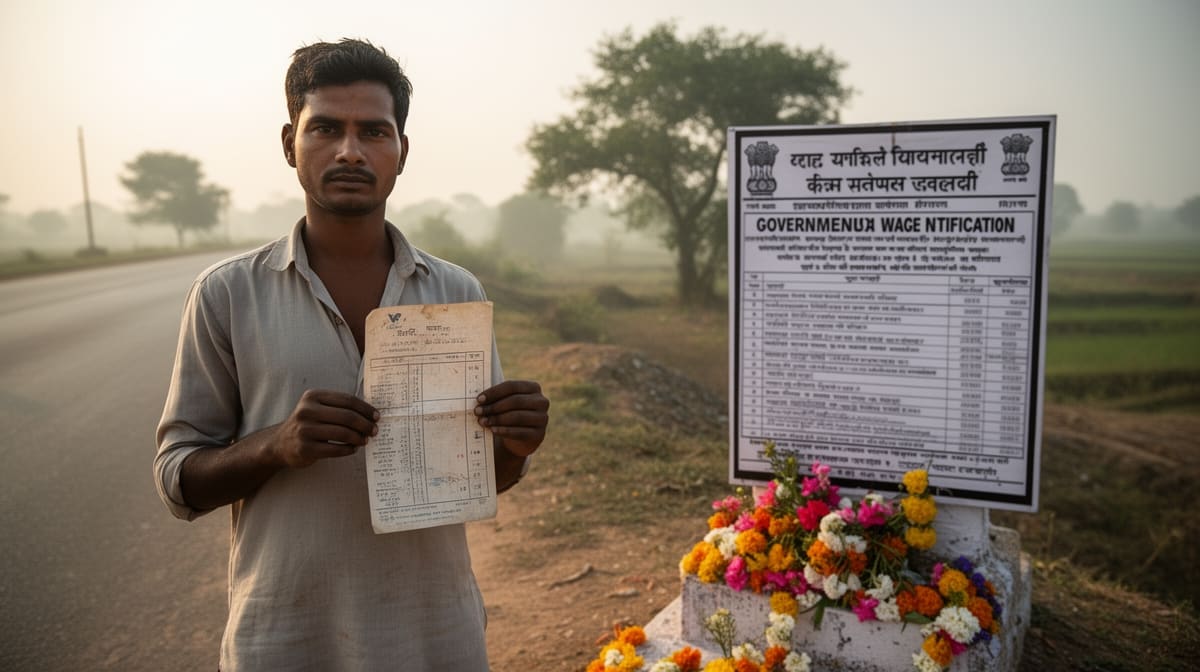
The Madhya Pradesh High Court has clarified that in motor accident claims, where documentary proof of income is unavailable, courts must not mechanically apply the lowest tier of minimum wage notifications. Oral evidence, if credible and uncontradicted, must form part of the income assessment, ensuring compensation reflects realistic earning capacity rather than arbitrary statutory floors.
Background & Facts
The Dispute
The appellants, legal heirs of Laltabai, who died in a motor accident on 4 March 2023, challenged the Motor Accident Claims Tribunal’s award of Rs.12,30,383, arguing that the Tribunal erred in fixing her monthly income at Rs.8,975. The appellants contended that the Tribunal should have adopted the State Labour Department’s notified minimum wage for unskilled labour, which stood at Rs.9,325 as of the date of the accident.
Procedural History
- 2023: Claim petition filed before VI Member, Motor Accident Claims Tribunal, Shajapur
- 2025: Tribunal awarded Rs.12,30,383, fixing deceased’s monthly income at Rs.8,975 based on speculative assessment
- 2025: Appeal filed before Madhya Pradesh High Court under Section 173(1) of the Motor Vehicles Act, 1988
Relief Sought
The appellants sought enhancement of the compensation amount by adjusting the deceased’s monthly income to Rs.9,325, in line with the Minimum Wages Act circular, and recalculating dependency and loss of consortium accordingly.
The Legal Issue
The central question was whether the Motor Accident Claims Tribunal is bound to adopt the minimum wage notified under the Minimum Wages Act as the sole benchmark for income assessment when documentary evidence of earnings is absent, or whether credible oral testimony may be considered alongside statutory norms.
Arguments Presented
For the Appellant
The appellants relied on Chandra @ Chanda @ Chandraram & Anr. v. Mukesh Kumar Yadav (2022) 1 SCC 198, arguing that the Apex Court had held that minimum wage notifications are only a yardstick, not an absolute standard. They emphasized that the Tribunal’s failure to consider the wife’s oral testimony - stating the deceased earned Rs.9,325 per month - was arbitrary and contrary to established precedent. They further contended that adopting Rs.8,975 was below the statutory minimum and undermined the compensatory purpose of the Act.
For the Respondent
The Insurance Company argued that the Tribunal had exercised reasonable discretion in assessing income in the absence of salary slips or income tax returns. They maintained that Rs.8,975 was a conservative and justifiable estimate based on local economic conditions and that any upward adjustment would set a precedent for speculative claims.
The Court's Analysis
The Court examined the ratio in Chandra @ Chanda @ Chandraram, emphasizing that while documentary evidence is preferred, its absence does not justify the mechanical application of the lowest wage bracket. The Court observed that the Tribunal’s reliance on Rs.8,975 - below the notified minimum wage of Rs.9,325 - was legally untenable.
"In absence of documentary evidence on record some amount of guesswork is required to be done. But at the same time the guesswork for assessing the income of the deceased should not be totally detached from reality."
The Court held that the Minimum Wages Act circular provides a legally recognized floor, and where oral testimony aligns with or exceeds this floor, it must be given due weight. The Tribunal’s failure to consider the notified wage rate, which was higher than its own estimate, constituted a material error in computation. The Court further clarified that dependency calculations must be based on the most accurate income estimate available, even if derived from non-documentary sources, to ensure just compensation under Section 166 of the Motor Vehicles Act.
The Verdict
The appellants succeeded in part. The Court held that the deceased’s monthly income must be fixed at Rs.9,325, the notified minimum wage for unskilled labour, and enhanced the compensation award by Rs.38,104. The rest of the Tribunal’s award, including interest and other heads, was upheld.
What This Means For Similar Cases
Minimum Wage Is a Floor, Not a Ceiling
- Practitioners must now argue that minimum wage notifications under the Minimum Wages Act serve as the baseline, not the maximum, for income estimation
- Where oral testimony supports an income equal to or higher than the notified wage, tribunals must adopt the higher figure
- Failure to do so invites appellate intervention on grounds of manifest error
Oral Evidence Carries Weight in Absence of Documents
- Credible oral testimony from close family members, if consistent and unchallenged, is sufficient to establish income for dependency calculations
- Tribunals cannot dismiss such testimony merely because it lacks supporting documents
- Practitioners should prepare affidavits and witness summaries to corroborate oral claims, especially in informal sector cases
Dependency Calculations Must Reflect Realistic Earning Capacity
- The multiplier method must be applied on the most accurate income figure available, not the lowest plausible one
- Courts must avoid undercompensating claimants by defaulting to outdated or arbitrary estimates
- This judgment reinforces the compensatory, not punitive, nature of motor accident claims under the MV Act