The Madhya Pradesh High Court has significantly clarified the methodology for assessing the income of deceased claimants in motor accident compensation cases where documentary evidence is lacking. By anchoring its reasoning in the Supreme Court’s precedent in Chandra @ Chanda @ Chandraram v. Mukesh Kumar Yadav, the Court emphasized that guesswork in income estimation must remain grounded in reality, not arbitrarily low benchmarks. This ruling provides critical guidance to Claims Tribunals and practitioners navigating the tension between evidentiary gaps and fair compensation.
Background & Facts
The Dispute
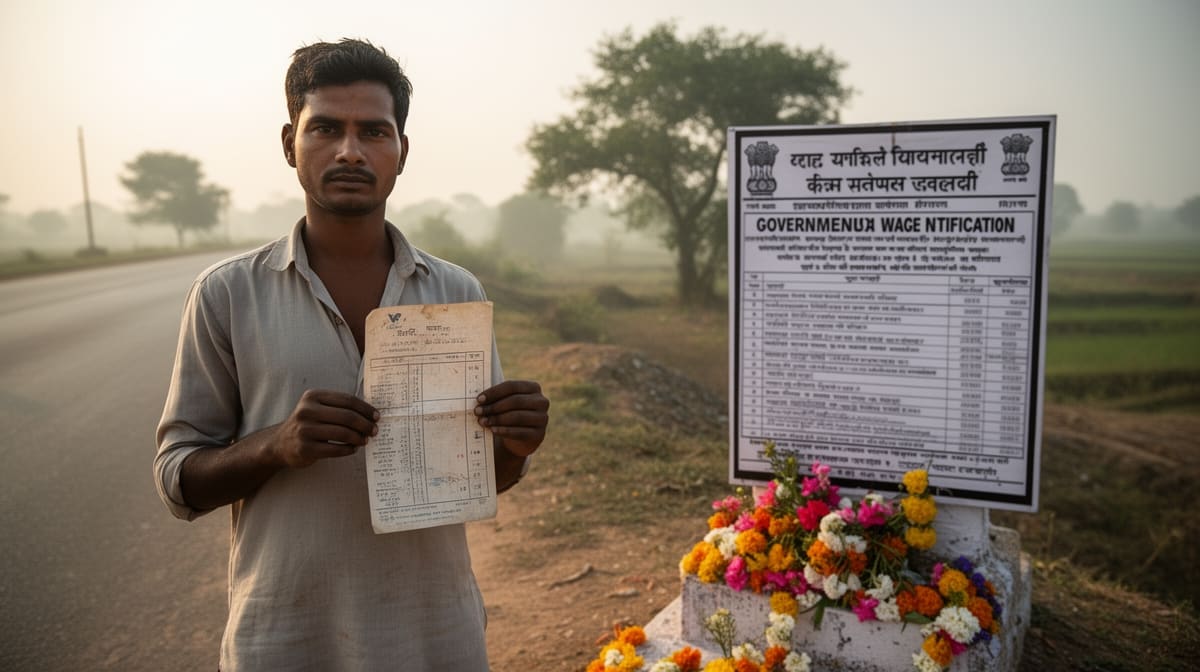
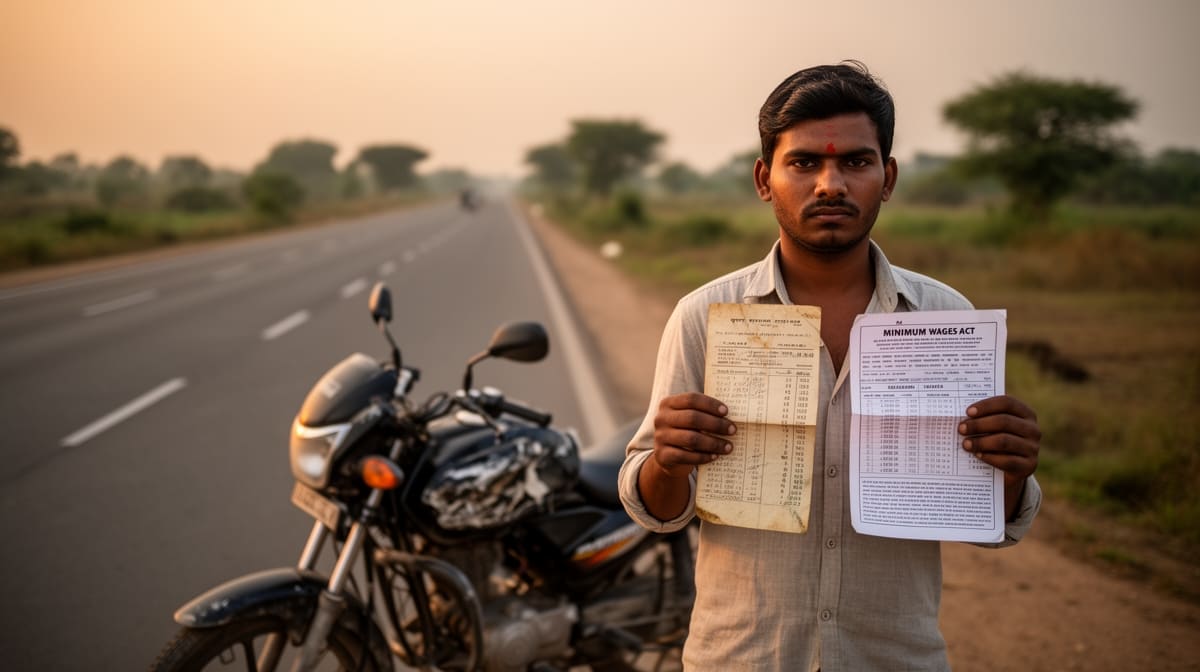
The appellants, survivors of Fatu Singh, challenged the Motor Accident Claims Tribunal’s award of Rs.8,31,853/-, arguing that the Tribunal erred in assessing the deceased’s monthly income at Rs.6,500/-, which was below the statutory minimum wage for unskilled labour in Madhya Pradesh as notified under the Minimum Wages Act. The deceased was an unskilled labourer, and no salary slips or employment records were produced by the claimants.
Procedural History
- 30 July 2023: Fatu Singh died in a motor accident.
- 2023: Claim petition filed before II Member Motor Accident Claims Tribunal, Manawar.
- 24 December 2024: Tribunal awarded Rs.8,31,853/-, fixing monthly income at Rs.6,500/- based on unspecified grounds.
- 2025: Appeal filed before the Madhya Pradesh High Court under Section 173(1) of the Motor Vehicles Act, 1988.
Relief Sought
The appellants sought enhancement of the compensation amount by revising the deceased’s monthly income to Rs.9,650/-, the minimum wage for unskilled labour as per the State Labour Department’s circular, and recalculating the total compensation accordingly.
The Legal Issue
The central question was whether, in the absence of documentary proof of income, a Claims Tribunal may rely on the lowest possible wage bracket or whether it must adopt the relevant minimum wage notification under the Minimum Wages Act as a reasonable and legally sound benchmark.
Arguments Presented
For the Appellant
The appellants contended that the Tribunal’s fixation of Rs.6,500/- was arbitrary and contrary to the Supreme Court’s direction in Chandra @ Chanda @ Chandraram v. Mukesh Kumar Yadav, which held that minimum wage notifications serve as a legitimate yardstick when documentary evidence is absent. They argued that the State’s own circular fixing Rs.9,650/- for unskilled labour provided a concrete, objective standard that the Tribunal ignored without justification.
For the Respondent
The Insurance Company argued that the Tribunal had exercised its discretion properly, noting that oral testimony alone cannot override the absence of formal income proof. They maintained that Rs.6,500/- was a conservative but reasonable estimate based on local economic conditions and past precedents, and that enhancing it would set a precedent for inflated claims.
The Court's Analysis
The Court undertook a detailed review of the Supreme Court’s ruling in Chandra @ Chanda @ Chandraram v. Mukesh Kumar Yadav, which explicitly rejected the mechanical application of the lowest minimum wage tier in the absence of documentary evidence. The Court observed:
"In absence of documentary evidence on record some amount of guesswork is required to be done. But at the same time the guesswork for assessing the income of the deceased should not be totally detached from reality. Merely because the claimants were unable to produce documentary evidence to show the monthly income of Shivpal, same does not justify adoption of lowest tier of minimum wage while computing the income."
The High Court held that the Tribunal’s reliance on Rs.6,500/- was not merely conservative - it was legally untenable given the existence of a statutory minimum wage notification for unskilled labour. The Court emphasized that minimum wage circulars issued under the Minimum Wages Act are not optional references but authoritative indicators of economic reality in the absence of formal proof. The Tribunal’s failure to consider this benchmark constituted a material error in law.
The Court recalculated the compensation using Rs.9,650/- as the base income, applying the standard 10% for future prospects, a multiplier of 9, and deducting 1/4th for personal expenses. It also upheld the Tribunal’s award for loss of consortium, funeral expenses, and medical bills, affirming the correctness of those components.
The Verdict
The appellants succeeded. The Madhya Pradesh High Court held that minimum wage notifications under the Minimum Wages Act must be used as the primary reference point for income estimation in motor accident claims when documentary proof is unavailable. The compensation was enhanced by Rs.2,80,611/-, bringing the total to Rs.11,12,464/-. The Court directed payment of enhanced amount subject to court fees within 30 days.
What This Means For Similar Cases
Minimum Wage Notifications Are Binding Benchmarks
- Practitioners must now cite State-specific minimum wage circulars as the default income standard in claims involving unskilled or semi-skilled labourers
- Tribunals cannot justify below-minimum income estimates without explaining why the statutory wage is inapplicable
- Oral testimony, even without salary slips, gains credibility when aligned with official wage data
Guesswork Must Be Reasonably Grounded
- Courts will no longer tolerate arbitrary or unduly low income estimates under the guise of "conservatism"
- The phrase "guesswork" in compensation calculations now carries a legal obligation: it must reflect the economic reality as defined by State notifications
- Advocates should proactively submit minimum wage circulars as evidence, even if the claimant lacks formal employment records
Enhanced Compensation Will Be the Norm
- Claimants in similar cases can now expect higher awards where the deceased’s occupation aligns with a notified wage category
- Insurance companies must reassess their settlement strategies and prepare for higher liability exposure in unskilled labour cases
- Tribunals must now record explicit reasoning if they deviate from minimum wage benchmarks, or risk reversal on appeal