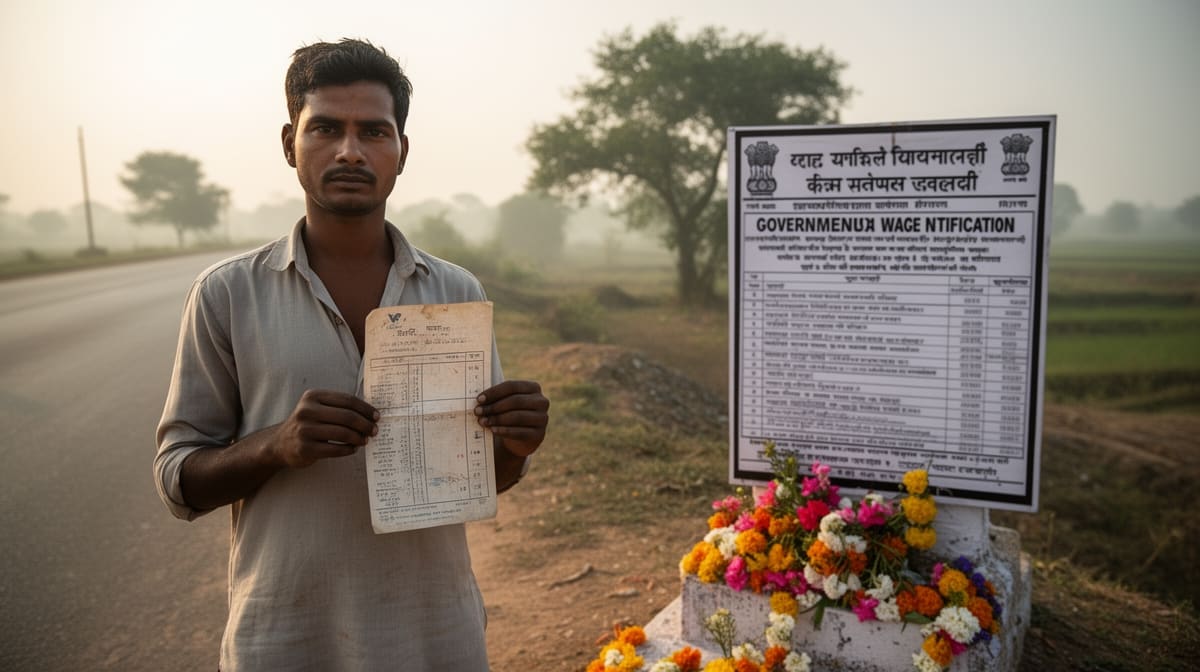
The Madhya Pradesh High Court has clarified that in motor accident compensation cases, where documentary proof of income is unavailable, courts may rely on credible oral testimony to determine the deceased’s monthly earnings. This ruling reinforces the principle that rigid adherence to paper evidence must not defeat justice for bereaved families, particularly when the deceased worked in informal sectors.
Background & Facts
The Dispute
The claimants, survivors of Dinesh, a 26-year-old motorcyclist killed in a collision with a truck on 16 December 2015, filed a claim for compensation of Rs.14.5 lakh. The Motor Accident Claims Tribunal (MACT) awarded Rs.7,12,600, assessing Dinesh’s monthly income at Rs.3,000 based on the lowest tier of minimum wage, despite oral testimony from his wife that he earned Rs.15,000 per month.
Procedural History
- 16 December 2015: Accident occurred near Village Balsamud, Khargone
- 6 January 2016: Claim petition filed before MACT, Khargone
- 26 September 2018: MACT awarded Rs.7,12,600, rejecting higher income claim due to lack of salary certificates
- 2018: Appeal filed before Madhya Pradesh High Court under Section 173(1) of the Motor Vehicles Act, 1988
Relief Sought
The appellants sought enhancement of compensation on two grounds: (1) higher income assessment based on the State Labour Department’s minimum wage circular, and (2) increased loss of consortium award to all four survivors as per Supreme Court guidelines.
The Legal Issue
The central question was whether income of a deceased in a motor accident claim can be assessed based on oral testimony when documentary evidence is absent, and whether the Minimum Wages Act circular serves as a permissible benchmark in such cases.
Arguments Presented
For the Appellant
Counsel relied on Chandra @ Chanda @ Chandraram v. Mukesh Kumar Yadav (2022) 1 SCC 198, arguing that where no salary slips or income certificates exist, courts must not default to the lowest minimum wage. The wife’s testimony, corroborated by the deceased’s possession of a heavy vehicle driving license, was sufficient to infer a higher income. The circular under the Minimum Wages Act should be used as a reasonable yardstick, not a floor.
For the Respondent
The insurance company contended that the MACT’s award was justified, as oral evidence alone cannot override the requirement for verifiable documentation. It argued that adopting Rs.6,575 as income would be speculative and inconsistent with prior tribunal practice.
The Court's Analysis
The Court examined the Supreme Court’s directive in Chandra @ Chanda @ Chandraram that guesswork in income assessment must not be detached from reality. It emphasized that while documentary proof is ideal, its absence does not justify arbitrary reduction to the lowest wage bracket.
"Merely because the claimants were unable to produce documentary evidence to show the monthly income of Shivpal, same does not justify adoption of lowest tier of minimum wage while computing the income."
The Court held that the deceased’s possession of a heavy vehicle license, coupled with his wife’s consistent testimony, provided a credible basis to infer a higher income. It applied the National Insurance Co. v. Pranay Sethi framework: 40% future prospects, multiplier of 17 for age 26, and 1/3 deduction for personal expenses. The Tribunal’s use of Rs.3,000 was found to be legally untenable.
Regarding loss of consortium, the Court affirmed that all four survivors - wife, son, mother, and father - are entitled to compensation under Magma General Insurance v. Nanu Ram and United India Insurance v. Satinder Kaur. Each was awarded Rs.40,000, totaling Rs.1,60,000.
The Verdict
The appellants succeeded. The Court enhanced the compensation to Rs.14,41,948, holding that oral evidence can form the basis for income assessment in the absence of documents, and that Minimum Wages Act circulars are valid benchmarks. The original award of Rs.7,12,600 was increased by Rs.7,29,348.
What This Means For Similar Cases
Oral Evidence Is Sufficient for Income Assessment
- Practitioners must now argue that failure to produce salary slips does not invalidate credible oral testimony
- Courts must evaluate testimony in context: occupation, license possession, and local wage norms
- Claimants in informal sectors (drivers, laborers, daily wage workers) are no longer penalized for lack of formal records
Minimum Wage Circulars Are Binding Benchmarks, Not Minimum Floors
- Circulars under the Minimum Wages Act must be used as reference points, not as ceilings or floors
- Income should be assessed at the level matching the deceased’s skill category (unskilled, semi-skilled, skilled)
- Tribunals must justify deviations from these circulars with reasoned analysis
Consortium Awards Must Cover All Dependents
- All legal heirs - including parents - are entitled to loss of consortium under Supreme Court precedent
- Awarding Rs.40,000 per survivor is now the standard unless exceptional circumstances exist
- Omitting parents or other dependents constitutes legal error