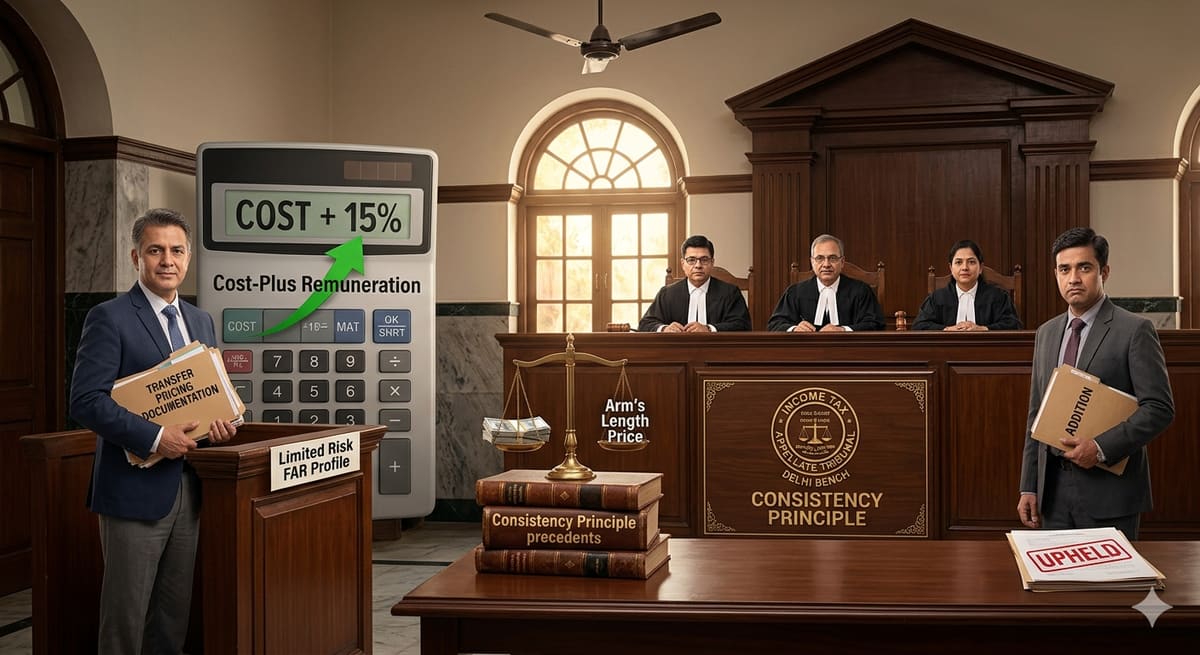
The Income Tax Appellate Tribunal (Delhi Bench) partially set aside the assessment order of 25.09.2024, directing the Transfer Pricing Officer to include functionally comparable firms, exclude non-comparable entities, and revisit working-capital adjustments for WSP Consultants India Pvt. Ltd. in Assessment Year 2021-22.
Background & Facts
The Dispute
WSP Consultants India Private Limited (the "assessee") provides back-office support services and low-end IT-enabled services to its Associated Enterprises (AEs) in sectors such as property, environment, transport and infrastructure. For FY 2020-21 the assessee entered into several international transactions. The Transfer Pricing Officer (TPO) enhanced the assessee’s income by INR 4,39,59,554 under section 143(3) read with section 144C(13) and section 1448, treating the outstanding receivables from AEs as a separate international transaction and imputing interest at 4.621% (LIBOR + 425 bps).
Key Facts
- Business model: Back-office support services (low-end ITES) and design-engineering services for AEs.
- International transaction: Provision of back-office support services valued at INR 4,38,71,117 (TNMM) and interest on receivables INR 88,437, totalling INR 4,39,59,554.
- Interest rate applied: 6-month LIBOR + 425 bps = 4.621% on receivables delayed beyond 60 days.
- Operating margin: 11.61% on costs for FY 2020-21.
- Working-capital collection period: Assessee 15 days vs. comparables ~161 days.
- Debt status: Assessee is a debt-free company.
- Comparables contested: Inclusion of Sundaram Business Services Ltd and Silgate Solutions Ltd; exclusion of Russell Reynolds Associates, Kamdar & Kamdar Associates, Global Innovsource Solutions, AAA Technologies, Interactive Manpower Solutions, Aparajitha Corporate Services, among others.
- Regulatory references: Rule 10B(1), 10B(2) and 10B(3) of the Income-Tax Rules, 1962; section 92C, Income-Tax Act, 1961.
Procedural History
- 25.09.2024: Assessment order passed by the Assessment Unit, Circle 25 (1), New Delhi.
- 12.05.2026: Writ petition (ITA No.5386/DEL/2024) filed before the ITAT, Delhi Bench.
- 29.07.2026: Tribunal pronounces its order.
- FY 2020-21 & FY 2019-20: International transactions and TP documentation prepared.
- 22.01.2021: Merger order affecting Aparajitha Capital Growth Pvt Ltd, effective 01.04.2020.
- Various DRP directions: Pages 41-72 of appeal set, directing re-verification of functional-comparability and application of filters.
Parties' Positions
- Assessee (Appellant): Contended that the TPO erred in (i) enhancing income, (ii) rejecting its economic analysis, (iii) selecting non-comparable firms, (iv) excluding functionally comparable firms, (v) treating receivables as a separate transaction, (vi) failing to grant working-capital adjustment, and (vii) levying interest and penalty.
- Revenue (Respondent): Asserted that the TPO correctly applied the arm's-length principle, that the receivables warranted interest, and that the selected comparables were appropriate.
Relief Sought
The assessee sought (a) reversal of the INR 4,39,59,554 enhancement, (b) inclusion of Sundaram Business Services Ltd and Silgate Solutions Ltd as comparables, (c) exclusion of the six non-comparable firms listed above, (d) a working-capital adjustment under Rule 10B(1)(e), (e) waiver of interest under sections 234A, 2348 and 234C, and (f) setting aside of penalty under section 270A.
The Legal Issue
What is the correct methodology for selecting and excluding comparable enterprises under Rule 10B of the Income-Tax Rules, 1962, and does the outstanding receivable from associated enterprises constitute a separate international transaction requiring a distinct arm-length price under section 92C of the Income-Tax Act?
Arguments Presented
For the Appellant
- The TPO violated Rule 10B(2) by arbitrarily rejecting the assessee’s comparable list and adding non-comparable firms without applying the functional-analysis-risk-asset-ownership (FAR) filters.
- The receivables are incidental to the back-office service transaction; therefore, they cannot be treated as a separate international transaction under section 92C.
- As a debt-free entity, the assessee cannot be said to have borrowed funds; consequently, interest under sections 234A, 2348 and 234C is unwarranted.
- Working-capital differentials (collection period 15 days vs. 161 days) must be adjusted per Rule 10B(1)(e), following the precedent in PCIT v. Kusum Healthcare Pvt. Ltd..
For the Respondent
- The TPO correctly applied the arm's-length principle by treating the delayed receivables as a distinct transaction, justifying interest at 4.621%.
- The selected comparables satisfy the FAR criteria; any exclusion would distort the benchmarking analysis.
- The assessee failed to provide sufficient documentary evidence for a working-capital adjustment; the onus of proof lies with the taxpayer under the principle that the burden of proof rests on the party asserting a fact.
The Court's Analysis
The Tribunal examined the statutory framework governing transfer-pricing comparables. It reiterated that Rule 10B(2) mandates a rigorous functional-analysis, requiring that each comparable share a similar risk-profile, asset-base and functions (the FAR test). The Tribunal noted that the TPO had excluded Sundaram Business Services Ltd and Silgate Solutions Ltd without a reasoned application of the FAR filters, despite the assessee’s evidence that both entities operate in the same BPO/ITES space and were previously accepted in earlier assessment years.
"The functions performed by the assessee is more or less similar and it is within the ambit of ITES. Even the same comparable was selected by the assessee consistently in the earlier two assessment years."
The Tribunal distinguished Syngenta Services P Ltd as persuasive authority supporting inclusion of functionally comparable firms. Conversely, it found the TPO’s reliance on companies such as Global Innovsource Solutions and AAA Technologies untenable because of (i) lack of publicly available financials, (ii) functional dissimilarity (KPO vs. BPO), and (iii) abnormal profit fluctuations, thereby violating Rule 10B(2).
Regarding the receivables, the Tribunal held that they are a direct consequence of the back-office service transaction and not a separate international transaction. Consequently, the arm-length price under section 92C should encompass the receivable component, and the imputed interest at 4.621% was excessive, especially given the assessee’s debt-free status.
On the working-capital adjustment, the Tribunal accepted the assessee’s submission that the collection period disparity materially affects profitability. Citing PCIT v. Kusum Healthcare, it directed the TPO to recompute margins after adjusting for working-capital differences, emphasizing that the adjustment is a statutory requirement under Rule 10B(1)(e).
The Tribunal also observed that the Revenue’s penalty under section 270A and interest under sections 234A, 2348 and 234C were not justified in the absence of a proven breach.
The Verdict
The Tribunal partially allowed the appeal. It directed the TPO to (i) include Sundaram Business Services Ltd and Silgate Solutions Ltd as comparables, (ii) exclude Russell Reynolds Associates, Kamdar & Kamdar Associates, Global Innovsource Solutions, AAA Technologies, Interactive Manpower Solutions and Aparajitha Corporate Services from the final comparable list, (iii) recompute the arm-length price incorporating the receivable as part of the service transaction and reduce the interest rate to the statutory rate, (iv) grant a working-capital adjustment as per Rule 10B(1)(e) based on the assessee’s annexure, (v) set aside the interest and penalty provisions, and (vi) remit the matter back to the AO/TPO for fresh computation, with a compliance deadline of eight weeks from the date of this order.
What This Means For Similar Cases
Functional Comparability Must Be Demonstrated
- Practitioners must furnish detailed functional-analysis reports showing that each proposed comparable matches the assessee on functions, assets and risks.
- Courts will scrutinise any exclusion of comparables lacking a reasoned application of the FAR test.
Working-Capital Adjustments Are Not Optional
- Differences in collection periods or working-capital levels must be quantified and adjusted under Rule 10B(1)(e).
- Failure to submit supporting data will result in the adjustment being denied.
Receivables Are Part of the Service Transaction
-
Outstanding receivables arising from back-office services cannot be treated as a separate international transaction.
-
Interest imputation must be justified by actual borrowing; debt-free entities are unlikely to attract interest under sections 234A/2348/234C.
-
Ensure that all comparables have publicly available financial statements; otherwise, they may be excluded.
-
Cite relevant precedents such as Syngenta Services, PCIT v. Kusum Healthcare, and Bechtel India to strengthen arguments.