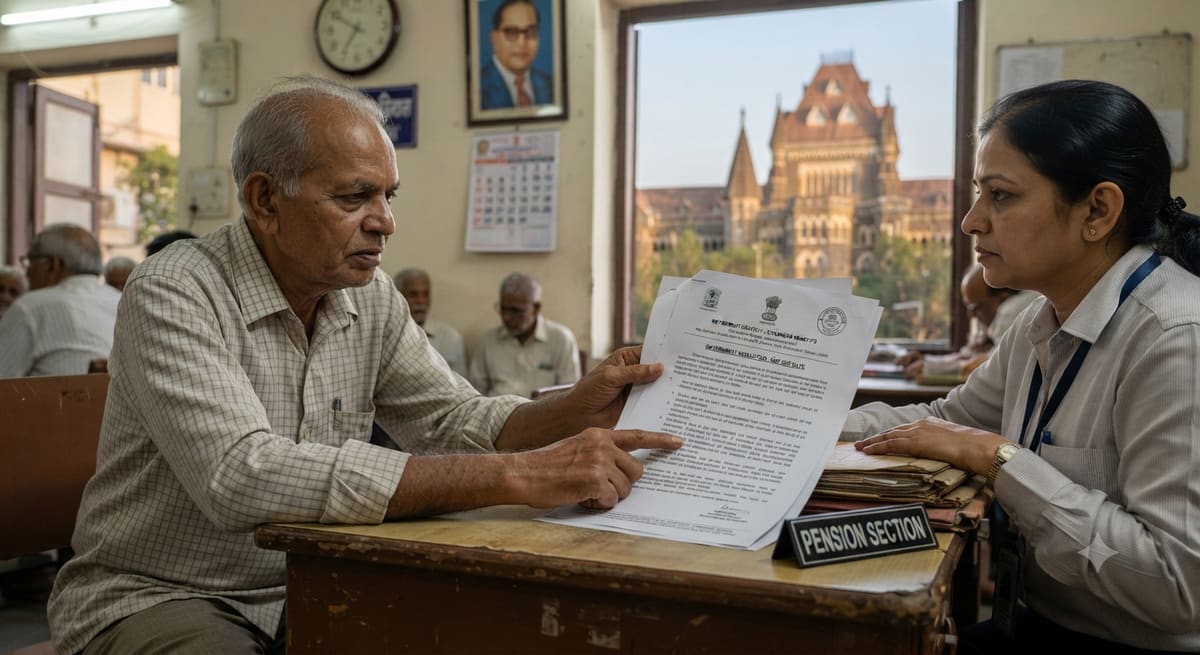
The Bombay High Court has delivered a significant judgment on the scope of a Government Resolution granting increments to award-winning teachers, clarifying that non-teaching staff cannot claim parity under the same policy. The Court upheld the State's classification between teaching and non-teaching employees, emphasizing that such distinctions are permissible when grounded in the exigencies of administration and the inherent differences in duties.
Background & Facts
The Genesis
The petitioner, Shri Kishor Nilkanth Thakur, is a non-teaching employee serving as a Clerk at Matoshree Rampyaribai Sarda Kanya Vidyamandir, Nashik. He was felicitated with the Presidential Award on 06/11/2013 for outstanding service rendered during the Census of India, 2011. Additionally, he received the Zilla Yuva Award from the Collector, Nashik.
The Government Resolution
By a Government Resolution dated 30/04/1984, the State Government granted two additional increments in salary to teachers who received National or State Level Awards. This policy was later replaced by a Government Resolution dated 04/09/2014, which replaced the increment system with a lump-sum amount of Rs. 1,00,000 for award-winning teachers.
The Petitioner's Claim
The petitioner sought a declaration that he is entitled to two additional increments under the GR dated 30/04/1984 or, in the alternative, a lump-sum amount under the GR dated 04/09/2014. He argued that his exceptional contribution merited parity with teachers who received similar awards.
Respondents' Stand
The respondents, including the State of Maharashtra and various education department officials, contended that the GR dated 30/04/1984 and GR dated 04/09/2014 were applicable only to teachers. They argued that the classification between teaching and non-teaching staff was reasonable, given the distinct nature of their duties and responsibilities. The State emphasized that granting increments based on awards was a policy decision within its discretion and not a matter of right.
Procedural History
- 2013-2014: Petitioner received Presidential Award and Zilla Yuva Award.
- 2015: Writ Petition (WP No. 11194 of 2015) filed before the Bombay High Court.
Relief Sought
The petitioner sought a declaration of entitlement to two additional increments or a lump-sum amount of Rs. 1,00,000, along with consequential benefits.
The Legal Issue
The central question was whether the petitioner, a non-teaching employee, could claim parity with teachers under the Government Resolutions dated 30/04/1984 and 04/09/2014, which granted incentives to award-winning teachers.
Arguments Presented
For the Petitioner
The petitioner argued that his exceptional contribution during the Census of India, 2011 merited recognition similar to that granted to teachers. He contended that the State's policy of incentivizing excellence should extend to non-teaching staff as well.
For the Respondent-State
The respondents submitted that the GRs were policy decisions applicable only to teachers. They emphasized the inherent differences in the duties and responsibilities of teaching and non-teaching staff, asserting that such distinctions were reasonable and permissible under administrative exigencies. The State argued that granting incentives was discretionary and not a matter of right.
The Court's Analysis
The Court examined the nature of the petitioner's claim and the State's policy decisions. It acknowledged that the teaching and non-teaching staff perform inherently different duties, as recognized in Osmania University v. V. S. Muthurangam and others (1997) 10 SCC 741.
The Court observed that while the State's policy of incentivizing excellence among teachers was commendable, it was not obligated to extend the same benefits to non-teaching staff. The Court held that the classification between teachers and non-teaching staff was reasonable and did not violate any constitutional mandate.
"The State Government having recognised the class of teachers who are National/State Awardees for the incentive in the form of either increments or a lump-sum benefit, we do find some substance in the expectation of the petitioner, who is a recipient of Presidential Award, that the non-teaching staff also needs to be encouraged by providing some incentive similar to the teachers."
However, the Court clarified that it was not possible to conclude that non-teaching staff could claim parity with teachers in respect of the grant of incentives. The Court emphasized that such decisions were within the realm of the State's policy and not justiciable unless they violated constitutional principles.
The Verdict
The writ petition was partly allowed. The Court directed the State Government to consider whether non-teaching staff who receive National or State Level Awards or Presidential Awards could be granted an incentive similar to that granted to teachers. The State was directed to take a decision within six months from the date of communication of the order. No costs were awarded.
What This Means For Similar Cases
Policy Decisions Are Discretionary
- The State's policy decisions regarding incentives for award-winning employees are discretionary and not justiciable unless they violate constitutional principles.
- Courts will not interfere with policy decisions unless they are arbitrary or violate fundamental rights.
Classification Between Teaching and Non-Teaching Staff Is Reasonable
- The Court upheld the classification between teaching and non-teaching staff, emphasizing the inherent differences in their duties and responsibilities.
- Such classifications are permissible under administrative exigencies and do not violate constitutional equality principles.
Expectation of Parity Is Not a Legal Right
- While the Court acknowledged the petitioner's expectation of parity, it clarified that such expectations do not translate into legal rights.
- The State is not obligated to extend the same benefits to non-teaching staff unless it chooses to do so as a matter of policy.