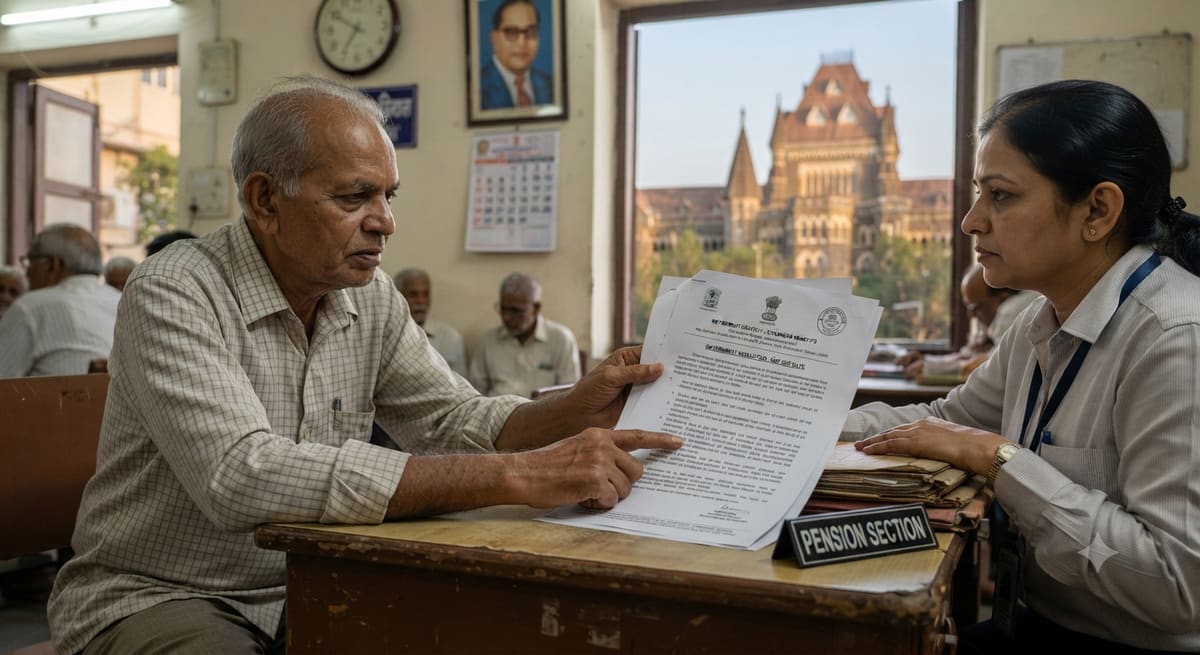
The Bombay High Court has reaffirmed the principle that hostile discrimination in the application of welfare schemes is impermissible, even on grounds of financial implications for the State Exchequer. In a significant ruling, the Court directed the State to extend pensionary benefits to three retired teachers who were denied the same despite clear entitlement under a Government Resolution, holding that parity must be maintained among similarly situated employees.
Background & Facts
The Dispute
The petitioners, Dr. Jayawant Subhedar Chaudhari and two others, are retired teachers who served in Janata Shikshan Sanstha's Arts and Commerce College, Wai, District Satara. The College is affiliated to Shivaji University, Kolhapur, and receives 100% salary grants from the State Exchequer. The petitioners challenged a communication dated 31st October 2023 issued by Respondent No. 3, which rejected their claim for eligibility under the Pension-Cum-Gratuity Scheme on the ground that they had failed to deposit the management's share of contribution under the Contributory Provident Fund (CPF) Scheme and that granting the benefit would result in financial loss to the State.
Key Facts
- Petitioner No. 1: Joined as Lecturer on 15th June 1971, promoted to Principal, retired on 31st May 2008
- Petitioner No. 2: Joined as Lecturer on 2nd August 1971, retired on 31st October 2007
- Petitioner No. 3: Joined as Lecturer on 1st July 1980, retired as In-charge Principal on 31st July 2016
The retirement benefits of employees in private aided affiliated colleges were initially governed by the CPF Scheme, under which both the management and the employee contributed 8.33% of the monthly salary. The Pension-Cum-Gratuity Scheme was introduced by the State Government via Government Resolution dated 21st July 1983, with clarifications issued on 20th June 1984 and 15th December 1984.
By letters dated 4th February 2006, the petitioners exercised their option to withdraw from the CPF Scheme and be governed by the Pension-Cum-Gratuity Scheme. Their request was rejected by Respondent No. 3 via communication dated 19th December 2006, leading to representations before the Director of Higher Education.
Procedural History
- 11th June 2008: Petitioners approached the Director of Higher Education requesting directions to consider their claim
- Writ Petition No. 1530 of 2010: Filed before the Bombay High Court challenging the rejection of their claim
- 12th October 2023: High Court set aside the communication dated 19th December 2006 issued by Respondent No. 3
- 31st October 2023: Respondent No. 3 issued impugned communication rejecting the petitioners' claim on grounds of non-deposit of management's share and financial loss to the State
- Writ Petition No. 13279 of 2024: Present petition filed challenging the communication dated 31st October 2023
Relief Sought
The petitioners sought:
- Quashing of the impugned communication dated 31st October 2023
- Extension of the Pension-Cum-Gratuity Scheme benefits to them
- Recalculation and disbursement of pensionary and retiral benefits
- Directions to the respondents to comply with the Court's earlier order dated 12th October 2023
The Legal Issue
The central question was whether the State could deny the petitioners' entitlement to the Pension-Cum-Gratuity Scheme on the grounds that:
- They had failed to deposit the management's share of contribution received under the CPF Scheme
- Extending the benefit would result in financial loss to the State Exchequer, when similarly situated employees had already been granted the same benefit.
Arguments Presented
For the Petitioners
- The petitioners' case is squarely covered by Clause 3 of the Government Resolution dated 23rd June 2015, which extends the benefit of the Pension-Cum-Gratuity Scheme to employees who exercised the requisite option
- The petitioners had exercised their option to switch from the CPF Scheme to the Pension-Cum-Gratuity Scheme via letters dated 4th February 2006
- Several similarly situated teachers from the same region had been granted the benefit, amounting to hostile discrimination
- The impugned communication dated 31st October 2023 defied the Court's earlier order dated 12th October 2023 in Writ Petition No. 1530 of 2010
- The contention of financial loss to the State Exchequer is unsustainable as the State had already taken a conscious policy decision via Government Resolution dated 23rd June 2015
For the Respondents
- The petitioners failed to deposit the management's share of contribution received under the CPF Scheme, which is a prerequisite for availing the Pension-Cum-Gratuity Scheme
- Extending the benefit to the petitioners would result in financial loss to the State Exchequer
- The petitioners are not entitled to adjustment or set-off of the amount received under the CPF Scheme
The Court's Analysis
The Court examined the submissions and material on record, focusing on the principles of equality and non-discrimination in the application of welfare schemes. The Court observed:
"The contention that extension of the Pension-cum-Gratuity Scheme to the petitioners would result in financial loss to the State Exchequer is equally unsustainable. The State Government, after considering all relevant aspects, has already taken a conscious policy decision by issuing the Government Resolution dated 23rd June 2015, whereby the benefit of the Pension-cum-Gratuity Scheme has been extended to employees who were appointed prior to the cut-off date and had exercised the requisite option. Respondent No. 3 cannot act contrary to the said policy decision and deprive the petitioners of their legitimate entitlement on the ground that implementation of the Scheme would entail financial implications for the State."
The Court held that the second ground for rejecting the petitioners' claim - financial loss to the State - was wholly untenable. The petitioners, being entitled to the benefit of a welfare scheme, could not be discriminated against when similarly situated employees had already been extended the benefit.
Regarding the first ground - non-deposit of the management's share - the Court noted that if the petitioners were required to refund any amount received under the CPF Scheme, such refund would necessarily be made in accordance with law. However, the Court refrained from expressing a final opinion on whether the petitioners would be entitled to adjustment or set-off of the said amount, leaving it to the respondents to consider the same under applicable rules or government policy.
The Verdict
The Court partly allowed the petition and disposed of it with the following directions:
- The respondents were directed to accept the petitioners' request for extension of the Pension-Cum-Gratuity Scheme, subject to compliance with applicable statutory requirements
- The respondents were to recalculate the pensionary and other consequential retiral benefits payable to the petitioners and complete the exercise within four months from the date of the judgment
- If the petitioners were required to refund the management's share of the amount received under the CPF Scheme, they were to deposit the same within two weeks from the date of communication of the amount payable
- The respondents were to issue any demand notice or challan within two weeks from the date of the judgment to enable the petitioners to deposit the requisite amount
- Upon compliance, the respondents were to ensure that the Pension-Cum-Gratuity Scheme was made applicable to the petitioners and all consequential benefits were disbursed in accordance with law
- Liberty to apply in case of difficulty was granted to the petitioners
What This Means For Similar Cases
Hostile Discrimination Invalidates Arbitrary Denial of Welfare Benefits
- The judgment reinforces that hostile discrimination in the application of welfare schemes is impermissible under law. Even if the State raises concerns of financial implications, it cannot deny benefits to a class of employees while extending the same to others similarly situated
- Practitioners can rely on this judgment to argue against arbitrary rejections of welfare claims, particularly when the State has already taken a conscious policy decision via Government Resolutions or circulars
Refund of Contributions Must Be Governed by Law
- The Court clarified that if refund of contributions (e.g., management's share under the CPF Scheme) is a prerequisite for availing pension benefits, such refund must be governed by applicable rules or government policy
- However, the Court left open the question of whether adjustment or set-off of the refundable amount is permissible. This implies that:
- If the rules permit adjustment, the respondents must consider the same
- If no such provision exists, the petitioners may be required to refund the amount in full
- Practitioners should scrutinize the applicable rules and Government Resolutions to determine the exact refund mechanism before advising clients on similar claims
Timelines for Compliance Are Strictly Enforceable
- The Court imposed a strict timeline of four months for the respondents to complete the exercise of extending benefits and recalculating pensionary dues
- Additionally, the respondents were directed to issue demand notices within two weeks and the petitioners were given two weeks to deposit the refundable amount
- This underscores the importance of adhering to judicial timelines in service matters, failing which contempt proceedings may be initiated
- Practitioners should ensure that clients are advised to strictly comply with deadlines set by courts to avoid adverse consequences