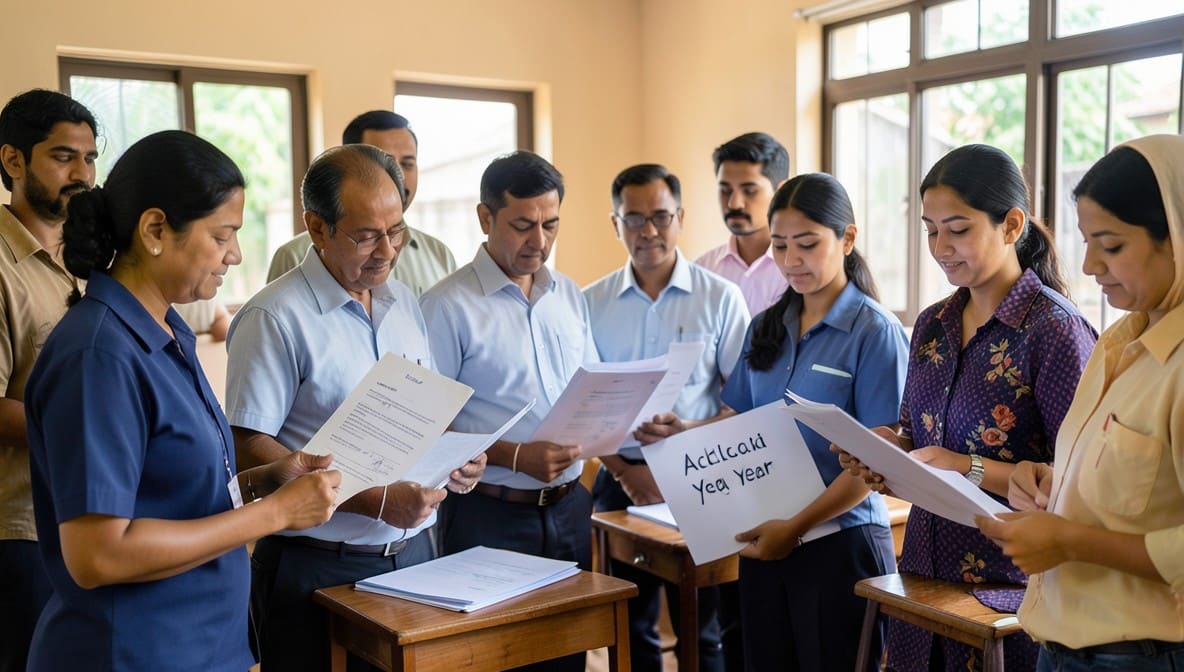
A landmark ruling by the Calcutta High Court has affirmed that a teacher who acquires a postgraduate degree after entering service cannot be denied the corresponding pay scale enhancement solely on the basis of statutory provisions that restrict automatic entitlement. The judgment reinforces the principle that vested rights in service benefits, once accrued, cannot be extinguished by subsequent legislation absent clear retrospective intent.
Background & Facts
The Dispute
The writ petitioner, Debabrata Pal, was appointed as an Assistant Teacher in June 1997 with a Bachelor of Arts (Pass) degree, placing him in the graduate pay scale. He later pursued and completed a Master of Arts degree, securing the qualification in 2007. Despite obtaining the higher degree with official study leave sanctioned by the West Bengal Board of Secondary Education, his request for a postgraduate pay scale was repeatedly rejected by the District Inspector of Schools (DI), Paschim Medinipur, citing Section 14 of the West Bengal Schools (Control of Expenditure) Act, 2005, and Notification No. 593-SE(B) dated November 27, 2007.
Procedural History
- 1997: Petitioner appointed as Assistant Teacher with B.A. (Pass) qualification
- 2007: Petitioner applied for permission to pursue M.A.; request not forwarded by school Secretary
- 2008: Study leave granted by Board; M.A. examination completed
- 2011: Petitioner formally requested postgraduate pay scale
- 2010: First writ petition filed; Court directed DI to consider claim
- 2016: DI rejected claim again, invoking Section 14 and Notification No. 593
- 2026: Present writ petition adjudicated by Calcutta High Court
Relief Sought
The petitioner sought declaration of his entitlement to the postgraduate pay scale with effect from the date of publication of his M.A. results, along with arrears and immediate refixation of pay.
The Legal Issue
The central question was whether Section 14 of the West Bengal Schools (Control of Expenditure) Act, 2005, read with Notification No. 593, bars a teacher from claiming a higher pay scale upon acquiring a postgraduate degree after service entry, even when the higher qualification was obtained with official permission and the statutory provision lacked retrospective application.
Arguments Presented
For the Petitioner
The petitioner relied on Utpal Kanti Karan v. State of West Bengal (2024 SCC Online Cal 1274) and Shivaji Chakraborty v. State of West Bengal to argue that: (1) acquiring higher qualifications is a fundamental right under Article 21, (2) the Act does not prohibit enhancement of qualifications, only automatic pay hikes, (3) the right to higher pay accrued upon completion of the degree, and (4) Section 16 of the Act explicitly protects pre-existing service terms from disadvantageous variation. He emphasized that the DI’s refusal ignored judicial precedents and violated the principle of beneficial interpretation.
For the Respondent
The State contended that Notification No. 593 unequivocally prohibits pay scale enhancement for teachers who entered service with a graduate degree, regardless of when the higher qualification was obtained. It argued that Section 14(2) bars any claim for higher pay beyond the scale at the time of appointment, and that granting the petitioner’s claim would undermine fiscal discipline and create inequity among similarly placed teachers.
The Court's Analysis
The Court undertook a rigorous statutory interpretation, distinguishing between the right to acquire qualifications and the right to financial benefit. It held that Section 14 does not prohibit teachers from pursuing higher education; it only denies automatic entitlement to higher pay. The Court emphasized that Section 16 of the Act protects service terms existing at the time of its commencement, and since the petitioner’s right to higher pay accrued before the Act’s enforcement, it could not be nullified.
"The petitioner was granted permission by the Additional District Inspector and based on such permission, he obtained necessary study leave in accordance with the Leave Rules and his leave has also been sanctioned by the Board. The ultimate success that the petitioner achieved by obtaining Master's Degree would be set at naught if the State respondents are now allowed to deny his claim based on a law which was not in existence on the date right accrued in his favour to have higher scale of pay offered to him."
The Court further relied on Utpal Kanti Karan to affirm that the staff pattern for equitable distribution of posts has no bearing on pay scale entitlement after qualification upgrade. It rejected the State’s argument that fiscal burden justifies denial, noting that beneficial interpretation must be applied in favor of public servants. The Court clarified that the relevant date for pay enhancement is the publication of results, not convocation, and that the DI’s failure to apply settled law rendered the impugned order arbitrary and illegal.
The Verdict
The petitioner won. The Calcutta High Court held that a teacher’s right to a higher pay scale upon acquiring a postgraduate degree after service entry is a vested right protected under Section 16 of the Act, and cannot be denied by subsequent administrative notifications. The Court directed immediate refixation of pay with effect from the date of result publication and ordered arrears to be paid within three months.
What This Means For Similar Cases
Vested Rights Trump Subsequent Restrictions
- Practitioners must argue that any service benefit accrued before enactment of restrictive rules cannot be withdrawn unless the statute explicitly provides for retrospective application
- Teachers who obtained higher degrees with official leave approval prior to 2005 Act enforcement have a strong legal basis for pay scale claims
Administrative Silence Cannot Defeat Entitlement
- If a teacher has taken all reasonable steps to obtain permission and the school or DI failed to act, the delay cannot be used to deny statutory benefits
- The burden shifts to the administration to prove that the teacher acted in bad faith or without authorization