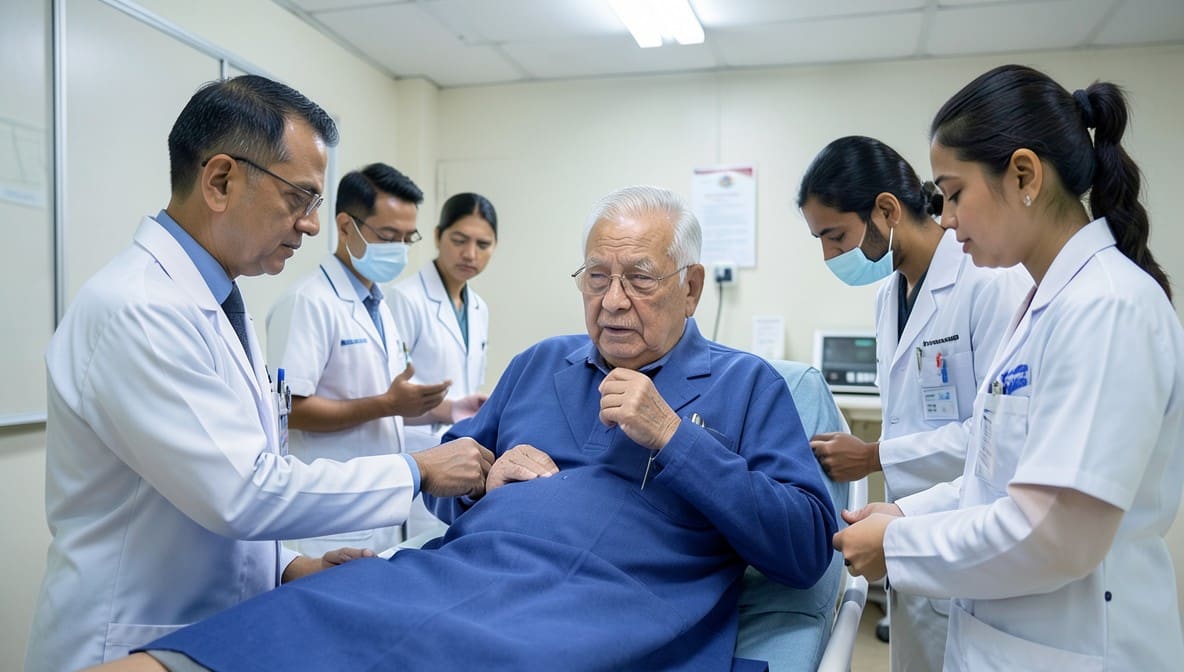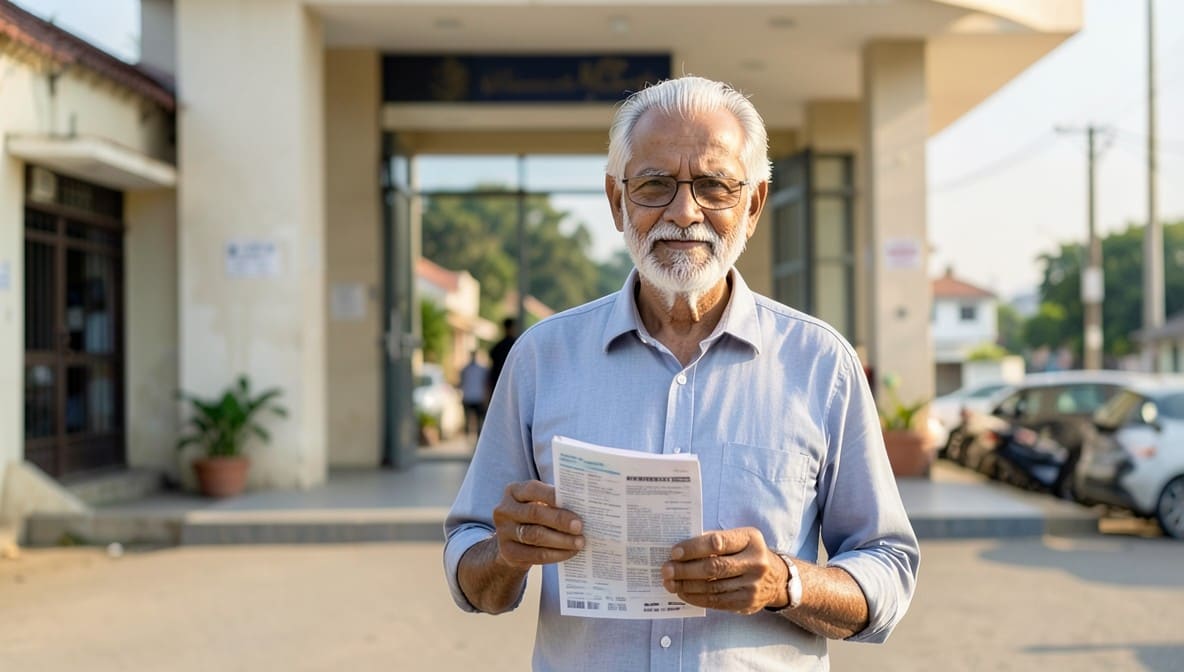
The Central Administrative Tribunal, Kolkata Bench, has clarified that receipt of Fixed Medical Allowance by a retired government employee does not extinguish the right to claim reimbursement for extraordinary medical expenses incurred for life-threatening conditions. This ruling reinforces the principle that pensioners cannot be denied essential healthcare merely because they opted for a monthly allowance instead of formal health scheme enrollment.
Background & Facts
The Dispute
The applicant, Shri V.P. Babu, a retired Assistant Director of the Andaman and Nicobar Administration, sought reimbursement of medical expenses incurred during specialized treatments for heart and eye conditions in Chennai and Varkala, Kerala. His claim was rejected by the Director of Health Services on the grounds that he was receiving a Fixed Medical Allowance (FMA) and had not enrolled in the Central Government Health Scheme (CGHS) or availed the cashless treatment benefit under Pradhan Mantri Jan Arogya Yojana (PMJAY).
Key Facts
- The applicant retired on 31.03.2009 after serving in various capacities, including as Assistant Director.
- In December 2020, while residing in Chennai, he was admitted to Madras Medical Mission Hospital for cardiac treatment, undergoing angiography on 28.12.2020 and being discharged on 01.01.2021.
- He incurred medical expenses of Rs. 4,24,573/- for this treatment, supported by original bills (Annexure A/7).
- On 01.06.2024, he underwent Phacoemulsification with IOL surgery at Dr. Anup's Insight Eye Hospital, Varkala, Kerala, incurring Rs. 46,170/- in expenses (Annexure A/13).
- He submitted claims for reimbursement on 30.01.2024 and 26.08.2024, accompanied by medical bills and references to judicial precedents.
- The respondents issued a Speaking Order dated 07.08.2024 rejecting the claim, citing FMA receipt and non-enrollment in CGHS or PMJAY.
- The Andaman and Nicobar Administration provides PMJAY-based cashless treatment up to Rs. 5,00,000/- per illness for pensioners at empanelled mainland hospitals, but the applicant did not utilize this facility.
- The applicant received FMA of Rs. 500/- per month along with his pension, as permitted under the CS(MA) Rules for non-CGHS areas.
Procedural History
- 26.12.2020: Applicant admitted to Madras Medical Mission Hospital for cardiac treatment.
- 01.01.2021: Discharged after treatment.
- 30.01.2024: First claim for reimbursement of Rs. 4,24,573/- submitted to Respondent No. 5.
- 04.03.2024 and 02.05.2024: Follow-up reminders sent.
- 15.05.2024: Respondent No. 5 responded that claim was under concurrence.
- 01.06.2024: Applicant underwent eye surgery in Varkala.
- 26.08.2024: Second claim for Rs. 46,170/- submitted.
- 07.08.2024: Speaking Order issued rejecting both claims.
- 18.03.2026: Hearing before CAT Kolkata.
- 23.03.2026: Order passed by the Tribunal.
Relief Sought
The applicant sought:
- Quashing of the rejection order dated 07.08.2024.
- Reimbursement of Rs. 4,24,573/- for cardiac treatment and Rs. 46,170/- for eye surgery, totaling Rs. 4,70,743/-.
- 12% interest on the claimed amounts from the dates of submission.
- Transmission of original records for fair adjudication.
The Legal Issue
The central question was whether receipt of Fixed Medical Allowance (FMA) under the CS(MA) Rules, 1944 constitutes a waiver of the right to claim reimbursement for extraordinary, life-threatening medical treatments, when the pensioner has not enrolled in CGHS or availed PMJAY benefits.
Arguments Presented
For the Appellant
The applicant’s counsel relied on multiple judgments from the Calcutta High Court (Circuit Bench at Port Blair) and the Supreme Court, including Union of India v. V.A. Abraham, Union of India v. Shri Amson, and Union of India v. Smti Malti Tiwari. He argued that:
- FMA is intended only for routine and minor outpatient expenses, not for major hospitalization or specialized procedures.
- The Supreme Court in Consumer Education and Research Centre v. Union of India recognized health as a fundamental right under Article 21.
- Denial of reimbursement in cases of critical illness imposes an unreasonable restriction on the right to health.
- The government’s own O.M. dated 05.06.1998 and 29.09.2016 explicitly permit pensioners in non-CGHS areas to claim reimbursement for IPD treatment even while drawing FMA.
- The applicant had no access to adequate medical facilities in Andaman and Nicobar Islands, necessitating travel to mainland hospitals.
For the Respondent
The respondents contended that:
- The applicant was receiving FMA of Rs. 500/- per month, which, as per DoPT O.M. dated 23.03.2022, is granted in lieu of OPD facilities.
- To avail CGHS benefits, a pensioner must formally opt out of FMA by submitting Form-2, which the applicant never did.
- The PMJAY scheme provided a cashless treatment benefit of Rs. 5,00,000/- per illness, which the applicant chose not to use.
- Therefore, the rejection of reimbursement was in accordance with established guidelines and no legal violation occurred.
The Court's Analysis
The Tribunal undertook a detailed review of the statutory framework under the CS(MA) Rules, 1944, and the government’s own clarificatory memoranda dated 05.06.1998 and 29.09.2016. It emphasized that these documents explicitly recognize two distinct categories of pensioners: those in CGHS-covered areas and those in non-CGHS areas.
"Fixed Medical Allowance is intended to meet routine and minor medical expenses, and therefore, cannot be construed as a waiver of the right to reimbursement for extraordinary or specialized medical treatment, particularly in cases involving life-threatening diseases."
The Court noted that the applicant’s conditions - requiring angiography and phacoemulsification surgery - were neither routine nor minor. They were life-threatening and required specialized care unavailable in the Andaman and Nicobar Islands. The Tribunal rejected the respondents’ argument that PMJAY’s availability negated the claim, observing that the scheme was optional and its non-utilization could not be held against the pensioner.
The Tribunal further relied on the principle articulated in Union of India v. Smti Malti Tiwari: when two plausible interpretations of a rule exist, the one favoring the aggrieved party - particularly a retired public servant - must prevail. The Court held that the respondents’ interpretation would effectively deprive pensioners of essential healthcare, violating the constitutional guarantee of the right to health under Article 21.
The judgments cited by the applicant, including those from the Calcutta High Court and the Supreme Court, were found to be directly on point and binding. The Tribunal concluded that the rejection order was legally unsustainable and contrary to established jurisprudence.
The Verdict
The applicant succeeded. The Tribunal quashed the rejection order dated 07.08.2024 and directed the respondents to reimburse the applicant Rs. 4,24,573/- for cardiac treatment and Rs. 46,170/- for eye surgery, totaling Rs. 4,70,743/-. The reimbursement was to be processed within three months of receipt of a copy of this order, subject to verification of bills under applicable rules. No interest was awarded. Costs were not imposed.
What This Means For Similar Cases
Fixed Medical Allowance Is Not a Substitute for Major Treatment
- Practitioners representing retired government employees must argue that FMA is strictly for outpatient and minor expenses, not for hospitalization, surgeries, or critical care.
- Claims for reimbursement of major medical expenses cannot be denied merely because FMA is being drawn.
- The burden shifts to the authority to prove that the treatment was routine or that adequate facilities were available locally.
Non-Enrollment in CGHS or PMJAY Does Not Bar Reimbursement
- Pensioners are not obligated to enroll in CGHS or PMJAY to claim reimbursement under CS(MA) Rules.
- The availability of an optional scheme cannot be used to deny a statutory right.
- Authorities must inform pensioners of all available options at retirement; failure to do so cannot be used to penalize them later.
Judicial Precedents Are Binding Across Jurisdictions
- Judgments from the Calcutta High Court (Circuit Bench at Port Blair) on this issue are binding on all administrative tribunals dealing with central government pensioners.
- The V.A. Abraham and Shri Amson precedents establish a clear doctrinal standard: health rights of pensioners must be interpreted liberally.
- Any denial of reimbursement for life-threatening conditions must now be justified with concrete evidence of local medical availability, not procedural technicalities.