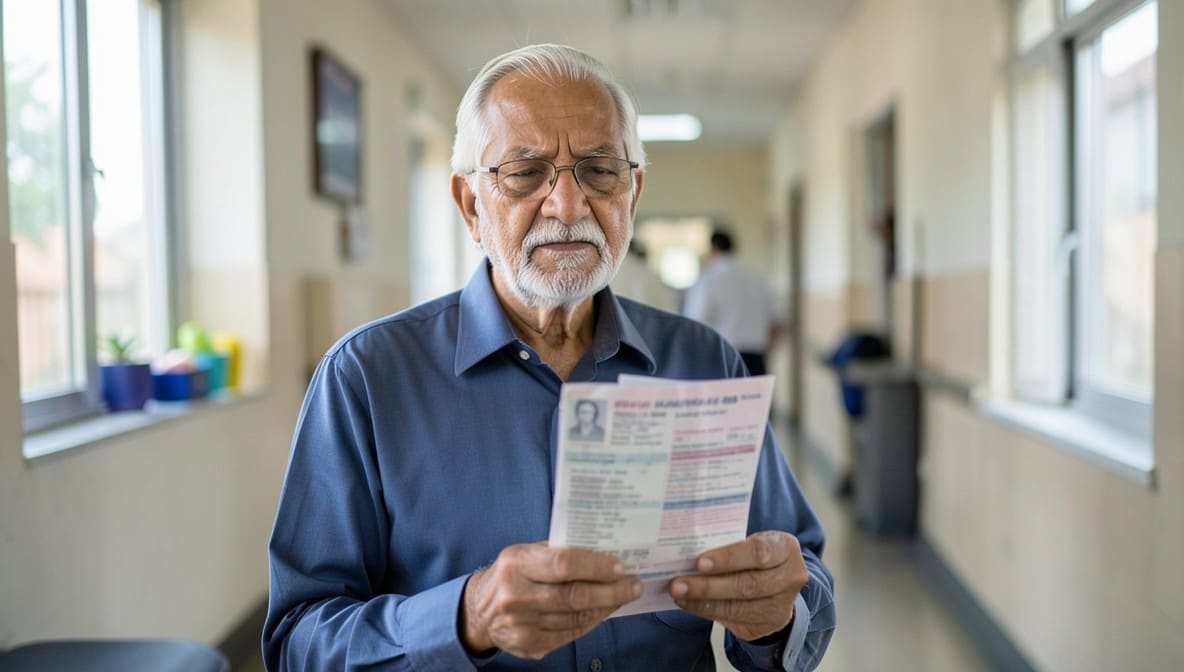
The Central Administrative Tribunal, Allahabad, has affirmed that treatment for advanced, life-threatening cancer constitutes a medical emergency, entitling a retired government employee to full reimbursement of expenses incurred at a non-empanelled hospital - even without prior permission - when continuity of care is medically necessary. This ruling reinforces the principle that procedural compliance must yield to the imperative of preserving life.
Background & Facts
The Dispute
The applicant, Mahesh Chandra Pachauri, a retired Junior Engineer (Works) with the North Central Railway, sought reimbursement of medical expenses incurred for the treatment of his wife, Smt. Sudha Pachauri, who was diagnosed with breast cancer in 2014. The illness progressed to involve her throat and lungs, necessitating continuous specialized care. Despite initial treatment at Railway hospitals and referrals to Central Hospital, New Delhi, the applicant was compelled to continue treatment at Dharmshila Cancer Hospital, New Delhi, a private facility not empanelled under Railway medical rules. The respondents reimbursed only Rs. 24,510 on a sympathetic basis but denied the remaining claim of Rs. 5,22,235, citing lack of prior permission.
Key Facts
- The applicant’s wife was first referred by Railway medical authorities to Dharmshila Hospital on 10.06.2014 and discharged the same day
- She continued treatment at Dharmshila Hospital on her own from 10.06.2014 to 31.09.2016 without obtaining fresh referrals or prior written permission
- Total expenses incurred: Rs. 5,22,235
- Rs. 24,510 was reimbursed on 27.06.2017 as a sympathetic gesture
- The applicant submitted representations on 25.03.2015, 14.05.2015, and 19.10.2016, enclosing all medical bills and prescriptions
- His wife passed away during the pendency of the claim
- The respondents had already spent approximately Rs. 10 lakhs on her treatment at empanelled hospitals including Max Hospital, New Delhi
Procedural History
- 10.06.2014: Wife referred to Dharmshila Hospital by Railway medical authorities; discharged same day
- 25.03.2015: First representation submitted to Chief Medical Superintendent, Agra
- 14.05.2015: Second representation filed
- 19.10.2016: Third representation submitted with additional bills
- 21.01.2016: Original Application No. 1342 of 2016 disposed of by CAT with direction to pass reasoned order
- 08.03.2017: Impugned order passed denying reimbursement beyond Rs. 24,510
- 2017: Contempt Petition No. 82 of 2017 filed for non-compliance with 21.01.2016 order
- 12.04.2017: Present Original Application No. 1099 of 2017 filed before CAT
- 23.04.2026: Judgment delivered by Hon’ble Mr. Justice Om Prakash VII, Member (J)
The Parties' Positions
Applicant: Argued that the progressive and life-threatening nature of cancer constituted an emergency under Indian Railway Establishment Code Vol-1, Chapter 6, Section 647(1) Note (2). He contended that repeated formalities were impractical and dangerous given the patient’s deteriorating condition. He relied on Shiv Kant Jha v. Union of India to assert that the factum of treatment, not hospital empanelment, determines entitlement.
Respondents: Contended that reimbursement is permissible only for treatment in empanelled hospitals or with prior permission. They argued that the initial referral ended on 10.06.2014 and subsequent treatment was voluntary, unauthorized, and for a chronic condition - not an emergency. They cited Indian Railway Medical Manual (IRMM) and Railway Board instructions to justify denial.
Relief Sought
The applicant sought:
- Quashing of the impugned order dated 08.03.2017
- Reimbursement of Rs. 5,22,235 spent on treatment at Dharmshila Hospital
- Interest on the amount
- Costs of the OA
The Legal Issue
The central question was whether reimbursement for treatment at a non-empanelled private hospital can be denied solely on the ground of lack of prior permission when the treatment is for a life-threatening, progressive illness like advanced cancer, and continuity of care at the same facility is medically necessary?
Arguments Presented
For the Appellant
Learned counsel for the applicant relied on Shiv Kant Jha v. Union of India to argue that the right to medical care is a fundamental aspect of the right to life under Article 21. He emphasized that the treating physician - not the administrative authority - must determine the necessity of treatment. He contended that cancer, especially when metastasized, constitutes a continuous medical emergency. The fact that the respondents had already reimbursed part of the expenses admitted the genuineness of the claim. Denial of the balance was arbitrary and violated principles of natural justice and welfare state obligations.
For the Respondent
Learned counsel for the respondents argued that the Railway Medical Rules strictly require prior permission for treatment in non-empanelled hospitals, except in genuine emergencies. They maintained that the initial referral ended on 10.06.2014 and the subsequent treatment was self-initiated. They distinguished Shiv Kant Jha on the ground that it involved an acute cardiac emergency requiring immediate intervention, whereas the present case involved prolonged, chronic care. They asserted that the Rs. 10 lakhs already spent on empanelled hospitals demonstrated adequate care was available.
The Court's Analysis
The Tribunal rejected the respondents’ technical argument that the absence of repeated permissions invalidated the claim. It held that the nature of the disease - cancer with metastasis to throat and lungs - required uninterrupted, specialized care. The Court observed that insisting on formal permission for each stage of treatment in a rapidly deteriorating condition was not only impractical but potentially life-threatening.
"The law on the subject is well settled. In Shiv Kant Jha (supra), it has been categorically held that the right to medical reimbursement cannot be denied on technical grounds and that in emergency situations, prior permission is not mandatory."
The Court emphasized that the real test is the factum of treatment, not the empanelment status of the hospital. It noted that the respondents had already reimbursed Rs. 24,510 for treatment at Dharmshila Hospital, thereby implicitly acknowledging the legitimacy of the care provided. Denial of the balance claim on procedural grounds was held to be arbitrary and contrary to the welfare objectives of the Railway Medical Rules.
The Tribunal further held that a progressive, life-threatening illness like advanced cancer, requiring continuous specialized oncological care, qualifies as a medical emergency under the rules. The Court rejected the respondents’ attempt to compartmentalize the illness as "chronic" rather than "emergency," stating that such a distinction ignores the clinical reality of cancer progression.
The Verdict
The applicant succeeded. The Tribunal quashed the impugned order dated 08.03.2017 and directed the respondents to reimburse the full amount of Rs. 5,22,235, after adjusting the Rs. 24,510 already paid. The reimbursement shall be processed within three months of receipt of a certified copy of this order. If unpaid within this period, the outstanding amount shall bear simple interest at 6% per annum from the date the claim became due until actual payment. No costs were awarded.
What This Means For Similar Cases
Emergency Medical Needs Override Procedural Formalities
- Practitioners representing government employees or retirees must argue that progressive, life-threatening illnesses like metastatic cancer constitute continuous emergencies, regardless of whether the treatment spans months or years
- Denial of reimbursement on grounds of "lack of prior permission" is legally unsustainable when medical necessity is established through certified records
- The burden shifts to the employer to prove that adequate treatment was available at empanelled facilities, not merely that alternatives existed
Factum of Treatment Trumps Hospital Empanelment
- The Shiv Kant Jha precedent now applies beyond cardiac emergencies to all life-threatening conditions requiring specialized care
- Medical bills certified by treating doctors and hospitals are sufficient proof of entitlement
- Administrative discretion to deny reimbursement must be exercised with compassion and clinical awareness, not mechanical adherence to rules
Welfare State Obligations Bind Public Employers
- Public sector employers cannot treat medical benefits as discretionary privileges
- The objective of welfare schemes like the Railway Medical Rules is to ensure dignity and access to care, especially for retirees and their dependents
- Courts will intervene where administrative inaction or rigid interpretation defeats the very purpose of the scheme