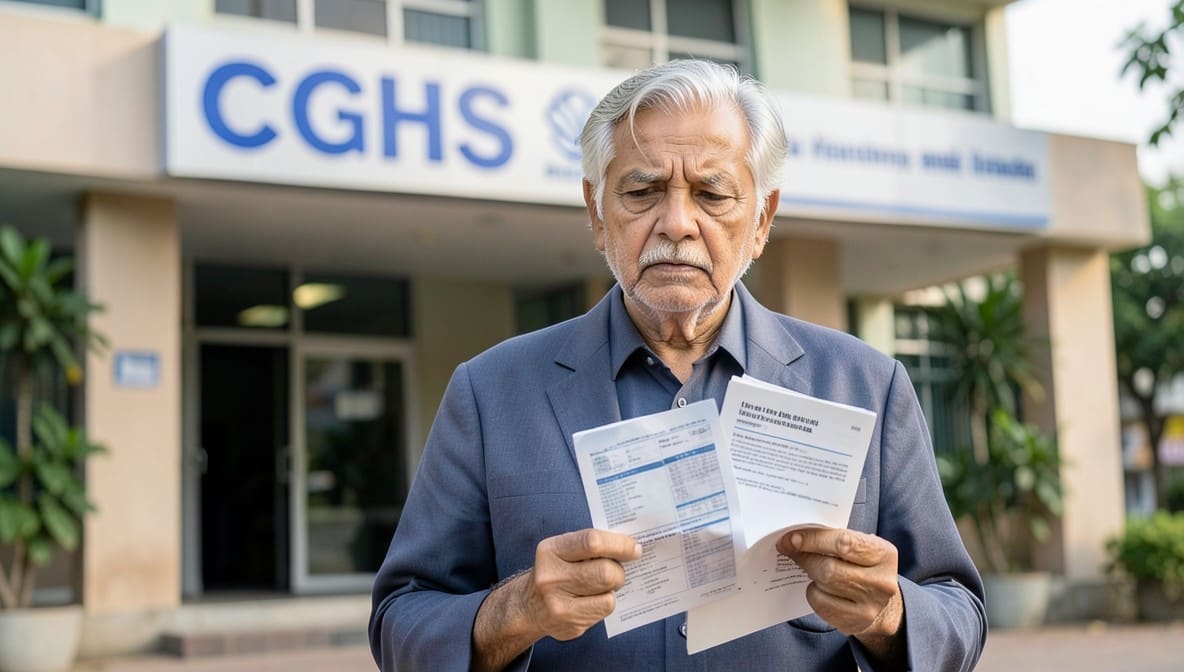
The Madras High Court has affirmed that government employees and pensioners cannot be denied full reimbursement for emergency medical treatment merely because the hospital is not empanelled under CGHS rates. The judgment underscores that the right to health overrides technical compliance when life is at stake, and mandates procedural fairness in claim adjudication.
Background & Facts
The Dispute
The respondent, Neela Lakshminarayanan, sought reimbursement for medical expenses incurred by her late husband, Mr. G. Lakshminarayanan, a retired CSIR scientist, following emergency cardiac treatment at Apollo Hospitals, Chennai. He underwent Transcatheter Aortic Valve Replacement (TAVR) in 2017 and was readmitted in emergency condition in October 2019, after which he passed away. The claim for Rs. 3,00,000 was partially sanctioned at Rs. 1,02,801 under CGHS rates, with the balance of Rs. 1,97,199 rejected on grounds of non-compliance with approved tariff schedules.
Procedural History
- 2020: Respondent filed Original Application (O.A. No. 258 of 2020) before the Central Administrative Tribunal (CAT), Chennai, challenging the partial rejection.
- 03.04.2023: CAT allowed the application, directing full reimbursement of the balance amount.
- 2023: Petitioners (Union of India, CSIR, CGHS authorities) filed this writ petition under Article 226 seeking quashing of the CAT order.
- 03.06.2025: The writ petition was heard and reserved; judgment delivered on 06.03.2026.
Relief Sought
The petitioners sought to set aside the CAT’s direction for full reimbursement, arguing that CGHS rates are binding and the Supreme Court’s ruling in Shiva Kant Jha was case-specific. The respondent sought affirmation of the CAT’s order, contending that the denial violated constitutional rights to health and dignity.
The Legal Issue
The central question was whether CGHS authorities can deny full reimbursement for emergency medical treatment solely on the basis of approved tariff rates, even when the treatment was life-saving, rendered in a non-empanelled hospital, and supported by certified medical records.
Arguments Presented
For the Petitioner
The petitioners relied on Shiva Kant Jha v. Union of India to argue that the Supreme Court’s direction for full reimbursement was confined to its unique facts and did not establish a general principle. They further cited Bina Saxena v. Union of India (Bombay HC) to assert that neither the Tribunal nor the High Court possesses the extraordinary jurisdiction under Article 142 to override statutory reimbursement limits. They emphasized that CSIR employees are governed by the Central Services (Medical Attendance) Rules, which cap reimbursement at CGHS rates, and that no procedural referral to the Technical Standing Committee was undertaken.
For the Respondent
The respondent contended that Shiva Kant Jha was not merely a case-specific order but a principled affirmation of the constitutional right to health. She argued that the denial of reimbursement in emergency situations, where patients have no choice but to seek care in specialist hospitals, violates Article 21 and the welfare state obligations. The claim was supported by certified hospital records, and the rejection was mechanical, ignoring the statutory provision allowing reimbursement beyond approved rates upon recommendation by the Technical Standing Committee.
The Court's Analysis
The Court examined the Central Government Health Scheme Rules, particularly Chapter 12 and Annexure 12.II of MH & FW O.M. No. 4-18/2005-C7P, which explicitly permit reimbursement in excess of approved rates if recommended by the Technical Standing Committee. The Court noted that the petitioners had not demonstrated any such referral, rendering their rejection procedurally defective.
"It is a settled legal position that the Government employee during his lifetime or after retirement is entitled to get the benefit of the medical facilities and no fetters can be placed on his rights."
The Court emphasized that the Supreme Court in Shiva Kant Jha had condemned the "inhumane approach" of denying full reimbursement in emergencies, holding that the "real test must be the factum of treatment" and not the hospital’s empanelment status. The Court rejected the petitioners’ attempt to narrow Shiva Kant Jha as a one-off order, noting that the judgment’s reasoning was grounded in constitutional principles of dignity and access to healthcare.
The Court further observed that the hospital had offered a discount to round off the bill to Rs. 3 lakhs, yet the petitioners still applied CGHS rates to the discounted amount - an illogical and arbitrary application of rules. The absence of any record showing referral to the Technical Standing Committee was fatal to the petitioners’ case.
The Verdict
The respondent won. The Court held that reimbursement for emergency medical treatment cannot be denied solely on the basis of CGHS approved rates, and that authorities are duty-bound to refer such claims to the Technical Standing Committee for consideration of full reimbursement. The writ petition was dismissed with directions to process the claim within three months.
What This Means For Similar Cases
Reimbursement Cannot Be Denied on Technical Grounds in Emergencies
- Practitioners must argue that any denial of full reimbursement in emergency cases violates the constitutional right to life under Article 21, as affirmed in Shiva Kant Jha.
- Medical records certified by treating hospitals are conclusive proof of treatment; empanelment status is irrelevant.
- Authorities must not apply CGHS rates mechanically when life-saving care is rendered.
Referral to Technical Standing Committee Is Mandatory
- All claims exceeding CGHS rates must be referred to the Technical Standing Committee under MH & FW O.M. dated 20.02.2009.
- Failure to refer renders the rejection illegal and subject to quashing.
- Practitioners should demand proof of such referral in every claim denial case.
Judicial Scrutiny of Administrative Arbitrariness Is Increasing
- Courts are increasingly willing to intervene where administrative decisions lack rationality, as seen in the Court’s observation that applying CGHS rates to a discounted bill "defies logic."
- This judgment reinforces that welfare schemes must be interpreted purposively, not technically.
- Future claims should be supported by a formal application for referral under Annexure 12.II, with timelines tracked to prevent delay.