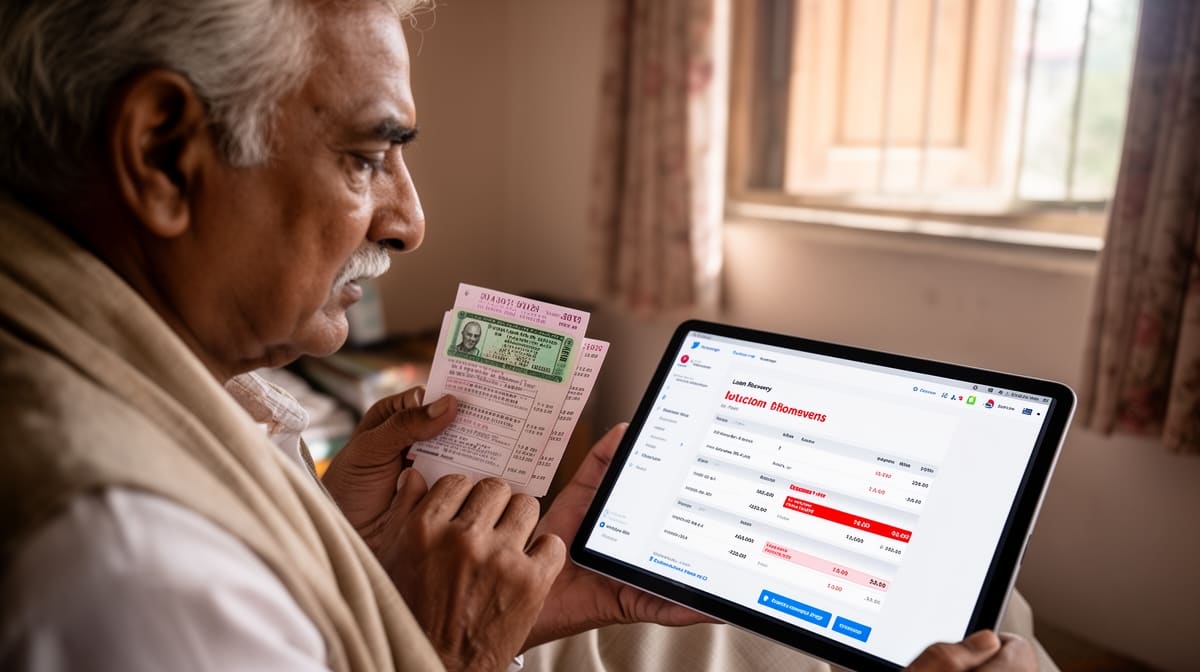
The Madhya Pradesh High Court at Gwalior has clarified that once the Employee Provident Fund Organization (EPFO) secures its dues through a statutory lien on auctioned assets, continued attachment of a petitioner’s personal bank account serves no legal purpose and must be vacated. This ruling reinforces the principle that recovery mechanisms must be proportionate and not multiplicative.
Background & Facts
The Dispute
The petitioner, Anuj Gupta, was a director of M/s Hotline CPT Ltd., which defaulted on its obligations under the Employee’s Provident Funds and Miscellaneous Provisions Act, 1952. The EPFO initiated recovery proceedings against the company and its directors, resulting in two impugned orders: Annexure P-1 (confiscation order dated 16.03.2022) and Annexure P-2 (order of recovery and attachment of bank account dated 16.03.2022).
Key Facts
- The petitioner’s personal bank account, No. 30983935840, maintained with State Bank of India, Sector-11, Noida, was attached on 16.03.2022 under Annexure P-2.
- The EPFO initiated proceedings under the Insolvency and Bankruptcy Code, 2016, against M/s Hotline CPT Ltd.
- The Debts Recovery Tribunal-III, Delhi, in O.A. No. 975/2018, ordered the auction of the company’s property at A-7, Sector-5, Noida, Uttar Pradesh.
- The auction realized a sum of Rs. 10.49 crores on 22.05.2025.
- Out of this amount, a lien of Rs. 4.06 crores was created in favour of the EPFO, fully securing its claimed dues.
- The petitioner filed this writ petition on 2022, challenging the attachment orders.
Procedural History
- 16.03.2022: EPFO issued Annexure P-1 (confiscation order) and Annexure P-2 (bank account attachment order).
- 22.05.2025: DRT-III, Delhi, passed order in O.A. No. 975/2018, auctioning assets and creating a lien of Rs. 4.06 crores in favour of EPFO.
- 2022: Writ Petition No. 7297 of 2022 filed before the High Court of Madhya Pradesh at Gwalior.
- 23.06.2026: Final hearing and judgment delivered by Justice Milind Ramesh Phadke.
The Parties' Positions
For the Petitioner
The petitioner contended that while the DRT’s order secured the EPFO’s claim, the continued attachment of his personal bank account was unjustified, disproportionate, and rendered redundant. He argued that the attachment caused operational hardship and had no legal basis once the EPFO’s dues were fully secured.
For the Respondents (EPFO & Others)
Respondents No. 3 and 4 conceded that the EPFO’s claim had been fully satisfied through the lien on auction proceeds. They did not oppose lifting the bank account attachment, provided the petitioner could demonstrate actual hardship. However, they challenged the delay of over four years in raising the grievance.
Relief Sought
The petitioner sought:
- Declaration that Annexures P-1 and P-2 were illegal and arbitrary.
- Quashing of Annexures P-1 and P-2.
- Direction to the Liquidator to release the EPF dues.
- Specifically, quashing of the bank account attachment (Annexure P-2) as it was no longer necessary.
The Legal Issue
The central question was whether the continued attachment of a personal bank account under the EPF Act remains legally tenable after the EPFO’s claim has been fully secured through a statutory lien on auctioned assets under the IBC.
Arguments Presented
For the Petitioner
The petitioner relied on the principle of proportionality in enforcement actions and argued that once the EPFO’s dues were crystallized and secured via lien, further coercive measures against personal assets violated the doctrine of necessity. He cited State of Haryana v. Bhajan Lal to argue that recovery must not exceed the debt owed. He emphasized that the bank account attachment was not a measure of last resort and had caused undue hardship.
For the Respondent
The respondents acknowledged that the lien of Rs. 4.06 crores fully satisfied the EPFO’s claim. They did not contest the need to lift the attachment but challenged the petitioner’s delay in raising the issue and lack of documentary proof regarding operational difficulties. They argued that the petition was maintainable only if the petitioner demonstrated actual injury.
The Court's Analysis
The Court examined the nature of the EPFO’s recovery mechanism under the EPF Act and its interaction with the IBC. It noted that the DRT’s order dated 22.05.2025 had created a lien of Rs. 4.06 crores in favour of the EPFO from the auction proceeds of Rs. 10.49 crores. This lien was a statutory mechanism under the IBC to ensure priority repayment to secured creditors, including the EPFO.
"Since the amount realizable by the EPFO has already been secured by the DRT by creating a lien, keeping Bank Account No.30983935840 under attachment would serve no purpose."
The Court held that the attachment of the petitioner’s bank account, initiated in March 2022, was rendered otiose after the DRT’s order in May 2025. The EPFO’s claim was no longer at risk; the lien provided a sufficient and legally recognized security. Continuing the attachment was not only redundant but also violative of the principle that enforcement actions must not be excessive or oppressive.
The Court rejected the respondents’ argument regarding delay, noting that the legal basis for the attachment ceased to exist only upon the DRT’s order. The petitioner was not required to challenge the attachment before the lien was created, as the latter fundamentally altered the factual matrix.
The Court further observed that the EPFO had no legitimate interest in maintaining the attachment once its dues were secured. The bank account belonged to the petitioner personally and was not an asset of the corporate debtor. Its continued freezing served no statutory objective.
The Verdict
The petition was allowed in part. The Court directed the State Bank of India, Sector-11, Noida, to permit the petitioner to operate Bank Account No. 30983935840 immediately, provided no other legal impediment exists. The attachment order dated 16.03.2022 (Annexure P-2) was set aside to the extent it related to this account. The order of confiscation (Annexure P-1) was held to be otiose in light of the DRT’s lien. No costs were awarded.
What This Means For Similar Cases
Attachment Must Be Proportionate to Debt
- Practitioners must argue that any recovery action under the EPF Act must be scaled to the actual debt owed.
- Once a lien or secured claim is established through another forum (e.g., DRT or NCLT), parallel attachments on personal assets are legally unsustainable.
- EPFO and other statutory authorities cannot maintain multiple recovery mechanisms simultaneously without justification.
Delay Is Not Fatal When Legal Basis Changes
- A petitioner is not barred from seeking relief merely due to time lapsed if the legal basis for the impugned action changes after filing.
- The emergence of a new fact (e.g., lien creation) that renders the original remedy redundant opens the door for subsequent relief.
- Courts will examine the substantive injustice, not just procedural delay, when the underlying legal condition has materially altered.
Bank Accounts Are Not Corporate Assets
- Personal bank accounts of directors cannot be treated as assets of a corporate debtor unless there is clear evidence of fraud or commingling.
- Recovery actions against individuals must be grounded in personal liability under the EPF Act, not merely their directorship.
- The EPFO must demonstrate direct liability before attaching personal accounts, and even then, such attachment must cease once the debt is secured elsewhere.