
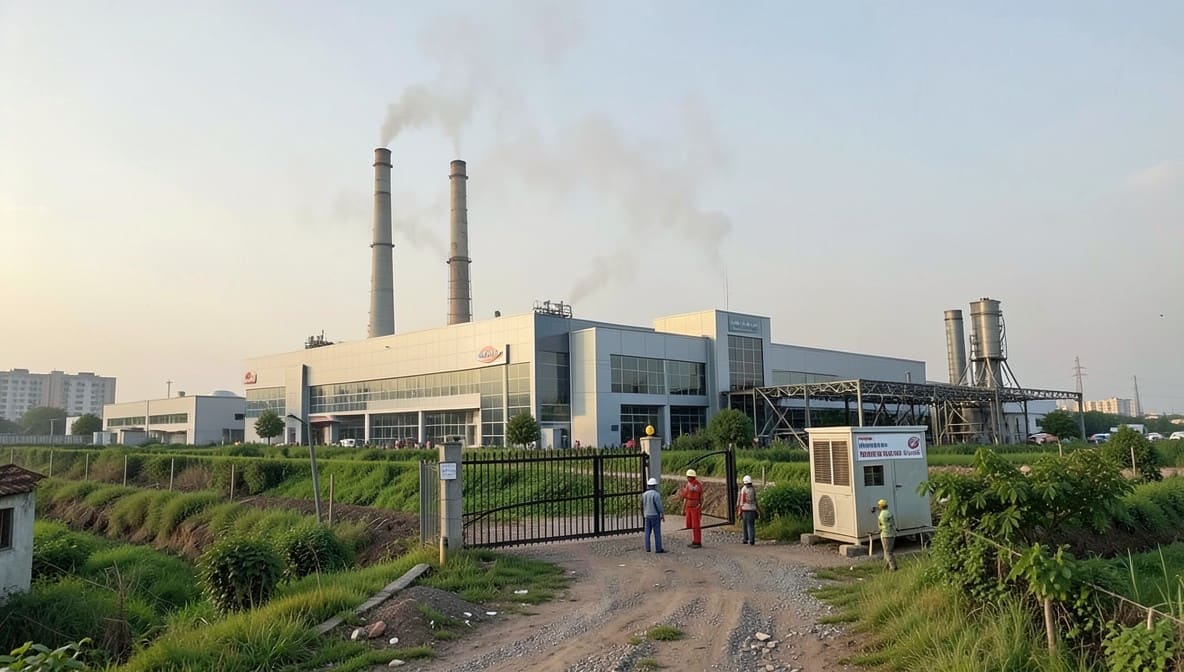
The Supreme Court has reaffirmed that industrial units operating under valid Consent to Establish and Consent to Operate granted by State Pollution Control Boards, which were unaware of the requirement for prior Environmental Clearance, cannot be shut down solely on the technical ground of non-obtaining of Environmental Clearance, provided the ex-post facto application process is underway. This decision restores balance between environmental compliance and economic continuity.
Background & Facts
The Dispute
The appellants are manufacturers of formaldehyde and its resins (melamine, urea, and phenol formaldehyde) operating in Rajasthan and Haryana. They were ordered to cease operations by the National Green Tribunal (NGT) in 2021 on the ground that they lacked prior Environmental Clearance (EC) under the Environment Impact Assessment (EIA) Notification, 2006. The NGT relied on its order in O.A. No. 287/2020 (Dastak NGO), which held that formaldehyde units cannot operate without prior EC. However, the appellants had obtained Consent to Establish (CTE) and Consent to Operate (CTO) from their respective State Pollution Control Boards (PCBs) years before the NGT order.
Key Facts
- Formaldehyde manufacturing units are listed under Sr. No. 5(f) of Schedule 1 of the EIA Notification, 2006, requiring EC
- The PCBs of Rajasthan and Haryana were initially unaware that EC was mandatory for such units
- CTE and CTO were granted by PCBs between 1994 and 2018, enabling units to commence and continue operations
- Rajasthan PCB issued Office Order dated 19.08.2019 directing units to apply for EC within 60 days
- Haryana PCB issued Office Order dated 10.11.2020 with identical directive
- All appellants applied for EC within the stipulated timeframes
- Screening and Scoping stages completed for all units
- Terms of Reference (TOR) granted to all units between 2021 and 2022
- Public consultation waived for all units as they are located in notified industrial estates
- For two units (Guruji Overseas and Chemwood Industries), public consultation was completed; only Appraisal remains
- Two other appellant units (Banke Bihari Overseas and G.B. Overseas Pvt. Ltd.) have already been granted EC and are operating
Procedural History
- 1994 - 2018: CTE and CTO granted by Rajasthan and Haryana PCBs to various units
- 19.08.2019: Rajasthan PCB issues directive to apply for EC
- 10.11.2020: Haryana PCB issues identical directive
- 01.10.2019 - 17.06.2021: All appellants submit EC applications
- 16.07.2021 - 20.07.2021: TOR granted to all units
- 03.06.2021: NGT passes order in Dastak NGO case directing closure of units without EC
- 03.06.2021: NGT applies same direction to other original applications (O.A. No. 298/2020 and O.A. No. 840/2019)
- 25.03.2022: Supreme Court in Pahwa Plastics v. Dastak NGO sets aside NGT’s order, allowing operation pending EC appraisal
- 16.11.2025: Supreme Court in Vanashakti v. Union of India strikes down ex-post facto EC guidelines (OMs dated 14.03.2017 and 07.07.2021)
- 18.11.2025: Supreme Court in Vanashakti Review recalls its own judgment, acknowledging conflict with Pahwa Plastics
- 28.03.2023 - 06.05.2026: Appeals filed before Supreme Court challenging NGT orders
The Parties' Positions
Appellants (Manufacturing Units): Argued that they acted in good faith based on CTE/CTO issued by PCBs, which themselves were unaware of EC requirement. They complied with PCB directives to apply for EC, completed all preliminary stages, and only the final appraisal remains pending. Relied on Pahwa Plastics as binding precedent.
Respondents (Dastak NGO, Vineet Nagar, Union of India): Contended that EC is mandatory under EIA 2006 and absence of prior clearance invalidates operations. Argued that Pahwa Plastics was decided on grounds of large-scale employment (8,000 workers), which does not apply here (10 - 15 workers per unit). Also challenged validity of CTO under Air Act, 1981.
Relief Sought
The appellants seek:
- Setting aside of NGT’s order dated 03.06.2021
- Permission to continue operations pending final EC decision
- Restoration of electricity supply, if disconnected
- Direction to the Union of India to complete appraisal within a fixed timeline
- Application of Pahwa Plastics ratio to their cases
The Legal Issue
Can industrial units that commenced and continue operations based on valid CTE and CTO issued by State Pollution Control Boards, which were unaware of the requirement for prior Environmental Clearance, be ordered to shut down solely due to non-obtaining of EC, when they have since applied for ex-post facto clearance and completed all preliminary stages under the EIA process?
Arguments Presented
For the Appellant
Senior counsel Nidhesh Gupta argued that the Pahwa Plastics judgment directly applies. The PCBs granted CTE and CTO in good faith, unaware that EC was mandatory. The appellants complied with subsequent directives to apply for EC, completed Screening, Scoping, and TOR, and waived public consultation due to industrial location. Only Appraisal remains. The Vanashakti Review judgment acknowledged the validity of Pahwa Plastics. Shutting down units at this stage would be punitive, not preventive, and ignores the procedural progress made. The number of employees (10 - 15) is irrelevant; the legal principle of good faith reliance on statutory authorities remains.
For the Respondent
Senior counsel Ankit Jain contended that Pahwa Plastics was decided on the unique ground of protecting 8,000 jobs, which is not present here. He argued that CTO under the Air Act, 1981, lacks deemed approval provisions, rendering it legally defective. He also claimed the Vanashakti judgment invalidated ex-post facto EC, making any relaxation unlawful. He further asserted that the appellants acted with knowledge of the law and cannot claim ignorance.
The Court's Analysis
The Court undertook a meticulous comparison of the facts in the present appeals with those in Pahwa Plastics v. Dastak NGO. It noted that the NGT’s impugned orders were based entirely on the now-set-aside Dastak NGO judgment. The Court emphasized that the Pahwa Plastics ruling was not confined to employment numbers but established a foundational principle: where statutory authorities (PCBs) grant CTE and CTO in good faith, and the unit subsequently applies for ex-post facto EC in compliance with directives, closure is impermissible pending final appraisal.
"The question in this case is, whether a unit contributing to the economy of the country and providing livelihood to hundreds of people, which has been set up pursuant to requisite approvals from the statutory authorities concerned, and has applied for ex post facto EC, should be closed down for the technical irregularity of want of prior environmental clearance, pending the issuance of EC, even though it may not cause pollution and/or may be found to comply with the required norms. The answer to the aforesaid question has to be in the negative, more so when the HSPCB was itself under the misconception that no environment clearance was required for the units in question."
The Court rejected the argument that CTO under the Air Act, 1981, is invalid. It held that since the PCBs, as the competent authorities, have not disputed the validity of CTOs and have themselves directed units to apply for EC, the issue of statutory infraction under the Air Act is not germane to the question of operational continuity.
The Court also clarified that the reference to 8,000 workers in Pahwa Plastics was not limited to that case alone but encompassed the entire formaldehyde manufacturing sector in the region. The principle of good faith reliance on statutory authorities applies irrespective of unit size.
The Court further noted that the Vanashakti Review judgment, while striking down the 2021 Office Memorandum, did not overrule Pahwa Plastics. On the contrary, it acknowledged the conflict and allowed review precisely because Pahwa Plastics represented a balanced, precedent-based approach.
The Court concluded that the appellants are not violators acting in bad faith. They are entities that operated lawfully under the guidance of the PCBs and have since diligently pursued compliance. The only remaining step - Appraisal - is stalled due to litigation, not due to any fault of the units.
The Verdict
The appeals are allowed. The NGT’s orders directing closure of the appellant units are set aside. The units are permitted to continue operations pending final decision on their ex-post facto EC applications. The Union of India shall decide on the EC applications within one month. If electricity has been disconnected, it shall be restored upon payment of dues. The Union shall, within three working days, inform the units in writing whether any further steps are required, and the units shall comply within one week thereafter. The final decision on EC shall be taken within three weeks of receipt of any additional submissions. If EC is ultimately rejected due to non-compliance, the respondents may then take action to disconnect utilities.
What This Means For Similar Cases
Compliance Through Statutory Guidance Is Not a Technicality
- Practitioners must argue that when a statutory authority (e.g., PCB) issues CTE/CTO and later directs compliance with a new requirement (e.g., EC), the entity’s subsequent application constitutes good faith compliance
- Courts cannot impose punitive closure for procedural gaps when the entity acted on official guidance
- This principle extends beyond environmental law to licensing, zoning, and industrial approvals
Ex-Post Facto Clearance Is Not Per Se Illegal - Context Matters
- The Vanashakti judgment prohibits blanket ex-post facto relaxations for willful violators
- But Pahwa Plastics and this judgment carve out an exception: where the violation stems from official misunderstanding, not deliberate evasion
- Legal teams must distinguish between willful non-compliance and systemic regulatory ambiguity
Appraisal Stage Is Not a Barrier to Operation
-
Units that have completed Screening, Scoping, TOR, and Public Consultation (or its waiver) are entitled to continue operations
-
The final Appraisal stage is administrative, not punitive
-
Courts must not treat pending appraisal as a reason for shutdown - this defeats the purpose of procedural due process
-
Practitioners should immediately file applications for continuation of operations in pending environmental cases where CTE/CTO were granted and EC application is pending appraisal
-
Evidence of PCB directives and completed procedural steps must be compiled and submitted as a matter of urgency
-
Any disconnection of utilities must be challenged as contrary to the Pahwa Plastics directive





